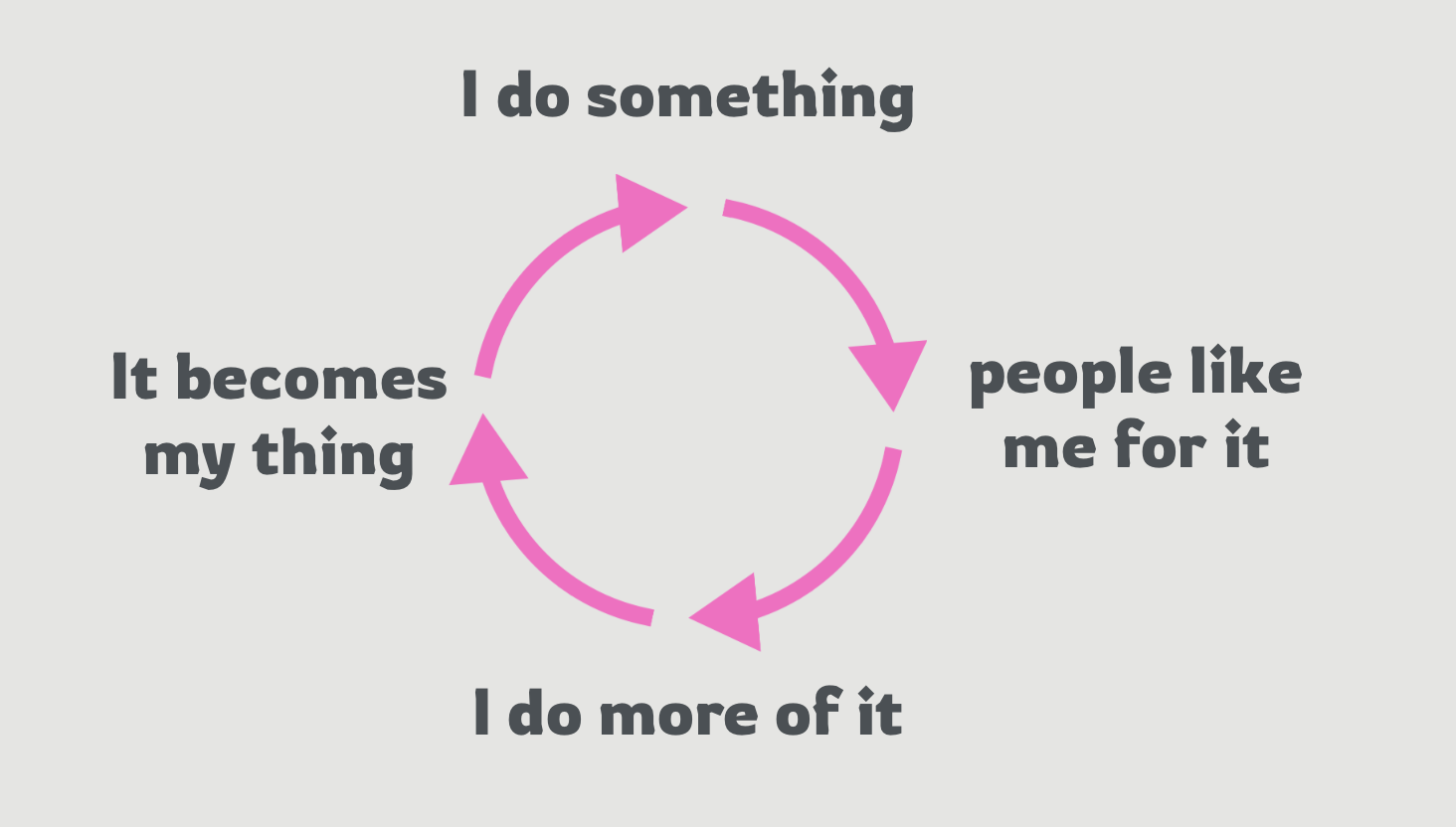
One of the things I did this year that I’m really happy about is to slow down with my writing. When I started out, my goal was to publish one essay per week, and I’m so glad I did. It improved my writing chops and helped me sharpen my voice.
Then, for a whole two years, my essay writing was heavily driven by guilt. I should’ve been writing, and I haven’t. Therefore, it’s my moral imperative to write something so good that it makes up for my absence. I must say, I think I did some of my best writing under that pressure.
This year I was like ma life, ma blog, ma rules, and I think I’ve done some of my even MORE best writing under no pressure. Man, life is just wonderful sometimes.
Anyway, my last essay on being Mangalorean, which was published over two months ago, was one of the most enjoyable and cathartic things I’ve ever written. I wrote it for me, and for my limited Instagram audience. But somehow, very unexpectedly, the Mangalorean diaspora on Instagram picked it up and passed it around. It got a ton of attention. Far more than I’m used to.
I found myself with a bunch of new followers, and I suspect a lot of them were hoping I’d have more to say about the identity-khichdi of being a Mangi. Alas, I do not. That was all the khichdi I made.
I was joking with a few friends about how people follow you because they enjoy one part of your personality, or something specific that you posted. And by following you, they’re subscribing to the possibility that you’ll do it again, and post MORE of what they enjoyed.
And that leaves you in a conundrum because you then have to decide whether to keep dishing out more of what seems to work, or go wherever the wind takes you.
Big news for the unemployed: Jennifer Lawrence joined Instagram
In September, Jennifer Lawrence joined Instagram after years of being one of the very few famous people who simply wasn’t on it. She had about 8.4 million followers very soon.
This is not surprising. If you liked cinema in the early 2010s, she was inescapable. A force to be reckoned with. She was the actress who tripped on the stairs on her way up to collect her Oscar and then joked about it.

She gave interviews like she was talking to her friends over a glass of wine. She was unhinged before everyone started using the word unhinged. She was “not like other girls” back when that was still a compliment.
So naturally, her fans were thrilled to have their favourite chaotic celeb on Instagram. But that excitement didn’t last long for two reasons.
Reason 1: People got annoyed was because of what she’d come to do, which was to launch………a celebrity beauty brand.
I personally find it a bit (very) cringey that there appears to be no conceivable amount of money at which a rich celebrity might decide that they have ENOUGH money. (I say this as a fully recovered former Taylor Swift fan. I’ve had ample time to think about this. In fact, I took to writing about it too.)

Reason 2: People weren’t happy because of…. her face. In the launch photos of her beauty brand, one comment showed up again and again, and it was people calling her unrecognisable.
Why? Because her distinct hooded eyes appeared to have changed. They looked rounder. That was it. A few millimetres of eyelid gained, and people reacted like someone had swapped her whole head out.

I have no particularly useful opinions about what plastic surgery Jennifer Lawrence has or hasn’t done to her face. But I AM interested in why people seemed so personally aggrieved by it, aside from the fact that people online generally aren’t happy about anything.

Part of the answer is in how we remember faces. You don’t store a face as a photograph. Instead, your brain stores some kind of “average face.” Let’s call it that. It’s built out of every face you’ve ever seen.
The way your brain remembers faces is by how far the person’s features move from the average. How much bigger their nose is from the average, or how far apart their eyes may be, or whatever else.
This is also why caricatures are so interesting as an art form. The artist spots someone’s distinguishing features, and exaggerates them.
A good caricature draws pretty much every single feature incorrectly, but you still identify the person instantly because everything you remember about their face is magnified, and therefore, more recognisable.


The same trick works in reverse. Take ONE thing that makes a face distinct, pull it slightly toward the average, and the person gets much harder to recognise, even with every other feature untouched.
I think that’s what happened to Jennifer Lawrence.
The official term for this is called an anticaricature, and its most famous modern example is the Instagram Face. Jia Tolentino named it in The New Yorker in 2019. It’s the face that professionally beautiful women are all aiming to have, with high cheekbones, catlike eyes, a small neat nose and full lips.
None of those features are average on their own. The problem is when everyone gets the same ones, they all look “prettier” and also harder to tell apart.

I think what annoyed J.Law’s fans was the fact that a beauty line is quite literally THE MOST predictable thing a famous woman is permitted to launch in 2026, and in one season, both her face and persona drifted towards being the celebrity average.
“You’ve changed” (derogatory)
I think we also treat whole personalities the way we treat faces.
Think about how you’d describe a friend to somebody who has never met them.
You wouldn’t start with the fact that they’re reasonably kind, enjoy a good meal, and occasionally get anxious about the future. You’d say something that would distinguish this friend from the billions of other people who would fit that description.
The people who know you don’t carry all of you around in their mind, or even most of you. Most people carry your exceptions. The handful of ways you differ from everyone else they know.
So any change, in any direction, costs you some recognition. The people around you lose a piece of the list they knew you by, and for a while they can’t quite find you.
In college, I used to be maddeningly irresponsible. That was a decade or so ago. But when I recently spent a lot of time with one of my closest friends from that season, the one thing I kept hearing from him was his disbelief that I was able to function as a wife and mother.
And the way that disbelief was expressed was: I can’t believe this is YOU. I fully agreed. There are people walking around with perfectly accurate memories of me that are now fairly inaccurate descriptions of me.
Your exceptions are how people recognise you, but they’re also a job you do in their lives. If you’re the irresponsible one, someone else has to be the responsible one. Even if it annoys them, it’s the dynamic y’all eventually inhabit.
Social groups often arrange themselves around each person’s exceptions. Not everyone can be the crazy one, or the one who’s always late, or the emotional one, or the spontaneous one.
So that also means that when you change, everyone else has to rearrange a little. Which is why some of the resistance to your change has nothing to do with you. That’s part of the reason why changing is often easiest with strangers and hardest at home.
Doing my own impression
Sometimes at a party, if I’m wearing a short dress or a crop top or anything that shows some skin, I’ll make a joke about it. Something stupid like, “Well, somebody had to be the slutty one here.”
I do this partly because I think it’s funny and partly because it gives me a quick read on a room.
Most people I know consider themselves far too open-minded to make moral assessments of women based on what they’re wearing. But the old association between certain clothes and one’s character is still sufficiently intact for the joke to work.
Some people laugh immediately and quite freely. Some flinch at the word and go straight to “Whaaat, nooo!” Either they can’t tell whether I’m joking, or they’re not entirely sure if they’re allowed to laugh at a woman calling herself that, so they reassure me instead. And occasionally somebody decides, on the basis of that one sentence, that they like me because of my irreverence or whatever.
I find this useful, because getting to know somebody takes a considerable amount of time, and it’s nice to have little ways of figuring out whether you might enjoy each other’s company.
What I’ve given them in that moment is a version of me that’s easier to read. There isn’t anything particularly dishonest about it. I do enjoy a well-timed crude joke, and I really AM interested in the social conventions that govern what people will and won’t say to each other.
I’ve just distributed the truth about myself a little unevenly. Which, of course, is how you draw a caricature.
But that joke alone wouldn’t give you an accurate picture of how I operate. I’m also terribly earnest about most things. I can be easily embarrassed. I have quite a large number of boring and conventional opinions. Plenty of times, I’m the one going “Whaaat, nooo!”
A good friendship needs time for all that contradictory information about a person to pile up, and some of my favourite things about the people I love, are things I’d never have guessed when we first met.
But I also know that when somebody likes me for a particular quality, I feel a small obligation to keep having it. If somebody thinks I’m funny, I feel a little more inclined to be funny around them. If somebody thinks I’m interesting, I’m slightly more conscious of saying interesting things around them. And if somebody enjoys a certain kind of irreverence in me, I’m more likely to indulge it in their company.
I don’t think I’m doing this consciously enough for it to count as pretending. All of these things are, to varying degrees, true of me. It’s just that I’ve found a reliable way of being liked, and I’m reluctant to give it up.
There must be a point at which knowing somebody very well becomes an impediment to knowing them any better.

We talk a lot about the ways other people’s disapproval shapes us. I’m beginning to think their approval is far more effective, because it never occurs to you to resist it.
I know people who are very proud of being “unapologetically themselves,” and watching them, I sometimes wonder how restricted they are. If you work very hard at staying unlike everybody else, you keep exaggerating whatever makes you different, and a few years in you’ve drawn your own caricature and have to keep living up to it.
Grandpa’s greatest hits
Most people, as they get older, become more concentrated versions of themselves. The mildly eccentric uncle becomes the very eccentric uncle. The aunt who was always a ‘bit’ particular eventually becomes super duper particular.
I think part of this has to do with the fact that you get better at arranging your life around the kind of person you are.
At 20, if you don’t particularly enjoy other people’s company, there’s only so much you can do about it. You have roommates and classmates and siblings. At 40 or 50, you can definitely choose to be a recluse if you really want to.
A lot of the things we do when we’re young are things we don’t really have a say in, and some of them end up becoming things we love. As we get older, we get quite good at avoiding things we think we won’t enjoy, which also means we get fewer opportunities to be wrong about ourselves.
Plus, as we get older, we have more time to collect feedback from other people. I used to wonder why grandpas (all grandpas), who have lived longer than everyone else at the table, seem to always be telling the same stories and the same jokes. Shouldn’t they have collected MORE stories than the rest of us by then?
But they’ve also had 70 or 80 years to figure out which of their stories get the biggest or best reactions, so I guess they default to the greatest hits.
What’s interesting to me is that none of this requires you to be particularly resistant to change. You could just spend your life doing more of what you enjoy, getting better at what you’re good at, and spending time with people who like you for certain traits.
All perfectly sensible things to do. And yet, given enough time, you might end up a fairly exaggerated version of the person you were to begin with. A caricature.
Ninety sittings
In 1905, Picasso decided to paint a portrait of Gertrude Stein.
Stein was an American writer living in Paris who had a habit of buying paintings by artists that weren’t yet famous. Picasso was one of them. He was twenty-four when he started painting her, and she ended up sitting for him about eighty or ninety times. Which is crazy.
Gertrude sat in a big broken armchair while he sat on a small kitchen chair very close to his canvas. While he painted, she worked out sentences in her head. It was a fairly productive arrangement for both of them, until Picasso, after several months of looking at her face, found that he couldn’t paint it anymore.
“I can’t see you any longer when I look” he said. And then, out of irritation, he painted over her entire head. Effectively erasing all his work. I love artists.
Picasso then decided to take a break and go to Spain that summer. He studied ancient Iberian sculpture, and then came back and finished the painting of Gertrude. He didn’t call her in for another sitting to do it, he just painted her from memory.
You can see the influence of sculpture in the finished painting. Her face looks like a stony mask.

A lot of people thought it didn’t look like her.
In 1907, Gertrude met Alice B. Toklas, who would become her partner for the rest of her life. Alice told Picasso she liked his portrait of Gertrude, and how everybody said Gertrude didn’t look like that.
“She will,” he said.
About twenty years later, Gertrude decided to get rid of the long hair that she used to pin up for most of her adult life. Alice gave her a very short haircut, and with age and the change in hairstyle, she came to look remarkably like the woman in Picasso’s portrait.
Gertrude herself was very fond of the painting.
She kept it for the rest of her life and said it was the only picture of herself that always felt like her.
In their last apartment in Paris, it hung over the fireplace, opposite the sofa where she usually sat. Alice liked to think that the two Gertrudes talked to each other when nobody else was in the room. I think that’s a rather nice way to be in the company of our own caricature.

Leave a Reply