“Where are you from?” has never been an easy question for me. I went to Mangalore with my family and met a genealogist who has spent decades piecing together the family trees of Mangalorean Catholics. This essay is about what I learned during that visit and what I thought about after it.
Part 1
My family and I took a trip to Mangalore. Both my parents are Mangalorean. My grandmothers were born in different cities, but both my grandfathers were born in Mangalore, and on this trip I got to see the houses they lived in as kids.
Two Houses
I went to the house that my Dad’s father was born in. It has changed a lot over the past few decades but today, it’s a bungalow in the center of the city. It’s called High Villa, because it’s up on a hill.
You can see the original parts of the house, and what the family that lives there now has built.

Grandpa was the youngest of 12 children. Some of them died in infancy, and one died in his late teens. They were a family familiar with tragedy, but the house doesn’t tell you any of that. If you saw it today, you’d assume they were super well off.
The place is HUGE. It’s on a big chunk of land with trees all over. Maybe for a while they were doing okay, but they ran into some troubles and eventually, my grandfather was orphaned as a child.
He moved to Bombay, to live with his eldest sister in Bandra. She raised him along with her many, many children. Later he moved to Allahabad for work, which is where my father was born and raised. That’s how my brother and I were born in Allahabad too.

Aba, my Mum’s father, was one of 10 children. His family were farmers, and while I didn’t get to see the house he was born in, we did visit the house he grew up in. I’d heard many stories from my Mum and her sisters about the long summers they spent in that farmhouse.
Because it was so important to them, it felt important to me too. I’ve visited it a few times over the years. The farmhouse itself is simple and charming. The family grew different crops there, and eventually they planted lots of supari trees. Aba’s younger brother lives there now with his wife. We had lunch with them and then I walked around the land they had lived on and worked.


Like my other grandfather, Aba ended up in Bombay too. He was one of the first and only entrepreneurs in my family. He started a laundry on Marine Drive called Marina Cleaners, and ran it successfully until he was too old to keep at it. He’s the reason everyone in our family is so particular about neatly ironed clothes.
My Mum and all her sisters worked there at some point. I remember visiting his laundry as a kid, and him proudly telling his customers that his grandchildren have come from abroad. Aba spent all his adult life in Bombay, which is how his wife (my grandmother) came to be called Bombay Nana.
If I’m talking about her today, I still say Bombay Nana, which I find cute. I like that both branches of my family involve a boy leaving Mangalore and moving to Bombay.
Michael
Some years ago, my Mum told me she was emailing someone who does research on Mangalorean Catholic families. Apparently this person had written books and published stuff about it, and our family was mentioned in his work. At the time, I thought it was interesting, but also far too niche for me. Like, sure, I care. But not that much. A few years later, with a family of my own, I found myself a lot more curious about this person.
He is Dr. Michael Lobo. Before he was a historian and genealogist, he was a mathematician. A very good one. He was among India’s top twenty chess players, did a PhD in applied mathematics, won a bunch of awards, and settled down in England as a professor.
His work in genealogy started somewhat by accident. When doing some paperwork for his family, he came across an old church record of his great-grandfather, Anthony Peter Lobo. The record named Anthony’s parents, so he searched the register for their other children, and from there went on to find the rest of his ancestors.
Eventually, Michael gave up mathematics, moved home to Mangalore. He spent the next few years copying almost every 19th century baptism, marriage and death record he could find at the main churches in Mangalore. He filed them by surname. But like most records, they were spotty.
Big chunks of the marriage and death registers were missing, and you can’t build a family tree out of baptisms alone. So he filled the gaps by talking to people and interviewing Mangaloreans in Bangalore, Bombay, Madras, Delhi and wherever else they’d ended up.
That work became his Genealogical Encyclopaedia of Mangalorean Catholic Families. He said that it’s about ten thousand pages now, and it still isn’t finished because people keep getting born and married. Even now, if you’re a Mangalorean Catholic, you can email him and ask about your own family. I’ve never met someone so meticulous, with such a phenomenally good memory. He can rattle off the names of your grand aunts and uncles, and tell you about them. And this isn’t even his own family. He’s just taken such a deep interest in his work, and I admire people like him.
There’s no way we would’ve known where my grandfather was born without Michael. He spoke to the current residents, arranged a visit, and joined us for the trip. While we were there, I started asking him more about his research, and he suggested we come to his place the next day.
“I have a gallery of vintage photographs,” he said. Sounds cool, I thought, let’s go.
The following day, we walked into his home, down a path under a canopy of trees. I was distracted by the DOZENS of giant jackfruit hanging from them. I LOVE jackfruit!!! But I digress.

We sat with Michael and talked about his writing. Besides the genealogy, he’s written a lot of essays, and I’d mentioned being curious about one of his collections. Instead of just chatting about it, he ducked into another room and came back with a copy for me to keep. I really appreciated the generosity.
Then, we went to see what we’d come for. His gallery of vintage photographs. Along a covered walkway, he has put up a record of family histories, one large printed poster per surname, edge to edge down the row.

Each poster has the family name across the top in heavy gothic lettering, then paragraphs of names, dates and villages, then the photographs.
There were studio portraits, wedding groups, families posed in front of houses in their best clothes. We walked down the path slowly, reading these posters one by one.

One is for Dr Gregory Noronha, the first Resident Medical Officer at Victoria Hospital in Bangalore, who worked through the plague there in the 1890s. He and his wife Matilda lost three of their children to it, and he died of complications from the disease when he was just 39. A portrait of the family from 1897 survived by accident. Many generations later, in 2012, the year that South Korean pop artist Psy released the song Gangnam Style, someone in their family was cleaning an old framed wedding photograph and found this family picture hidden behind the glass. That’s how they traced their lineage.

Then there’s Stephen Fernandes, a magistrate who served all over the Bombay Presidency. The first of his seven children on the list is his daughter Maisie, who married a man named Camillo Lobo. Maisie and Camillo are Michael’s parents. I think it’s sweet that before Michael was anybody’s historian, he was someone’s grandson. Trying to find his own people.
By then I’d been reading for a while, and every poster had been about other people’s families. Some were fascinating and some were heartbreaking, but they were all someone else’s.
Then I stood in front of Menezes. Before I could ask the question, Michael answered it: That’s your family.
That’s your family
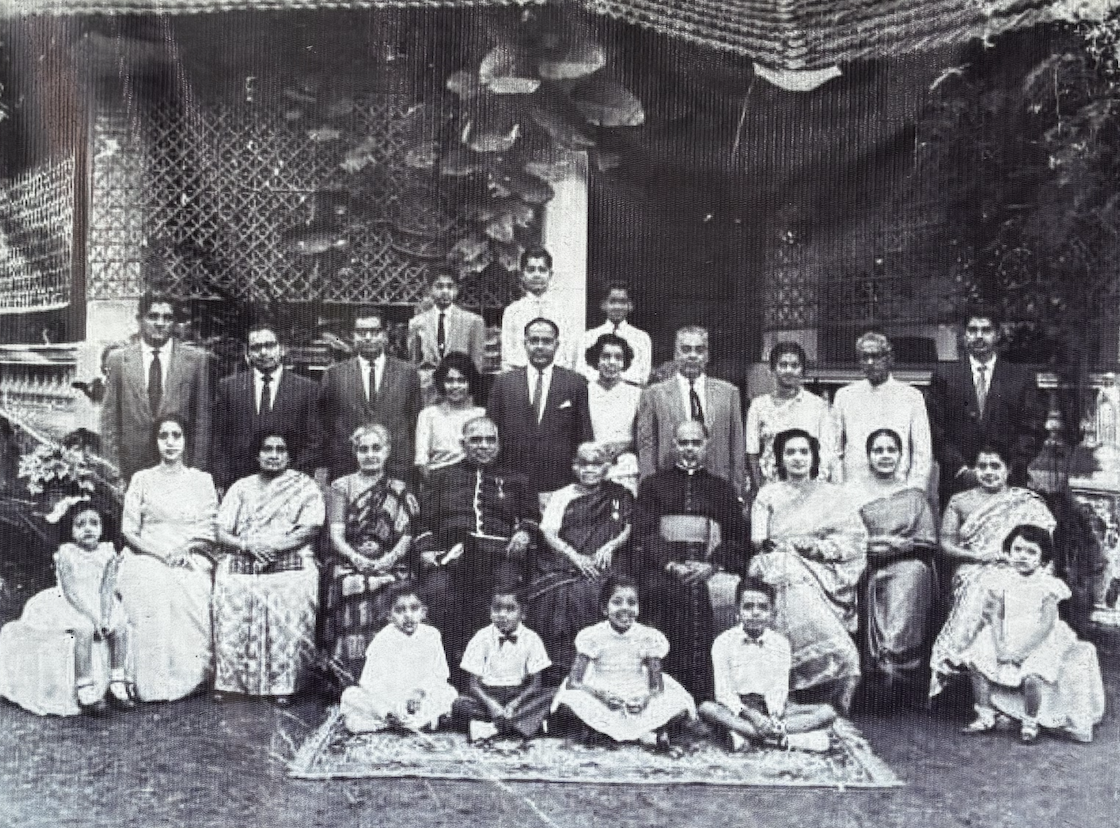
The poster has a black-and-white photograph of about thirty people arranged in front of a house. For a few moments I just stood there, staring at their faces.

The woman is Rose Menezes, and the poster is built around her.
She was born in 1887, married young, and was widowed four years later with a small son. She married again, raised a houseful of children, and outlived her second husband by almost fifty years. The photograph was taken in the early 1960s at her house in Falnir, which was called Rosedale. (I love that she lived in a house named after her.)
Up until that point, I’d never heard of any of them. I’d never heard of Rose. It’s a strange feeling to be claimed by people you didn’t know existed.
My family has always been a size I understood. The people I’d met, and the people I’d heard about from my parents and grandparents. And the only ones I actually remembered were those I saw at weddings and funerals. But here was a picture telling me it had always been much bigger than that.
It’s wild to think those blurry grey people might have shaped how my family thinks and works and what we care about. None of my grandparents went to college, and they still raised incredibly hard-working children who valued education and pushed themselves to do well. They did really, really well.
Those children had us, my siblings and cousins and me, and taught us the same things. We’ve taken those lessons in directions that might surprise them. I notice it in my siblings and cousins more than in most others my age: we work really hard and we’re proud of it.
The other thing running through my family is faith. I come from a long, long line of people who have been in some form of ministry, on both my parents’ sides. There are priests and nuns and choirmasters. Rose’s son Winibald (don’t make jokes), became a bishop.
My own father is a pastor. My uncle is a pastor. And now, my brother is too.
I don’t think faith is something you can inherit, the way you inherit a surname. Nobody can believe on your behalf. Each of us has to eventually reckon with God for ourselves. What a family CAN do is point you toward God and live in a way that makes you want to look. That’s what I’m proudest of. Generation after generation, my family has raised children who were taught about God, but then went out and found God themselves. I’m one of them.
Before we left, Michael gave me a printout of a photo he’d taken of the tombstone of my great-GREAT-grandparents, John Manuel and Paschalia Menezes. The stone itself is gone. It was destroyed along with many others when the church was renovated, and Michael had kept some of the broken pieces.
At first I didn’t fully get why this upset him so much. The people buried there died a long time ago, and churches need renovating. But then I thought about how he actually does his work. Remember, big chunks of the old church registers are missing. For a lot of people from that time, there’s no marriage record, no death record, and nobody alive who remembers them. Sometimes a gravestone is the only place where a person’s name is written next to their husband’s or wife’s name, along with the years they lived. It might be the last proof that they were here at all. So when an old stone gets smashed, the only clue connecting one generation of a family to the next might go with it.
Whatever you might think of a man who keeps broken pieces of other people’s gravestones so that he can, quite literally, piece history back together by hand, I can tell you without a shadow of a doubt that he has an immense capacity to care.
In the end, I think he does it out of love for his community and for everything it has become. I find that fascinating and beautiful, and I’m forever grateful to him for it.
A long history of leaving
Mangalorean Catholics have been leaving places for a very long time, and most of that history starts in Goa.
Many of the first families to convert to Catholicism were Saraswat Brahmins, who take their name from the Saraswati river. Over centuries they moved south along the Konkan coast and settled in Goa because who wouldn’t?!
When the Portuguese arrived in 1510, a bunch of missionaries followed and whole villages were baptized. People gave up their Hindu names and usually took the surname of the Portuguese man who stood as godfather at their baptism. That’s how a family of Konkani-speaking farmers ends up being called Fernandes, or Lobo, or Menezes.
About fifty years later, the Church decided the new converts were STILL too Hindu. The Inquisition opened in Goa in 1560 and they tried to ban some of the customs that families had carried into their new faith.
According to Michael, one of those was the roce (pronounced like roast but without the t). It’s a ceremony held a day or two before the wedding where the family anoints the bride or groom with coconut milk and blesses them. Families who refused to give up practices like these left Goa for Canara, the area around Mangalore.
The local kings welcomed them because they were skilled farmers, much like Aba’s family would be, and the kings gave them land to cultivate. Wars and famines in Goa sent more families to Mangalore. They learned Tulu and Kannada to get by and do business, and they kept speaking Konkani at home.
For a while, this worked. Then Mangalore got caught in the middle of someone else’s fight. About 200 years after the first people left Goa for Mangalore, a guy named Hyder Ali who was the ruler of Mysore Masala Dosa, took over Mangalore and Canara. But the British wanted it too because it had a port.
After Hyder died, his son Tipu Sultan won Mangalore back from the British in 1784 and became convinced the local Catholics were siding with the British. So he punished them.
One Ash Wednesday, his soldiers rounded up the Catholics in the area and marched them on foot over the Western Ghats to his capital at Seringapatam. About one-third of them died on the way. The ones who survived were held captive for fifteen years, until the British killed Tipu in 1799.
Only a fraction of these people came home still Christian, and Michael says that today’s Mangalorean Catholics descend almost entirely from that group of survivors.
One of the people who came home was a guy named Kempa Simon Fernandes Prabhu. His name holds both halves of the story. He gets Fernandes from a Portuguese godfather somewhere back in Goa, and Prabhu is the name his family carried before that.
Kempa had six sons. One of them, named Michael (different Michael), had a son named Thomas, who had a son named Gaspar, who had a son named Athanasius. In 1931, Athanasius had a son he named John Baptist. That’s my grandfather, Aba.
Aba conducted my roce. Traditionally, the eldest member of the family does it, and that was him. He and my Mum cooked for everyone, and Bombay Nana sang the traditional roce songs, but in an English version that she wrote herself for me.
I loved it at the time without thinking much about where it came from. Now I know that families walked out of Goa so they could keep doing exactly this, and that the man blessing me was the great-great-great-grandson of someone who walked home from captivity.

History like this always feels like it’s way too long ago to matter. There are too many years in between. But when you count history in people and generations, it’s much closer.
Only four people stand between Kempa Simon and Aba, and Aba lived until 2024, which was just the other day.
When I moved from Bombay to Goa six years ago, I thought I was doing something cool and new. But Mangalorean Catholics have spent centuries leaving Goa, and I’ve somehow ended up back here.
Part 2
Where are you from?
Okay, let’s take a break from the history lessons because it’s a lot of names and facts, and it gets boaaaring after a point.
Time to talk about my feelings instead, the best part, yay!
Honestly, I never thought I’d be writing an essay like this, but lately I’ve been feeling quite lost. I feel like I don’t belong anywhere. Right now, with how culture is heading, there’s a lot of “go back to where you came from” kind of rhetoric going on. I sort of understand why. Places are changing fast and people want to protect their version of home. But whenever I hear it, I try to work out WHERE I’d actually be sent, and I can’t.
“Where are you from?” is supposed to be an easy question. For me it’s always been complicated. It always feels like I’m bullshitting a bit.
- If I say Allahabad because I was born there, it feels fake because I’ve never really lived there.
- If I say Dubai because I grew up there, it doesn’t quite make sense because nobody is really FROM Dubai. Everyone there has a ‘back home.’
- I’ve lived in a few countries after Dubai and I liked them all, but I didn’t belong to any of them.
(I understand and acknowledge that this is a very stupid problem to have, so I’d like to assure you that this issue does NOT keep me up at night. Unfortunately, my real problems do.)
Bombay is the only place I’d call home. I’ve lived all my adult life there. I know the city, I love the city. But as much as I’d like to claim Bombay as mine, I don’t think it would claim me. I don’t speak Marathi, I don’t really feel local.
And now, for the past 6 years, I’ve been living in Goa. I can’t say I’m from here, and I don’t know if or when I’ll ever be able to.
So if anyone asks, I give them the short answer and I say I’m Mangalorean but I’m from Bombay. This essay is, finally, the long version of where I’m from.
What I’ve been reading
I’ve been trying to make sense of why this trip meant so much. On paper, it was a regular family holiday. But I left feeling like I had so much to think about. Why do these dead relatives feel important? Should I care about this? Is there any benefit to knowing all this stuff?
I sat and did some thinking. Then I stood up and did some more thinking. Then I did some fancy footwork, all while doing some more thinking. After I thought so much, I did some reading and I found three really interesting theories that I think you’re gonna LOVE so stay with me please.
Theory 1: 20 questions
Two researchers came up with a version of 20 questions for kids and called it the “Do You Know?” scale. They asked them stuff like:
Do you know where your grandparents grew up?
Do you know how your parents met?
Do you know some of the jobs that your parents had when they were young?
Apparently, the kids who could answer more questions correctly had higher self-esteem and felt more in control of their lives. And it didn’t matter whether the family story was impressive or not.

The main takeaway that these research people published later was this:
They say that family stories usually come in 3 shapes. Find yours here.
- Rising: We started with nothing, and look at us now
- Falling: We had everything and lost it.
- Oscillating: This one goes up and down. We had good years and we had really awful ones, and we stuck together through both.
According to them, it’s the up-down shape of family stories that is apparently the healthiest. If your family has only ever gone up and up and up, when you have a bad year or years, it makes you feel like the outlier.
If your family seems to only have gone downhill, e.g. see what we had and see how things have ended up, you grow up carrying grief that isn’t yours. And it can break even the strongest people.
I think the up-and-down version shows you that bad things happen and some of it will be your dumb decisions and some will be beyond your control, but your family has survived them before, and you will be able to survive it too. I’m 33 years old, and I think this is my general life philosophy.

Theory 2: The floating gap
A Belgian historian named Jan Vansina spent his career studying how communities remember their past.
He kept seeing the same pattern. People knew a lot about the very beginning, because the origin story has been told and retold. You’ll know that your ancestors fled from somewhere. You’ll know that they arrived on a boat from wherever.
People ALSO knew a lot about the last 2 or maaax 3 generations, because maybe they’d met those people, or they’d heard about them.
But in between, they knew very little. This is the floating gap.
Nobody knows who their family was four generations ago. Nobody knows their names or where they came from. Whole generations have just disappeared into this floating gap. The gap moves forward every time a generation dies. Your grandmother can maybe tell you about her grandmother because she knew her.
But once your grandmother is gone, all memory of her grandmother is gone too. Nobody has to forget for this to happen. People just have to keep dying, which, historically, they’ve been very reliable at doing.
Here’s where I appreciate someone like Michael. He has documented ten thousand pages of history and spent 30 years of his life walking into the floating gap with a torch, pulling people out one name at a time.
But a torch only goes so far. The gap keeps floating forward, and one day it’ll reach all of us.
Okay, now for the last and final theory that I think should be a dinner table conversation the next time you meet your friends.
Theory 3: The asteroid
Let’s assume you and all your friends live a relatively normal life. You go to work, save money, pay your EMIs, maybe buy a house and raise kids. You make friends, maintain relationships, take care of your parents, learn new skills. Eventually, you die at a good old age.
BUT THEN.
Thirty days after you die, an asteroid hits the earth and everyone is killed. Boom.
First question: Does that bother you? Is it upsetting? You’re dead anyway, does it matter?
Second question: If you found out that an asteroid would destroy everything you loved a month after you die, what would you do differently today? Would you still save money? Would you still water your stupid plants? Would you finish that course, or that creative project, or that renovation? Would you still be reading this LONG essay?
I find this so cool because of how people answer. I think most people would say it would bother them a bit, even though they’d be dead. Like, nobody wants the people and pets they leave behind to suffer.
And when you go through the list of what you’d change, it’s never the small stuff. Obviously, nobody would give up a nice night with their friends, or cuddling their kids, or eating an excellent spaghetti.
What stops making sense is everything that takes a long time to pay off. Stuff like saving, planting, building, learning.

The thought experiment comes from a philosopher called Samuel Scheffler. He says that without realizing it, we all count on something he calls the collective afterlife. We care about the fact that people will keep living after we’re gone. We hardly ever think about it, but so much of what we do only makes sense because of it. He even argues that, in some ways, knowing other people will go on living matters to us more than our own survival.
That’s why we care about climate change, and education, and building systems that will take care of the world we leave behind. It’s why people lose sleep over what the planet will look like in 2100, knowing full well they won’t be around to see it.
It’s why it hurts a little to see an old building torn down to make way for a mall. It’s why you can’t bring yourself to throw away a card in your grandmother’s handwriting.
Because this essay has been about family, I wondered whether this is just a parent thing. Do you only care about the future if you launch your children into it? Maybe parents care more.
But most people I see fighting for a better, fairer world aren’t doing it for their own kids. They just care.
After walking past family after family on Michael’s wall, I came away feeling like the people in those photos lived as if they knew I’d exist one day. They sent their children to school, taught them to pray, and passed on their values. They overcame extreme hardships and kept going, because, for the most part, that’s what humans do.
None of that makes sense if all that matters is the few decades that we’re alive. But for some reason, I think we care about more than just that.
Eternity
I’m ending this essay now, I promise. I called this section ‘eternity’ because that’s how long I’ve been going on for. If you’re still here, THANK YOU.
Since the trip, I’ve occasionally thought about the blurry grey people that make up my family. Almost all of them have been forgotten. That’s just what happens. One day, that’ll be me. And you.

A 100 years from now, nobody will know what you did for a living or whether you got recognition for it. Nobody will know about your worst mistake or your biggest achievement. The things you’re saving money for will belong to strangers. Your great-grandchildren may not know your name.
Someone will clear out your cupboards and throw away the stuff you couldn’t bear to. Your face will end up in a photograph that eventually, nobody can identify.
It’s bleak, but it’s also weirdly freeing because at the end of the day, you’re free to make your choices. You’re free to live. But life is HARD. What’s the point of any of it?!!!
Ecclesiastes, one of my favorite books in the Bible, is said to be written by the wisest and richest man who ever lived. He had everything a person could want, and he opens his book like this: “Meaningless! Meaningless! Utterly meaningless! Everything is meaningless.”
The word he uses for “meaningless” is hevel. It literally means breath, or vapour, like the ‘smoke’ you breathe out on a cold morning. It’s real for a moment, and then it’s gone. That’s what he says our lives are like. Most of the time, that feels true, but sometimes, I don’t feel meaningless.
Sometimes you stand before mountains that have been there for thousands of years, or you see birds building a nest. Or you hear the roaring ocean, or see the stars on a clear night. You sing a song together with a room full of people, or watch the sunrise, and you wonder HOW you ended up alive right now. In this body, in this place, at this time.
You feel so small and so weirdly significant, like something inside you is reaching out to everything that ever lived.


The only explanation I’ve EVER found for that feeling is also in Ecclesiastes: “He has also set eternity in the human heart.”
The Hebrew word for eternity there is olam. It means time stretching out of sight, far back into the past and far forward into the future. Our lives are vapour, and yet we long for eternity, which is a strange thing for meaningless creatures to want.
I think that longing exists because God put it there. Because maybe in our pursuit of meaning, we might end up finding God.
I don’t know where my family will be in a 100 years, or what they’ll call home. They won’t remember me and I won’t matter. I’m somewhere in the middle of a very long story that doesn’t start or end with me.
I went to Mangalore feeling like I didn’t belong to a place. I still don’t. But I came home knowing I have a people, and for now, I’m happy with that.


Leave a Reply