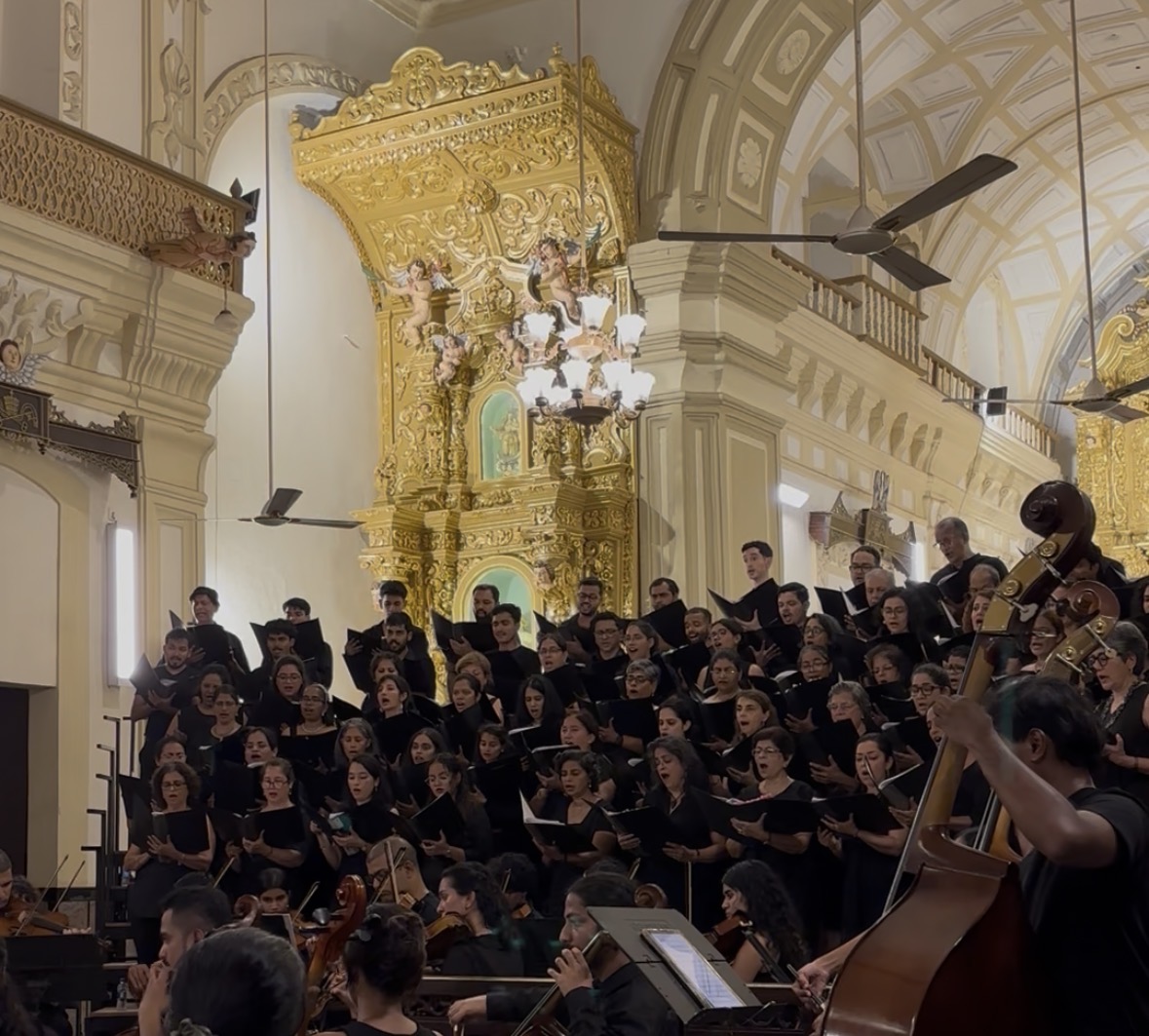
Last Friday evening we drove to the Church of St. John the Baptist in Benaulim to hear the Stuti Choir perform Handel’s Messiah.
The last time I attempted to go for a Stuti Choir performance, I had reached ten minutes early. By then, the church was packed and we stood outside and heard them sing through the speaker system. Determined to not let that happen again, this time we reached nearly an hour early.
Growing up, we had a CD of Handel’s Messiah with a red cover, which to me, meant it was a Christmas album. I’ve listened to it countless times, and because most of the lyrics are a) in English, and b) straight out of the Bible, it was the one piece of classical music that felt familiar.

The choir rehearsed and prepped as church pews filled up. Kyle and I quickly googled stuff about it and discussed what we found so we could appreciate the performance a little more. Summary: It was composed in 1741. A German guy living in London wrote it in a 24-day frenzy, working through a bout of what was almost certainly depression. He was also bankrupt at that point. This piece of music changed his life and made him rich and famous.
Nearly three hundred years later, far away from London, we sat in church and heard a choir perform the music he wrote. I honestly think it’s some of the most beautiful music ever composed. We paid nothing to be there, and the choir and orchestra was paid nothing to perform. Every person in that choir probably had a day job. Most of them had families. Yet they put in hours and hours of practice, week after week.
So why did they do it? A fair question.
In this essay, I’m going to talk about two conversations I’ve been hearing that I think are worth looking at.
One conversation is about work: Work is a scam. Your job is not your identity. The real you exists outside of what you do between 9 to 5. It’s what happens outside of work that gives your life meaning. Work is devoid of meaning and purpose.

And the second is about aesthetics: Why don’t we make beautiful things anymore? Why is everything ugly now? Is anyone composing music that people will still be listening to in 300 years? Is anyone putting up a building that will last for centuries? All the big, enduring, beautiful things seem to have been made a long time ago by people who are now dead. It seems like we’ve lost the ability to do it.


Maybe you’re starting to see how these conversations are related, but I promise this essay isn’t going to be a lecture on working harder or being a more subservient tool of capitalism. No.
Here’s what I’m going to tackle:
- Why has work lost its meaning?
- Why do we no longer make things that last?
- What are we actually living for?
Sounds like a fun task! Buckle up buttercups, we’re going for a ride.
Why work?
In April 1942, in the middle of the Second World War, a woman called Dorothy Sayers stood up in a small town on the south coast of England and gave a lecture called Why Work?
At this point, the war was going badly. People were hungry and broke, and many were dead. Rationing was at its most severe. They called on Dorothy because she was an icon.
She was one of the first women EVER to get a degree from Oxford. She was a close friend and intellectual peer of C.S. Lewis, and one of the sharpest theological minds of her day.
She paid her rent by writing best-selling detective novels. She wrote BBC radio plays about the life of Christ that were so ahead of their time that people attacked them for being too irreverent (side note – they were later recognized as important work).
She taught herself Italian in her fifties so she could read Dante in the original. Her translation of the Divine Comedy is the one that’s STILL in print today.

That’s not all.
She had a child out of wedlock, and then went on to not marry the baby-daddy, and her cousin raised the child instead. When she was invited to speak on women’s issues, she titled her talk “Are Women Human?”.
She wore trousers when women didn’t. She swore like a sailor in some of her writing. She believed in Christianity intensely, while also being a chaotic mess. That was Dorothy. She was a force.
Make good tables
I’ve read her essay about ten times now, and I get why it’s considered an important piece of work. I think every argument she makes applies as clearly to us today as it did to the people back then.
“Work is not primarily a thing one does to live, but the thing one lives to do.”
Wait, that sounds familiar. Did she just say…

For Dorothy, work was the natural exercise of a human being. It was how a creature made in God’s image imitated God, who also makes things. What went wrong, she said, was that we stopped treating work that way. We started treating it as a transaction.
You worked so you could earn money. You earned money so you could live decently and give to the Church. Your real spiritual life happened elsewhere, at home, on Sundays, in your leisure hours.
Dorothy thought this was catastrophic. She wrote:
“The Church’s approach to an intelligent carpenter is usually confined to exhorting him not to be drunk and disorderly in his leisure hours, and to come to church on Sundays. What the Church should be telling him is this: that the very first demand that his religion makes upon him is that he should make good tables.”
Make good tables.
Not make tables so you can earn enough to give to the church. Not make tables and be pleasant to your colleagues while you do. Just make good tables. The carpentry itself is the religious act. You could not be a faithful Christian and a careless carpenter. Christ was himself a carpenter.
“No crooked table legs or ill-fitting drawers ever, I dare swear, came out of the carpenter’s shop at Nazareth.”

She proposed a simple test for how different our lives would be if we actually took this seriously. Ask a different set of questions.
We should ask of an enterprise, not ‘will it pay?’ but ‘is it good?’ (I think in 2026, we can ask both though, sori Dori)
Don’t ask a person ‘what does he make?’ but ‘what is his work worth?’
When talking about things, don’t ask ‘Can we induce people to buy them?’ but ‘are they useful things well made?’”
If you treat work as something that exists only to produce income, you produce a culture built entirely around that premise. You produce a society, she wrote, “in which consumption has to be artificially stimulated in order to keep production going.”
And she’s right, because it’s impossible to open any form of media without being artificially stimulated to keep production of goods going (which is how I’m going to refer to ads henceforth).
Dorothy said that a society like this would be founded on trash and waste. She described our present day pretty accurately back in 1942.
The larger point that she makes across the essay, is that there are two frameworks available to most of us now, and they’re both wrong in exactly the same way.
- Work harder and earn more.
- Work less and live better.
Both assume the work is just a task with no higher purpose. Both treat the thing produced as secondary to the life of the person producing it. Neither of them can make anything that will last generations or have deep cultural significance.
Why don’t people make beautiful things anymore?
Dare I say, the people asking this question are asking a version of Dorothy’s question: Why work?
You know the feeling you get when you walk into a room or see a building that feels like it has life in it? It’s got character, it makes you feel something. Awe, comfort, wonder, energized, calm. Some towns have it, some don’t. Some churches, colleges, and libraries have it, some just don’t.

For most of history, people treated this as a question of taste. Some things are pretty. Some things aren’t. What can you do.
A guy in Berkeley said that explanation was garbage. There must be a better answer. And so, he spent his whole entire career finding answers.
His name was Christopher Alexander (you guys already know I have issues with people with two first names, but we’ll put that aside for now). You’ve probably never heard of Christopher Alexander. But I can guarantee his work has shaped something you used this week. Or today, even.
He was born in the late 1930s so if you’re my age, then this guy is roughly your grandparents’ age. He won a scholarship to Cambridge to study chemistry and mathematics. He then went on to Harvard, where he was awarded the FIRST doctorate in architecture the university had ever granted!!!
Fun fact – his Harvard dissertation was based on fieldwork in the Bavra village in Gujarat, India. The first building he ever built was a school in that village with a budget of ₹5000.

He basically spent his whole career bringing mathematical rigor to a question most people thought was a matter of taste: Why do some spaces feel alive and others don’t? Why do some rooms make you feel calm the moment you enter them, and why do others agitate you?
To answer the question, he and his colleagues published a book called A Pattern Language.
In it, they outline 253 patterns that make good buildings, at EVERY scale. From the layout of entire regions down to the placement of a single window seat. He listed out each pattern as a small architectural truth, illustrated and cross-referenced.


The influence of his work is astounding. Communities are being built on these principles: walkable neighborhoods, houses with front porches to encourage socializing, and lots of green space.
But it’s not just architecture where his work has made a difference. His design framework was adopted almost wholesale by the software industry, where it became the foundation of what programmers now call “design patterns” and “pattern languages.”
His work inspired human-centered design, and the flexible, collaborative software development that we call agile today.

Ward Cunningham is the guy who invented the wiki (the technology that made Wikipedia possible) after reading his book. He tried to build a tool for capturing patterns the way Alexander did.
His work has influenced almost every well-designed thing you interact with.
Christopher Alexander was very happy with all this. He thought he had cracked the code. You could apply these patterns, and good building would emerge.
The book was his answer to his life’s question on how you make places feel alive.
But then over the next 20 years, he changed his mind
How could you do that to us, Chris. I bought your book!!! It was like 5000 bucks on Amazon!!! That’s the whole budget of the school you built in the 60s.
So what was the issue? Was there a problem with the patterns?
Apparently not. He noticed that you could follow all 253 of those patterns, and still create something that felt dead. There had to be another explanation, he thought. Something was at work underneath the patterns, something the patterns pointed at but could not themselves produce.
Christopher became obsessed with this question, and spent the rest of his career trying to find the answer.
The research that came after his first successful patterns book was four volumes long and over two THOUSAND pages, published between 2002 and 2004. Almost nobody has read it, and it’s nearly impossible to find it in print today. It’s called The Nature of Order.
In this research, he finally arrived at what makes a place feel alive, and people didn’t like his explanation that much.
God.
That is what forty years of work by one of the most serious minds in twentieth-century architecture arrived at.
“The most urgent, and I think most inspiring way we can think about our buildings, and our way of making and remaking the Earth, is to recognize that each small action we take, in placing a step, or planting a flower, or shaping a front door of a building, is a form of worship – an action in which we give ourselves up, and lay what we have in our hearts, at the door of that fiery furnace within all things, which we may call God.
The capacity to do this lies in the heart of every man and every woman… it is stark in its simplicity. To make each brick, each path, each baluster, each window sill, a reflection of God.
The world shaped by this presence, will thrive from it, and will surely lead us back to a vision of God, and a sense of right and wrong, and a sense of well-being. Future generations will be grateful to us if we do this properly. ”“I was led from architecture to the intellectual knowledge and love of God. It was my love of architecture and building, from which I slowly formed an edifice of thought, that provides for the existence of God as surely as we have previously known the world as made of space and matter.”
– Christopher Alexander
Chris was careful not to make this about a particular religion. He was raised Catholic but he didn’t return to Catholicism while writing these books. He studied lots of different doctrines – Christianity, Judaism, Buddhism, Hinduism, Shinto.
He believed that the world is like a face, and beauty is the experience of recognising yourself in it. You make the thing, and the thing makes you. The person carving intricate stonework is being changed by the carving as much as the stone is being changed. The act of making well is reciprocal. The maker gives, and thus, is given to.
The people asking why our buildings aren’t beautiful, why our cities don’t feel alive, and why nothing we make has soul – want an answer they can implement without changing who they are. Bring back craftsmanship. Use better materials. Cultivate a sense of taste. None of it will work and Christopher told us why. Every civilisation that ever made anything truly awe-inspiring was a civilisation organised around something larger than itself. No amount of wanting beauty back is going to give it to us until we reckon with that.
Enduring, life-changing things come out of transcendence.
“We cannot make an architecture of life, if it is not made to reflect God.”
The people who made beautiful things were working for something outside themselves, and the work was changing them in return. We don’t do that much anymore. We make to sell, or be seen, or get paid. We produce the thing, and the thing produces nothing back.
This is not a issue of good taste or of good craft. It’s a matter of conviction and better design isn’t going to fix it.
Why else would an artist carve or paint something 30-feet up on a ceiling, somewhere no human eye would ever see? You cannot have the cathedral without God. You cannot have the Psalms without God. You cannot have Bach, who signed all his music Soli Deo Gloria (Glory to God alone), without God.
The thing outside the self
Am I saying you have to be Christian to make anything good? Obviously not. Plenty of beautiful work has been made by people with no particular faith, and plenty of godawful work has been made by the deeply devout. The point isn’t about the person making the thing. It’s about what the thing is being made for.
It’s about our sense of duty and obligation to do good work for a greater purpose.
We’ve built our lives around a self that answers to nothing outside itself, and then we wonder why it isn’t enough. It was never supposed to be!! The self was never the thing you were meant to build. It was the thing meant to do the building. And the building was meant to be for something else.
The trouble with a sentence like that is it sounds like advice for geniuses. It has nothing to do with us. Most of us aren’t going to build a cathedral. Most of us aren’t going to compose anything that lasts a century. Sure, we can use this as inspiration to be better at our jobs. But I’m not about to write a life-changing B2B SaaS article tomorrow.
Lucky for us there is one thing ordinary people have always been able to build that outlives them. A thing that has always been available to everyone, in every culture, at every income, in every century. A thing that doesn’t require genius or talent. A thing that is, in the literal sense, the longest-lasting creative work a human being can participate in.
A family.
Let’s talk about this
We’re going to talk about kids. Gasp. I can feel the vibe shift already.
A family is the one thing ordinary people have always made that runs on the same logic as building a cathedral. You will not live to see it finished. It isn’t an object you produce. It’s something that will keep going, altered by you but not owned by you.
When we talked about you making the thing and the thing making you, it described parenting perfectly. The direction of the work is always, always outward. A family is not for you. It’s for the people in it, and for the people who will come from it, and for a future you will not personally see.
To build a family is to accept that your life stops being primarily about you. Your grandchild will meet a version of your love that reached them through your child, in habits and phrases and weird pieces of advice that you set in motion. None of this is work you get to finish. You hand it on half-done and trust the people after you to keep going.
That used to be the point. A life was supposed to be a contribution to something larger than itself, and for most people, family was where that contribution got made.
That’s why the conversation about work, and making beautiful things, and raising a family seem related to me, because they all seem to end up at the same question: what is a life for? If the answer is “for the person living it,” then hard work starts to look unreasonable. Whether it’s building something, or raising a child.
You’re being asked to give up something immediate for something you can’t even measure. That exchange was never supposed to make sense on those terms.
Now before I sound like a tradwife, let me be clear about what I am not saying. I am not saying childfree lives are empty. I’m not making the argument that everyone should have children. Some people cannot. Some people should not. Throughout history, there have been expansive, meaningful, generative people that have chosen not to have children. In fact, maybe they had the capacity to be so expansive and generative because they didn’t have children.
I don’t think the people I know who’ve decided not to have kids are failing some civilisational duty, so if that’s you, I hope you’ll stay with me as I humbly present my thoughts.
I’m proposing that the conversation happening right now about whether to have children is one that ought to drive more curiosity and examination. Having a child is not a lifestyle choice of the same category as getting a dog or running a marathon. For the most part, it sits alongside eating, sleeping, seeking shelter, burying the dead. These are not hobbies you opt into based on whether they fit your current era.
They are the basic tenets of being an animal of our species, and every human culture that has ever existed was organised around them without thinking about it very hard, because there was nothing to think about.
For almost all of human history, children weren’t a decision. The philosophical question available to people was rarely: should I have children? It was: how should I raise them, and what do I owe them, and what do they owe me?
This wasn’t just because people lacked autonomy or access to contraception. It’s because every culture that had ever existed was organised around the assumption that the continuation of life is the thing life does. We are, at scale, the first humans treating this as a lifestyle question. That is genuinely new.
If you’re online, it’s likely that you’ll hear a lot of discourse about people who have opted out of having children, and who talk about that choice confidently. I’ve made it a point to hear and understand that perspective, and I’ve talked with friends who made that decision. It helped me understand and appreciate their point of view.
What I hadn’t heard until recently, was the other side of the conversation where someone chose not to have kids, and later expressed some regret or grief over the decision.
I was caught off guard when I heard this. It’s a conversation that doesn’t happen much in public, and I understand why. Someone who says out loud that they regret not having children becomes immediately vulnerable to the worst possible readings of that choice.
But they weren’t bitter. They had built full lives and had plenty to show for it, that part didn’t need defending. They were just telling me something I don’t often hear people talk about – that it’s possible to be a successful, fulfilled adult and still carry some grief about a life-altering experience that you didn’t get to have.
They acknowledged the profoundly human aspect of life that they missed out on with so much humility that I was left speechless.
I’m going back to the start
I want to bring this back to where the essay started, because this isn’t really about kids, and it isn’t really about cathedrals, and it isn’t about being a carpenter, and believe it or not – it isn’t really about work.
We are a generation that was told the self would be enough. We were told it kindly, by people who meant well, and who were trying to free us from older arrangements that had cost them a lot.
We were told we could build our own sense of meaning from scratch, using nothing but our own interests and desires. That our fulfilment is the project. That the meaning of our lives is something we generate from within ourselves, through work we choose, relationships we design, experiences we curate, and versions of ourselves we optimise.
We were told that whatever we chose for ourselves, if we chose it freely, it would be sufficient.
It hasn’t been sufficient.
We have a severe crisis of purpose. We’re lonely in a way people weren’t lonely before. We’re anxious in a way people weren’t anxious before. We’re tired. We can blame capitalism and patriarchy and the cost of living and the algorithm, and we wouldn’t be wrong about any of it. That is a real conversation and a necessary one, and it’s bigger than this essay.
I don’t think we need to find a way back to a nostalgic past that a lot of people correctly chose to leave behind. But underneath all that is something simpler. A life lived entirely for the self eventually collapses under the weight of itself.
We were not born too late for meaning. That’s the thought I want to close with.
The desire to give ourselves to something bigger is still there, and it’s a wellspring of creative energy and joy, waiting for us to stop asking what we are owed and start asking what we owe.
Make good tables. For God, for the people you love, and for the strangers who will sit at them long after you are gone.
“The more one forgets himself — by giving himself to a cause to serve or another person to love — the more human he is and the more he actualizes himself. What is called self-actualization is not an attainable aim at all, for the simple reason that the more one would strive for it, the more he would miss it. In other words, self-actualization is possible only as a side effect of self-transcendence.”
—Victor Frankl
More reading
- Learn more about Dorothy Sayers
- Learn more about Christopher Alexander
- Read Christopher Alexander’s Open Letter to Architects
- The hidden tax of ugliness in our cities
- Learn about Wiki as pattern language: Ward Cunningham on how reading Alexander led him to invent the wiki, the technology that would eventually make Wikipedia possible.
One more thing. Whenever I’m working through an argument I care about, I spend time reading the sharpest counter-arguments I can find. Not to talk myself out of my own view (although I often do) but to make sure the view I end up with is one I actually stand by with conviction.
Below are some of the best objections to what I’ve said in this essay. If you disagreed with some (or all) of what I’ve written, maybe take the time to skim through these and build your own convictions.
I’d love to hear your thoughts 🙂
- The Incredible Cost of Medieval Cathedrals
- Why are more women saying no to having kids? with Peggy O’Donnell Heffington
- Secular meaning is possible and enough — Philosopher Susan Wolf’s Meaning in Life and Why It Matters makes a careful case that meaning comes from active engagement with objectively valuable projects, and that this does not require belief in God. She does agree that you need to commit to something beyond yourself.
- The Ethics of Identity by Kwame Anthony Appiah. He defends the liberal project of individual self-fashioning as a genuinely good thing, not a fall from grace.
- Noreena Hertz’s The Lonely Century argues that the rise in loneliness and anxiety is almost entirely attributable to material and political conditions like urban design, gig work, digital life, erosion of civic institutions. Framing it as a spiritual crisis risks letting those structural problems off the hook.


Leave a Reply