
I’ve written about music in the past, and how it helps us feel like we’re in an augmented reality with manufactured vibes based on the song you’re listening to and the memories attached to it. This essay is about how our relationship with music evolves as we get older – and why it sometimes stops evolving entirely.
The first time I heard the song ‘The A Team’ by Ed Sheeran was while traveling by train to class. The song came out in 2011, and I was in my first year of college. My friend told me I had to listen to it, and that it would change my life.
‘Nobody knows who this artist is. I discovered him! He’s gonna be famous one day,’ he told me.
I heard the song, and then heard it again. I chewed on it for weeks. It was all I listened to. When I watched Ed Sheeran perform live in front of thousands of people a few years later, I texted my friend to tell him.
We used to spend a few hours a week discussing new music. We discussed what we liked about songs and artists, and why we thought the other person would appreciate it. One day, we had an hour-long dissection chat dedicated to a song called ‘Edge of Desire’ by John Mayer. We were 16.
Music was such an important part of my friendships back then, not just this one. My friends and I would regularly send each other lists of songs to listen to. We’d talk about music, listen to music together, and feel connected over shared music taste.
Today, I have a playlist on Spotify that I don’t share with anyone. It’s got all the songs that I consider ‘MINE’ because they’re attached to specific formative memories and moments, mostly around my highschool and adolescence. The A Team is obviously on it.
When I have a lot going on and want to feel something, I default to this playlist without a moment’s hesitation. It’s got songs that are filled with melancholy, angst, anticipation, sadness, longing, and pure unbridled joy.
Last week, was one of those weeks, and I needed some music to help me think through the mess of my present as I went for a drive. My mind was racing with uncomfortable thoughts and for some reason, I felt like I couldn’t touch my secret playlist.
I felt like I needed to listen to something new. Not new like 2023-release new. Just something else. For the first time ever, I felt like if I heard those songs, my current state of mind would overwrite the memories I had attached to them.
The A Team would no longer remind me of the perils and powers of youth and the commodification of women. It wouldn’t remind me of my friend. It would now be coded with whatever I was dealing with at the present. I didn’t want that.
Maybe that’s an oversimplified way of thinking in some ways.
It’s those dang teenagers
“Not every little girl gets to do what they want. The world could not support that many ballerinas.”
Marie Calvet, Mad Men
When my friend and I would share music with one another, we’d usually go onto a website that let us download YouTube videos as an mp3 file and then we’d have to transfer it onto our phone. Before that, we’d have Limewire or Ares, a sketchy software that would give us illeg@L access to the music we wanted.
When I had an iPod, I’d have to upload new music onto iTunes and then sync it all up. Finding your new song in the middle of your old playlist was quite thrilling. Before that, people had to shell out actual monies and buy music.
Today, I have more ways to access music than at any time in history, and more music than I could possibly listen to in a lifetime. But when I need to feel something, the songs I listen to are the ones I downloaded from YouTube back in 2011. They’re my old friends.
The thrill of discovering new music can enrich your life at any stage. Except, most of the time, it doesn’t.
We don’t care about new music as much because most of our music preferences are solidified during our teenage years. There’s strong evidence to back this up, and it’s mainly because of two reasons:
Number 1: During our teens, our brains are finally mature enough to truly appreciate the music we hear.
Number 2: The potent cocktail of emotions we experience during puberty helps form deep and lasting memories with the music we listen to during this time. When you’re younger, ‘what you listen to’ is a much bigger part of your identity than when you’re say, thirty. ‘Your music’ becomes intrinsically linked with the people, places, and memories that shape your sense of self.
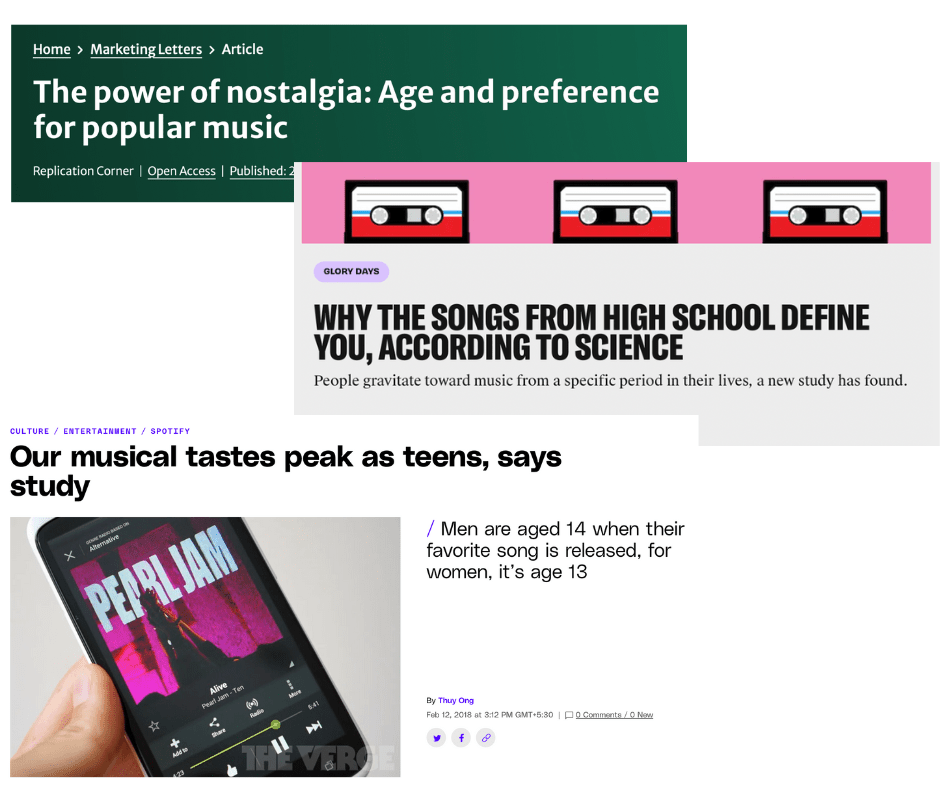
In fact, all our memories during this time are stronger because of a thing called the reminiscence bump, which I wrote about in my essay about our mental age.
The music machinery knows this! Spotify curates playlists called ‘Your Time Capsule’ that literally figures out your teenage music preferences based on your listening habits, and puts together those songs for you. Feedback on the playlist’s accuracy goes from “creepily spot on” to “not bad”, “a reminder that I was super lame” to “HOW DOES IT KNOW SO MUCH?”

Why bother with new music if it might suck
“I bet there were people in the Bible, walking around complaining about kids today.”
Roger Sterling, Mad Men
So why take the bold plunge into the unknown realms of new music when you might land somewhere gross and unknown?
Especially as a busy grandma, you want the comforting embrace of your tried-and-true millennial jamz to carry you through your weekend chores. Is it really worth venturing out of your comfort zone and potentially facing disappointment, in a world that’s already so disappointing in, like, so many ways?
This is not just a rhetorical question but a genuine ask: Why on earth would you invest your time and energy to listen to something you might not enjoy?
To keep up with the times? Eww.
Music these days isn’t as good as it used to be. I get it, I really do.
As an avid Elton John, Pink Floyd, Taylor Swift, Imogen Heap, Coldplay, Billy Joel, Switchfoot, Jay-Z, James Morrison, John Mayer, Jason Mraz, Ingrid Michaelson, Tracey Chapman, and Queen fan – I get it. (wow look at her trying to flex)
A lot has changed about the music industry over the last decade. And while I want to talk about that, I also don’t. There are many people far more qualified to do so, and when I came across their take on it, I felt annoyed.
Not because I felt like they were wrong, but because I felt like they were annoying.
A reputed music producer with over two decades of experience named Benjamin Groff listed out ten reasons why music today SUCKS. Here’s a summary of the reasons:
- Thanks to technology, it’s easier to make music without being a skilled musician. Meaning music creation is democratized. You can use samples, or produce instrument sounds without actually knowing how to play.
- Record labels used to hold all the power, and they could make or break careers as they liked. Now, they can’t. Booooooo.
- Music is more commodified. Many successful artists have changed their strategies to focus on what will trend on social media platforms over what their personal artistic inclination might be.
- Labels have been arm twisted into signing the most popular artists on TikTok, where musical ability is undermined by general popularity or virality. Most of these artists don’t have the skill to last in the music industry, and are there only for their ‘moment’ (which is all that record companies care about encashing on anyway)
I might sound critical of his opinion, but that’s just me. If you want to know more about the music machinery of 2023, here are other great explainers:
Why is Modern Music so Awful?
The TikTokification of Music
Now, here’s MY mini-take on this subject:
The moment something is democratized or made accessible to everyone – things change. The gatekeepers of the old world (producers, managers, record labels execs) get their panties in a bunch because they can’t monopolize talent and success anymore.
What was once available only to those with a magical combination of talent, hardwork, privilege, whiteness, luck, connections, and money can now be made available to more people.
That means talent might be found in places that the long arm of the labels might never have reached.
And if everyone can be a musician, then no one is truly a musician. Right? No. If music-making is available to everyone, it doesn’t dilute the concept of a “true musician.”
Let’s apply the same thing to another profession like art. I was recently talking to an artist at my pottery class. I think he might have been in his 70s. He worked at an ad-agency called Lintas and used to design their posters. Like, draw and paint them out.
He told me about how his daughter is a graphic designer, but she uses computers to make art. Things like photoshop and illustrator.
I immediately thought (to myself, so as NOT to out myself as being an idiot) about how I use Canva to make my own creatives, without being an artist like this man, OR a graphic designer like his daughter. And when you look at my designs, can you tell the difference?
YES YOU REALLY FRIGGIN CAN!!!!!!!!
Even though everyone can technically create art, there’s a clear divide between dabblers and professionals. Not everyone can create something that genuinely moves you.
Your average person with a Canva Pro subscription can’t pour their heart and soul into creating art that makes you feel something. So while these tools, especially AI tools, might have made creators out of us all, they can’t replace the dedication and skill of true artistry.
And frankly, if anyone can be a musician, then great. Let them do it! I’d like to live in a world full of musicians. Take me to that world AT ONCE I say!!!
Those committed to their craft will always, always, always stand out. If not for their talent, purely because they care enough to stick around and keep at it and not give up.
Okay that’s my take.
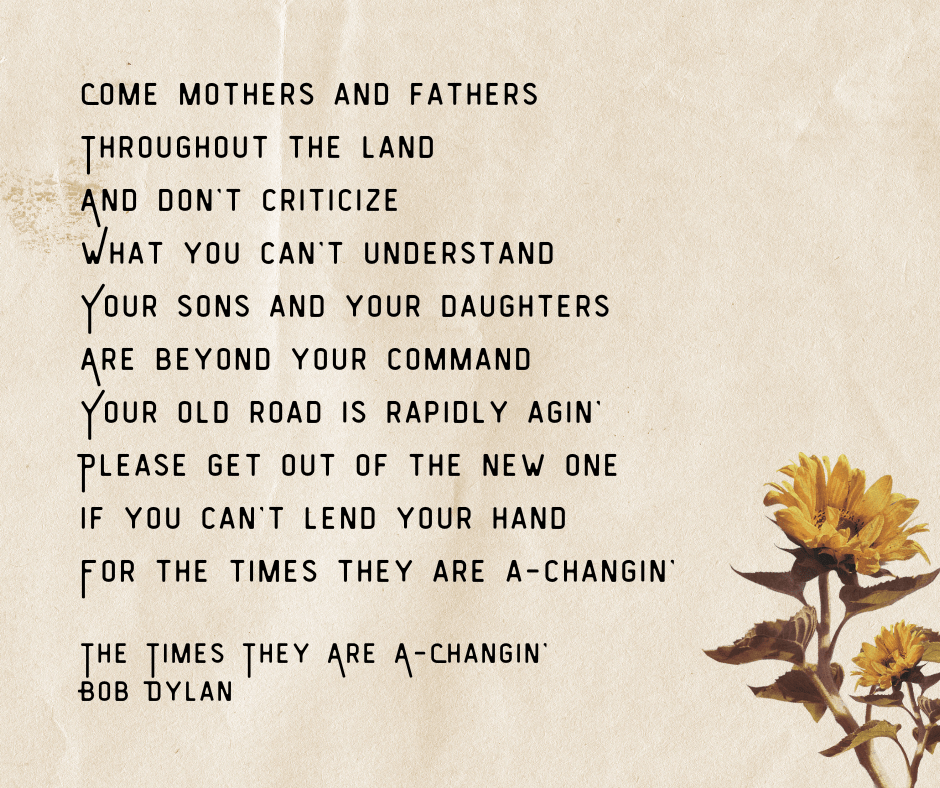
The times they are a changin’
“Change is neither good nor bad. It simply is.”
Don Draper, Mad Men
If you sometimes want to experience music as a passive comfort, like a warm blanket or re-watching Friends, I support you! I’m not coming for the things you love. I need my old songs too.
Our auditory cortex is wired to make everything we already recognize far more pleasurable than everything we don’t. Our brains run away from the unfamiliar. Forget brain, my legs also run away from the unfamiliar.
I’d like to argue that although listening to new music is hard, it’s necessary. And by new, I don’t mean 2023-new. I mean unfamiliar-new. Not your college playlist-new. I mean something you’ve never heard before-new. You get it.
There’s an excellent article on Pitchfork called ‘Why Do We Even Listen to New Music’, and they aptly describe listening to new music like lifting a couch.
“Listening to new music is hard. Not hard compared to going to space or war, but hard compared to listening to music we already know. I assume most Americans don’t listen to new music because it’s easy to forgo the act of discovery when work, rent, children, and broadly speaking “life” comes into play. Eventually, we bow our heads and cross a threshold where most music becomes something to remember rather than something to experience.”
That last line is important.
Our engagement with new music acts as a tether to the present. And although you might insist that the present sucks compared to the glorious 2000s, you still live in the present. You’re gonna be in the present for a long, long time.
Stop expecting new music to ‘hit’ the same way as old music does. You aren’t the same spongy, ready to absorb everything with open ears person that you used to be either. The world will keep spinning and culture moves with it.
I mean, how dare we engage our frontal lobes with something as frivolous as a song we’ve never heard before?
The Pitchfork article shares an important opinion on this too:
“The choice to listen to new music prioritizes, if for one listen only, the artist over you. It is an emotional risk to live for a moment in the abyss of someone else’s world, but this invisible exchange powers the vanguard of art, even in times of historic inertia.”
Your old songs aren’t going anywhere, and neither will you if you remain stuck to the past. Your brain is highly plastic – meaning it CAN change, it CAN form new patterns, and it actually needs to in order to retain that plasticity – even if it doesn’t like the process.
The ability to create new associations between life events and music remains a potent force, with the potential to give your life new depth and richness. Use that potency. Refuse to be obsolete.
Listening to new music, a messy guide
Here are some general thoughts about how to successfully listen to and like new music for anyone over the age of 25.
- Don’t expect new music to play the same role in your life as your old music. It just won’t happen. It’s unfair to expect it have the same impact. Instead, find new things to like about new music. It can be tied to new memories, people, or places. Or you can like the story behind the song or artist. You can appreciate the musicality or the creativity of the lyrics.
- If you’ve discovered a new artist, listen to one or two songs that interest you rather than a whole album. You can build curiosity slowly and steadily.
- Practice different modes of listening to music. If you like listening to familiar music while working out or driving, then try new music while you’re doing chores or in social settings. You could even listen to music more formally by watching musicians perform at gigs or concerts.
- Use a tool like Spotify. If you like an artist, check out their radio. You’ll get similar genre stuff and might discover new artists and songs in the process. Plus, on Spotify there’s usually an artist’s playlist. If you like the music an artist creates, you might like the music that inspires them too.
- Be patient. Don’t assume that because you don’t immediately like an unfamiliar song that it’s not worth listening to. The more you listen, the better your brain will be at triggering a pleasure response. If you don’t like one song by an artist, try a few others. Read something about the album to understand what they were trying to communicate with their music. Treat artists with some respect!
- Find a friend to give you recommendations. There’s a good chance you’ll listen to music suggested to you by someone you like and admire. Make collaborative playlists on Spotify so it doesn’t feel like y’all are constantly giving each other homework in the form of song recommendations.
- Don’t feel like you have to keep up with new music. This isn’t about being ‘trendy’. There are literally one hundred years of music for you to explore. If you feel like you’ve tried listening to modern music (circa 2020s) with an open mind and you absolutely hate it, you are NOT the problem. Consider that the artist might be making music for a different audience. Don’t lose heart. There’s enough for you out there.
My hope isn’t that we turn listening to new music into a task on our list in order to keep up with times. We won’t be culturally relevant forever, and that’s a dumb aspiration anyway.
We move from actively shaping culture, to engaging with it, to appreciating it from afar, to having no idea what it is anymore. That’s the circle of life, and it moves us all.
I’d like for us to take this on as an adventure and see what lies on the other side. Maybe we’ll ‘discover’ artists for ourselves, and go along with them on their journey to success. Maybe our new memories will be stronger and more colorful because they’re coded with our new favorite songs. Maybe we’ll discover a new genre that we’d never heard of before.
The daring act of listening to new music is not just an aesthetic pursuit, but proof of our desire to evolve, to feel, and to deeply connect. May that spirit never die!
The following sections are just for fun. I was gonna delete them but then I spent too long writing them so here they are. Read if you want, or don’t read also. The essay is officially over. Thank you for being here. Love you.
Tasty music patterns
“I keep going places and ending up somewhere I’ve already been.”
Don Draper, Mad Men
Let’s talk about music taste for a moment.
Our musical “taste” is more than just a preference; it’s a fairly slick response rooted in brain chemistry. The adaptability of our brain plays a crucial role in how we perceive music.
Essentially, our brains are wired to recognize and form patterns in everything around us, and music is FULL of patterns. When we listen to music, a set of nerves in our auditory cortex act like a Type-A admin person that files and catalogs these patterns.
So when our brain recognizes a familiar musical pattern, it says thumbs up and releases a bunch of dopamine. Dopamine is responsible for most of our profound emotional experiences, which is why music and art evoke such strong feelings in us.
It’s our brain’s way of saying this is dope, keep doing whatever it is that you’re doing.
And since music is full of patterns, it makes it so easy to enjoy. More than any other art form, I’d argue. Speaking of patterns – if you’re a musician, you’ll instantly recognize the familiar chord progression ‘I-V-vi-IV’ found in so many popular songs.
Someone Like You by Adele
Let It Be by The Beatles
Beast of Burden by The Rolling Stones
No Woman, No Cry by Bob Marley
Don’t Stop Believin’ by Journey
With or Without You by U2
Fight Song by Rachel Platten
Where is the Love by Black Eyed Peas
She Will Be Loved by Maroon 5
HERE IS A SPOTIFY PLAYLIST WITH ONLY I-V-vi-IV SONGS
This simple progression is woven into the fabric of pop music’s very design, which lovingly caters to our brain’s addiction to patterns.
Artists and genres I’ve enjoyed lately
Bossa nova: This genre is basically a fusion of Samba and Jazz. It uses traditional Brazilian rhythms but with more harmonically complex jazz stuff in between. Bossa nova covers are some of my casual listening favorites.
The Wasia Project: I’m a sucker for sibling bands, right from The Everly Brothers to The BeeGees to my favorites: Simon and Garfunkel. So naturally, I was curious when a friend recommended this English sibling duo. They make interesting, textured alt-pop jazz stuff that is just beautiful to listen to.
Joey Pecoraro: Here’s an artist I feel like I discovered. His debut album in 2017 was called Tired Boy. I was in a season of applying for jobs and really, really enjoyed the casual, easy-listening, warm, fuzzy vibes of his music. I later learnt that this genre is called lofi, and while I don’t like ALL lofi, Joey Pecoraro is truly outstanding. He JUST released a new album so go check it out.
Sleeping At Last: If you need music to contemplate life to, go here. Their music is equal parts beautiful, sad, and poignant. The lead singer writes from the depth of his soul and every song of his feels important. If you want to start with something more familiar, he has an album of covers too. My favorite song is called ‘Saturn.’
The Cinematic Orchestra: Apparently their genre of music is called nu jazz. I feel kinda elite just knowing that. According to Wikipedia, their music ‘fuses a live band with electronic samples and a turntablist (what’s this?) to deliver a sound that straddles between jazz improvisation and downtempo electronica.’ Idk about all that, but check them out.
And here’s a special section dedicated to my music-making friends. They’re incredible, brave, talented, and their work is worth listening to!
Parallel Lines by Zarir Marfatia
Undivided by Tribes Music (my brother wrote this song, and my best friend sang it!)
Serotonin Skies by Achante
Here Now by David de Menezes
References that I used to write this essay
The self-defining period in autobiographical memory: Evidence from a long-running radio show – Catherine Loveday, Amy Woy, Martin A Conway, 2020
A New Framework for Understanding Memories and Preference for Music – Alexandra Lamont, Catherine Loveday, 2020
The role of music in adolescent development: much more than the same old song
Age trends in musical preferences in adulthood: 3. Perceived musical attributes as intrinsic determinants of preferences – Arielle Bonneville-Roussy, Tuomas Eerola, 2018
Training Yourself To Listen To New Music : r/LetsTalkMusic
“Music was better back then”: When do we stop keeping up with popular music?
Why Do We Even Listen to New Music? | Pitchfork


Leave a comment