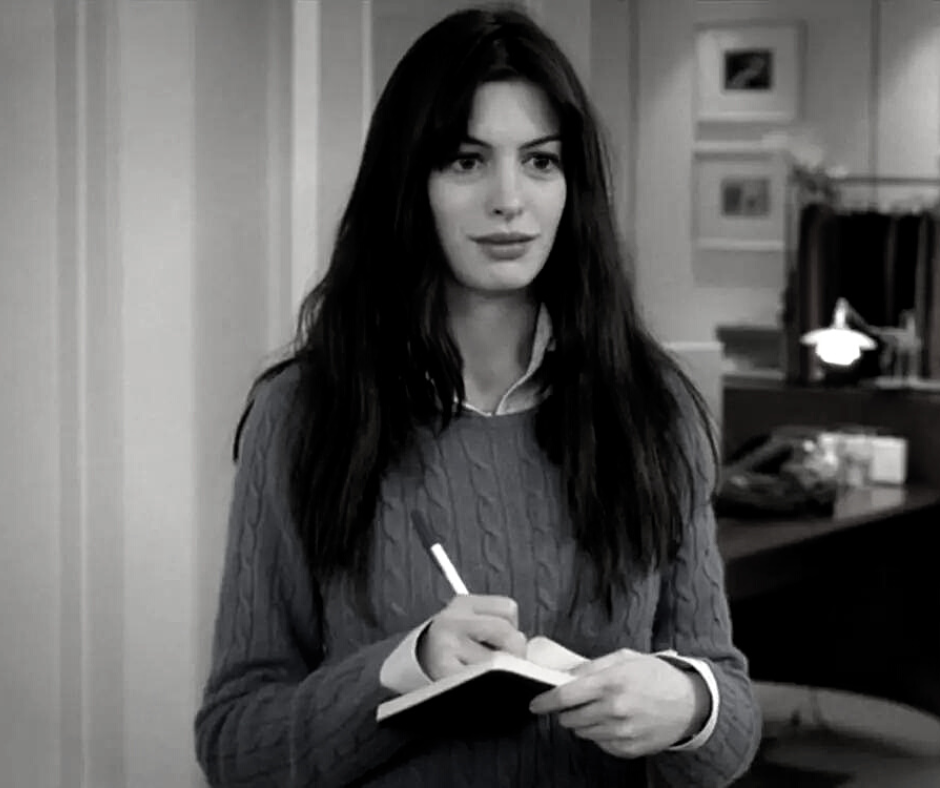
I’ll never forget the opening scene of ‘The Devil Wears Prada’. It’s a movie that shaped my perceptions and altered my relationship with myself in more ways than I’ve fully unraveled.
Andy is getting ready for her first day of work in the big bustling city of (where else) New York. She goes about it haphazardly. In stark contrast, snapshots of other New York women show up as they start their day with finesse. They look flawless as they curl their eyelashes, pick out matching undies, and check out gorgeous outfit choices in the mirror.
Cut to Andy who reaches for her cherry chapstick as she grabs her coat, and darts out door. All these girls kiss their men at home goodbye before leaving for work (cool concept I love it). The scene continues on with their commute, hailing down New York taxi cabs, briskly walking through Manhattan, only to end with all of them entering the same office building.
The song playing in the background, KT Tunstall’s Suddenly I See, became my initiation into main character syndrome. I could inject meaning and whimsy into my life just by playing that song on my iPod. It was a weapon for me. It was the song I’d listen to when I had a big day to concur. The song I used to play while wedged in a local train, jostling around with the other hapless souls condemned to commute to Lower Parel.
With the opening bars of ‘Suddenly I See’, I was not hapless anymore. I was full of hap, instantly teleported from the sticky confines of the 8:36 am Borivali slow (or Bo Slow as we called it) to an alternate realm. One free from the boisterous commuters, the incoherent station announcements, and that god-awful train horn.
I could be in a world like Andy in The Devil Wears Prada.

With the right song, every interaction becomes loaded with meaning. I no longer walked, I strutted. I didn’t daydream, I contemplated. And as I contemplated, I’d gently tuck a strand of hair behind my ear with all the insufferable nonchalance of a girl convinced that everyone in the room HAD to be in love with her.
I was given my first mp3 around the age of thirteen. It was then that I decided every scenario had to be improved with music. Walking to class, taking a shower, doing my homework, falling off to sleep, waking up – I needed to soundtrack my entire existence like some obsessive omnipotent DJ.

Vibes engineering
Music is a defining aspect of our existence. It has the power to manipulate mood, focus attention, and make us feel something tangible. It’s art in one of my favorite forms. Frankly, I often wonder what life would be like without it, and the answer is always sad. But I feel like modern culture has turned this beautiful thing into a bit of an addiction. We’re addicted to engineering the perfect vibes.
You’ll rarely see people in public (mostly in cities) without earphones. Spotify has near-perfect playlists for every moment – getting ready for girls night, quiet Sunday morning, cooking, cooking with kids, spring cleaning, rage cleaning, rainy afternoon with coffee, walking in like you own the place, sad girl starter pack, angry drives.
Apart from the occasional ASMR video, everything you watch on Instagram is probably set to music too – the trip to Europe, last night’s dinner, birthday compilations, a celebrity interview. It’s like our whole life is muted and then set to the perfect background score.

In his essay called “Always In”, Drew Austin says, “With everyone silently attending to their own auditory environment, the public soundscape will increasingly consist of fewer voices and more ambient filler and sonic exhaust from the devices themselves — phone conversations, buzzing devices, unmuted YouTube videos.”
Eerie.
For me, music wasn’t just a rejection of ambient noise, my incessant need for music was a straight up rejection of silence. Silence felt meaningless and uncomfortable. That’s probably why I’d habitually fill up spaces of quiet with sound to create the illusion of constant activity, or to engineer the vibes. I’d wander off to the beach quite often in the pursuit of peace and ‘quiet’ but invariably, I would always have earphones in. The waves sounded better with some Novo Amor song.
Your soundscape is a thing that exists
The organic, unplanned noises of our surroundings – the buzz of a city, the chaos of a coffee shop, the sound of the waves, or the heartbeat of silence – all get drowned out thanks to our private soundtracks.
As we strive to sync our lives to music, we end up trading the authenticity of an un-engineered existence for a manufactured reality. If I think back to my favorite places, like the park near my building, or the little walk from my college gates to the foyer; the ‘familiar sights and sounds’ are only familiar sights. The sounds were replaced with whatever was on my playlist at the time.

The college I attended had a fun tradition: If someone dropped a glass, the entire canteen would erupt in loud applause and cheering upon hearing it shatter. It was pointless and noisy, but it was memorable. If you heard cheering in the foyer, you knew someone had dropped a glass. It was a cascading set of events and accompanying sounds unique to that space.

Raymond Murray Schafer explored the subject of ambient sounds in his work called The Soundscape (1977). Schafer was a a Canadian composer, writer, music educator, and environmentalist, and he pioneered the discipline of ‘acoustic ecology’. For the curious, acoustic ecology is a fascinating discipline at the crossroads of science, nature, and art. It’s all about listening to the world around us.
It examines the relationship between sounds and people within a given landscape, otherwise known as a ‘soundscape.’ These soundscapes are as varied and diverse as the world we live in, from the sound of rustling leaves to a crane hauling stuff at a construction site.
Acoustic ecologists don’t just document these soundscapes, but delve deeper into how they impact and interact with everything around them, including us hapless humans. They question how man-made noise affects wildlife communication, or how a city’s sonic footprint might impact our wellbeing and mental health.

Acoustic ecology also champions the importance of silence and highlights the fascinating, often overlooked, natural and cultural sounds around us. It nudges us to appreciate these ambient soundtracks that lend a unique identity to each place, fostering a sense of belonging and connection.
I must have been about six years old when I had my first memorable soundscape experience. We lived in a building in Dubai not too far from the airport, and while playing in the park, we would regularly hear the loud, LOUD sound of airplanes flying overhead. I don’t often hear planes these days, but if I do, the first thing I’m thinking about is not my next holiday.
It’s that kids’ park in Dubai.
There’s an acoustic ecology concept that I also came across called ‘deep listening.’ It’s a conscious, attentive tuning in to what’s in your soundscape. Even ten minutes of deep listening can teach you so much about your environment. I spent a few minutes noticing the sounds in my bedroom this morning. The hum of the AC, baby babbles, our neighbour’s dog, and the many birds that call the view from my bedroom their home. I also realized that our bedroom fan is kinda noisy.
I want the sound of my home to be as familiar as the sound of the intro of Suddenly I See. I want to be able to play it back in my mind whenever I want. I think it’s a beautiful thing for the people that live in my soundscape to recognize it, like a shared experience just for us.
Earphones are an augmented reality device
While music and songs bring unity and emotional depth, it can sometimes feel like a smokescreen. The relentless pursuit of curated experiences can suppress spontaneous thoughts, emotions, or even ideas. It leaves no room for surprises because the omnipotent DJ decides what’s right for us to hear and feel.
What if the vibes are engineered but the engineer sucks? How much of our thought process is shaped by the noise around us? What ideas might have occurred to us if we weren’t listening to our sad girl starter pack playlist?
The more you think about it, the more odd this sense-modification seems. Hearing is a potent source of input, and the need to constantly deprive ourselves from the actually sensation around us is odd. It’s about as bizarre as wearing some kind of weird futuristic glasses that show you the cobblestone streets of Florence as you walk down the station platform to catch your train. Sure, it makes the commute easier but it’s not real. Putting earphones in is a conscious decision to check yourself out from your present soundscape.
To quote Austin’s essay again, “Though the AirPod experience appears strictly solitary and a matter of personal choice, the headphones in fact reshape social behavior for everyone around them, whether those others have their own pair or not,” he notes. “AirPods have externalities – penalizing non-wearers while confining the value they generate to their individual users.”
Suddenly I hear
I usually have a writing playlist (actually multiple writing playlists) that accompany this creative process, but I chose to write this piece without their aid. I was going to say that I wrote in silence, but that wouldn’t be true. I heard my noisy fan. The neighbor’s dog had his lunch. I heard baby babbles. I heard some angry birds.
If you want your life to have a soundtrack, it already does. Sometimes you may like it, sometimes you won’t, but to ignore it entirely seems harsh. Maybe millions of people can listen to Suddenly I See, but I’m literally the only person in the world hearing and experiencing this soundscape in my own unique way. It’s way better than a playlist made just for me.
I’m not suggesting a banishment of your favourite songs. I don’t think I’ll ever choose to sit in a car without music. All I’m suggesting is that we bring a little balance back into the mix. If I’m not Andy, and I don’t live in New York, and I’m not woking for the devil in Prada, and my life is not, in fact, a movie – it might be helpful for me to experience my life as it really, truly is.

Leave a Reply to “I’m Doing This For Me” and Other Beauty Industry Myths – Unfinished ConversationsCancel reply