
Hi. I hope you’re holding up okay. The world is in a bit of a state right now, and I don’t mean that in the vague hand-wavy way. I started this blog around three years ago———wait we’re in March, let me check exactly when I published my first post. Brb.
OHMIGOSH, yesterday was the 3 year anniversary of this blog. 4th March 2023. Ugh, it’s too late to do an anniversary wow-I’m-so-grateful-for-this type of essay. But I AM getting a beer to celebrate.

And also I’m not thaaaat grateful, it’s just a blog for crying out loud. I’ve stopped taking it that seriously, which is good news for everyone and especially for me. What I’ve realized about like 80% of my readers is that they love me anyway. They’re my friends. They’d be around whether I was a prolific blog writer or not.
Having said that, thank you to my regular readers. Karmarkar twins will always get a special mention don’t know why. And hi to all my new readers in (checks stats again) Ghana, Nigeria, and the Netherlands. Stay fancy. If you’ve been here from day one, message me and I’ll put you in my will. I love you guys.
Okay back to the state of the world.
Since I started this blog, the world has changed tremendously. Wars have broken out, and some of them have ended. AI wasn’t a mainstream thing, and now it is. I didn’t have a full-time job then, and now I have many, many (yay). My hair wasn’t greying then, and now it is. I was finding my footing as a new mum then, and now I really feel like I’m thriving in this role. Back then, I wrote an entire blog post whining about how I wanted to exercise but for some reason couldn’t bring myself to. Now, I’ve been consistent with fitness for a year and have fallen in love with a new sport in the process. My house is a mess as I write this, and I don’t care. Progress progress.
Enough rambling, let’s get into this essay.
Do you recognize this lion?
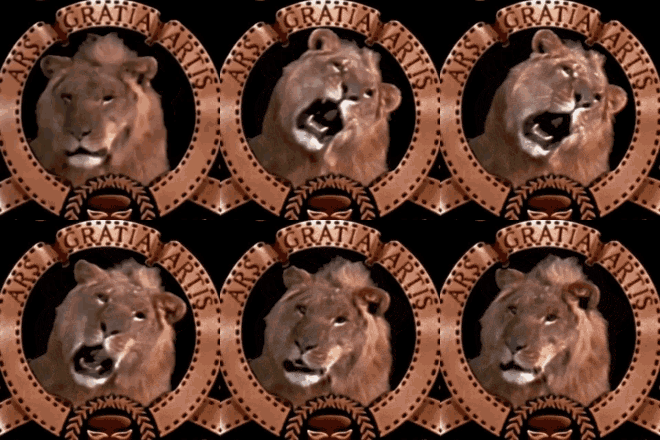
His name is Leo (filmmakers and storytellers really gave their imaginations a break with that one) Now apart from Leo the sideways-roaring lion, have you noticed the words written above?
Ars Gratia Artis: art for art’s sake.
It’s a beautiful idea. Let’s ignore the fact that it was deployed in the service of generating billions of dollars through blockbuster films because we love irony here. But it says: Art for art’s sake. The idea that some things are just worth doing, without needing to produce anything beyond themselves. That’s what today’s essay is about.
Oscar Wilde said a version of the same message sometime towards the end of the 1800s: All art is quite useless. He used this idea as a preface to The Picture of Dorian Gray, which is one of his most iconic books. And it made people really, really angry. Even angrier than Leo the sideways-roaring lion dare I say.
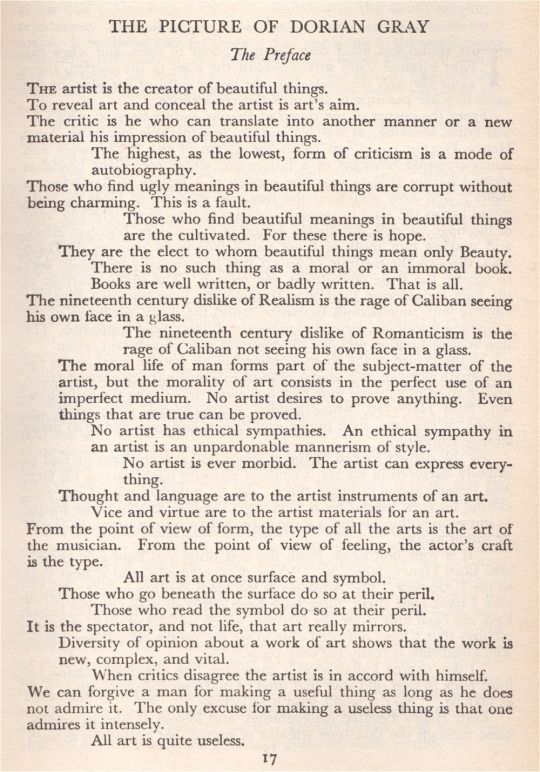
Why, though? Because back in Victorian England, people had very different expectations from art. The prevailing view was that art existed to make people more civilized.
There was a guy named Matthew Arnold (always be wary of people with two first names) who believed that literature and poetry could do the moral work that religion was increasingly failing to do. He, along with most of the elites, thought that if you exposed enough people to “the best that has been thought and said” society would become more refined and more ethical.
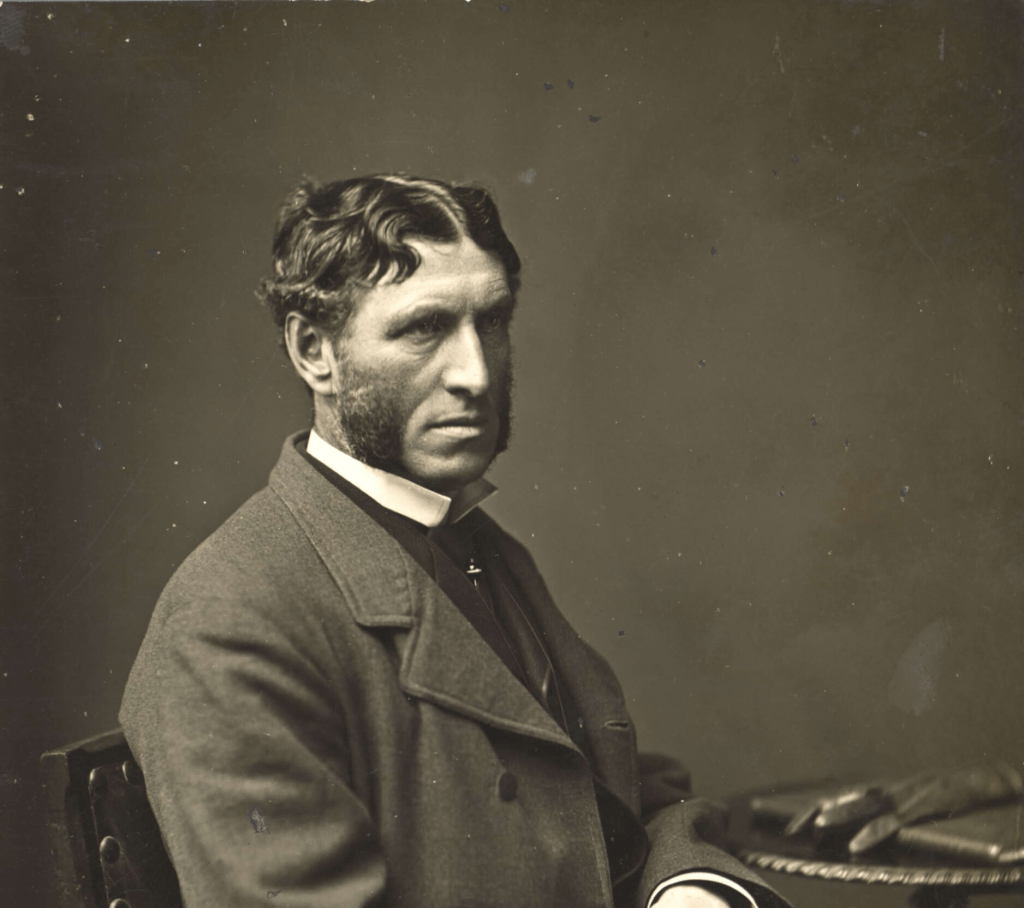
So to combat crazy loons like Oscar Wilde, Matt decided to spend his career writing very long, very earnest essays (oh no, like mine!!!) about duty and being dignified. He wrote a whole book called Culture and Anarchy, in which he divided English society into categories he called the Barbarians, the Philistines, and the Populace, and proposed that literature could save them all.
Artists back then, the great writers and painters and thinkers, were praised specifically for what their work DID to readers. How it stirred conscience, how it made you more sympathetic to the poor or more alert to social injustice. Those were the KPIs they had to work with.
Wilde found all of this exhausting and dumb so he made his work immoral (according to critics) by making it useless. His writing didn’t aim to make you better. He just wanted to make you feel something that was true.
The unsurprising ending to this story is that you’ve probably never heard of Matthew Arnold unless you have a very specific kind of arts degree. Meanwhile, Oscar Wilde’s work survived everything. People quote him constantly and often don’t know they’re doing it: Be yourself, everyone else is already taken. He has inspired more Instagram selfie captions than he could have possibly imagined.
Uselessness has extraordinary lasting power. Being boring is a far more effective way to disappear from history than being scandalous.
I think about this lion, and ars gratia artis, and Oscar a lot when I consider how we talk about the things we love now.
Walks are great for mental health.
Travel broadens the mind.
Friendships give you community.
Even the way people talk about having children. It teaches you unconditional love. It gives you perspective. It makes you a fuller person. Sure it does all of those things. But if you’re talking to someone about their decision to have kids and they said: for the perspective gains, it would sound really strange.
Since we’re talking about things we love (actually I think it’s the beer talking now) let’s discuss food for a second. At some point between genuinely caring about nutrition and having access to unlimited information about it, eating has become a series of decisions. Is this enough protein? Where are my macros? Am I eating this because I’m hungry or because I’m emotional? Food has always been sustenance, yes, but it’s also been one of the oldest and most reliable sources of uncomplicated joy. And this is a category that’s getting harder to protect. We need Leo the lion to intervene like yesterday.
This is why I’ve developed a completely indefensible soft spot for smokers. A smoker is currently one of the last people on earth engaging in an act of pure unoptimised pleasure with absolutely NO pretence that it is doing anything good for them. Nobody lights a cigarette and thinks—ahh this is doing wonders for my cortisol—no. They just smoke because. In the current landscape, this is almost philosophically radical.
Rant over, and also, beer over 😦
Last Saturday, I visited a Montessori school. My daughter is three and a half so I thought it meant I had a comfortable runway before schooling became a serious thing to think about. I was wrong.
Since she already goes to a Montessori playgroup, this wasn’t entirely new territory. I’d watched her trace sandpaper letters with her finger, and I’d seen the little activities and the pouring and the general air of very small people doing very important work. It’s lovely.
So anyway, I went to visit last weekend.
Here’s some context before I describe the actual school, because I think it matters. Most of the schools we know and went to were designed during the industrial revolution believe it or not. In the mid-1800s (a little before Oscar Wilde but around the same-ish time) England introduced compulsory mass schooling. This was the structure they landed on: fixed periods, bells, rows of children doing the same thing at the same time, graded and ranked and moved along in batches.
It was meant to mirror quite deliberately what happened on the factory floor. Children arrived at a certain time, were processed through standardized content, and were evaluated on how much useful output they could produce.
The explicit goal, stated plainly by the politicians and industrialists who funded it, was to create a literate but obedient workforce. People who could read instructions, follow a schedule, and be productive. Not people who were curious or self-directed or interested in things for their own sake because obviously that would be a problem on an assembly line.
This system spread across the world and became so normal that we stopped noticing it was a design choice at all. It just became what school is.
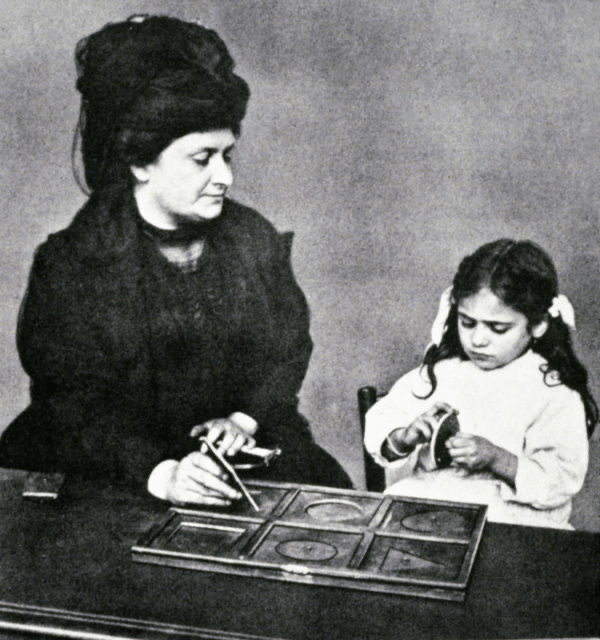
Maria Montessori opened her first school in Rome in the early 1900s, so right in the middle of this factory business, and she basically said what if we didn’t do any of that stuff? Also, she was a smoker hehehaha.
She worked initially with children in the slums of Rome, kids who society considered impossible to educate. Children with disabilities were included in this group too. She saw that when you gave kids the right environment and GET OUT OF THEIR WAY, they actually wanted to learn. Not because you rewarded them for it or punished them if they didn’t, but because children are just naturally curious before you train it out of them. And so they like to learn.
Here’s what I saw at this small and weird little school. Everything is miniature and positioned super low. The shelves, the tables, the chairs, and all the stuff is neatly laid out and it feels like you’re stepping into a small museum. Small trays and baskets holding a bunch of knick knacks. There’s a little mop, a tiny broom and dustpan. All of it looks like playing house but for grannies.
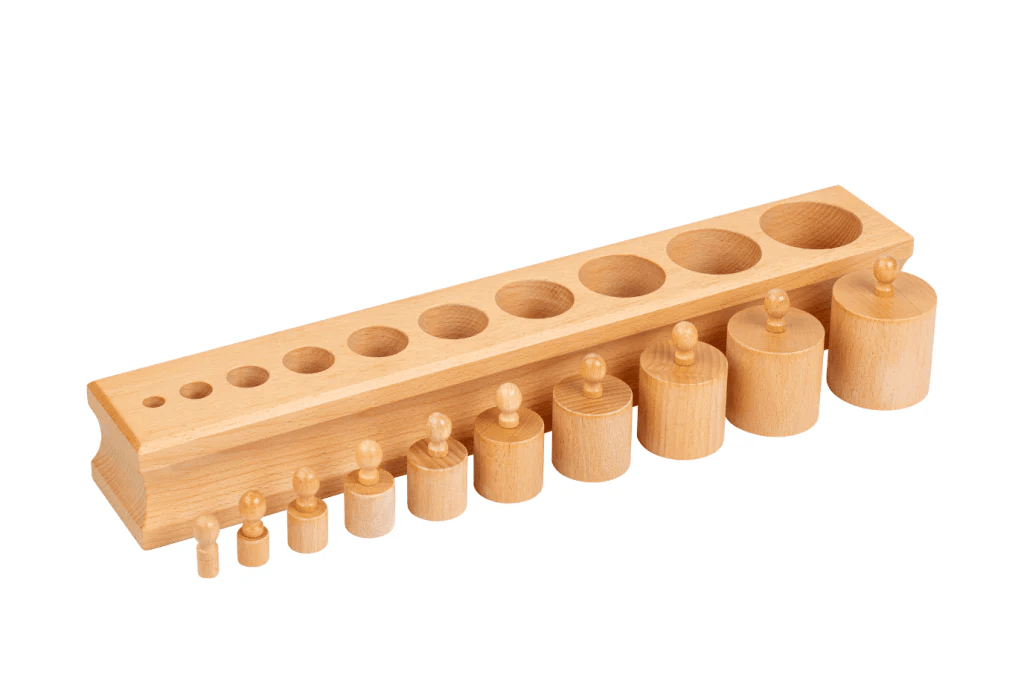
One section had wooden cylinders of varying heights and diameters that fit into corresponding holes in a block. If you place one in the wrong hole and the remaining cylinders won’t fit. There’s no red mark, and nobody to tell you that you did it wrong. The wrongness is just there in the fact that the last cylinder has nowhere to go, and you work backwards until you’ve figured it out.
I got to the math section, which is where I lost my mind a little bit. Most of us learned numbers the way we learned most things in school: Someone said IT IS, and therefore, it was.
1 means one thing, 10 means ten of them, and 1000 is a lot. The numbers with their symbols came first and the understanding (if it came at all) arrived later. Which is why so many people carry a vague, low-level anxiety about numbers their whole lives.
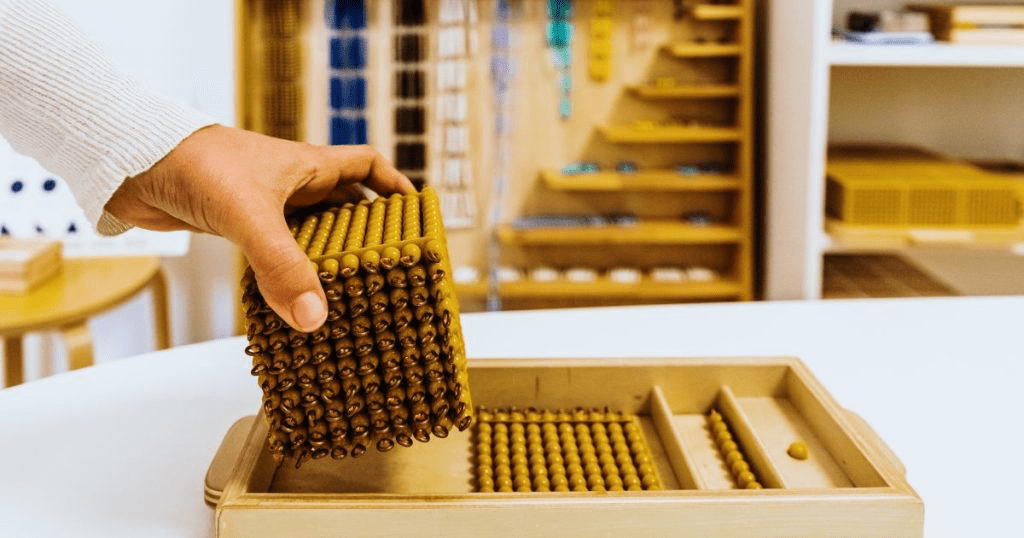
Here, the math section had a bunch of golden beads. They were arranged as single units, then bars of ten, then squares of a hundred, then cubes of a thousand. A child who wants to understand what a hundred or a thousand is doesn’t get told. They get handed the cube. They feel the weight of it.
They can lay out ten hundred-squares and watch them become the same thing. They can compare a single bead to the cube and understand in their hands what it would take to count from one to the other. The quantity is real before it becomes a symbol. And thennnnn the symbol gets introduced as a convenient shorthand for something the child already physically understands.
The idea is to for you to understand the concrete or the tangible before you understand the abstract, and it sounds obvious when you explain it that way but almost NOTHING in conventional schooling actually works like this.
We hand children abstractions all the time in the form of numbers and rules and ask them to trust the concrete reality behind them. I felt very happy holding that little golden bead cube, and I think it’s safe to say I’m now gearing up to be an insufferable Montessori mama.
I’ve been thinking a lot about that Saturday school visit as I thought about this essay. Not because Montessori education is “useless” in an Oscar Wilde sense (I think it takes itself TOO seriously perhaps). Oscar and Maria aren’t making identical arguments. But they’re both pushing back against the same assumption that the way to get someone to value something is to attach a consequence to it.
Oscar said that consequence corrupts art. Maria said it corrupts learning.
So they both said that treating an experience purely as a means to a future outcome suckssss big time (their words not mine).
Leo the Lion is getting pissed and would like to know where we’re going with this. Fair ask Leo.
We talked about Oscar, and art being useless, and some guy with two first names who divided all of England into three categories of idiot. We dunked on people who care about protein and we praised smokers. We described a school full of tiny furniture in painstaking detail and the underlying subtext is that I’ll be paying a lot of school fees but here’s the common thread: What happens if we stop asking things to be useful? Art has to improve you. Food has to better you. A school has to produce a particular kind of child at the other end.
I don’t think the solution is any grand rejection of purpose, and if it were, I’d be the last person qualified to make that argument. I have always worked a frankly unreasonable amount, I like achieving things, and I have never really lived a “slow life.” It’s not for me any time soon. This is not an essay written by someone who has opted out of ambition.
BUT I do think that there’s a version of going for a walk where you’re just walking, and a version where you’re getting your steps in. A version of a meal where you’re eating, and a version where you’re tracking it. They look identical from the outside but trust me, they’re not the same experience at all.

Alysa Liu, the figure skater all over your Instagram feed, basically lived this out in public. She quit the sport when it became purely about outcomes, came back when she found the joy in it again, and then had her best results. At just 20, she won an Olympic gold for it, something that no American had achieved in her lifetime!!
This is either a lovely story about following your heart or a very inconvenient data point for everyone optimizing their way through life. Probably both.
Oscar Wilde calling art useless was the highest praise because he meant something precise by it. Could it be that you’d sit with a beautiful thing and feel something, and then walk away no better equipped to be a productive member of society? Wilde’s answer was essentially: yes, and so what?
Art could be useless in the same way a piece of music that brings you to tears is useless. The way a good sunset is useless. The way that me learning boxing at 32 knowing I’ll never set foot in a ring is useless. The way that playing shop-shop with my toddler is useless.
We’ve spent a long time now asking everything to justify its existence. I wonder genuinely what we’d find if we stopped. Probably nothing useful at all, and also probably everything that matters.
 Unfinished Conversations
Leave a comment