
It’s my daughter’s third birthday.
I’m spending my Tuesday morning at her playschool instead of tackling the mountain of emails that have somehow managed to find me well.
Her school has this thing where parents can come in and conduct an activity with the class. It’s meant to get parents involved in their kids’ school lives, and it gives kids a chance to show off their parents to their friends. I presume this is a brief window of opportunity before we become deeply embarrassing to them.
I planned to do a cupcake decorating activity with thirty kids because I’m nothing if not delusional about my own competence. But since I also occasionally know my limits, I called for backup. My husband and his sister joined us for the occasion. We showed up early. Unlike the usual drop-off where we stay firmly on the parent side of the door, this time we crossed the threshold, took off our shoes, and stepped onto the mat. All three of us adults looked visibly nervous for reasons I couldn’t explain.
The morning light cut through the window and made all the primary colors and artwork in her little classroom look even brighter. There were paintings and cutouts everywhere, and cubbies filled with toys and puzzles. My husband sat on a chair built for someone a quarter his size, his knees nearly touching his chest. We watched two- and three-year-olds flood through the door in waves of cartoon character T-shirts and crocs.
Each one needed their own specific ritual upon entry. One needed her mother to crouch down, eye-level, and talk to her. Someone else dumped their bag on the floor and ran in. Another one hovered at the entrance until one of the teachers commented on her outfit. The teachers moved between them easily, meeting each need as it came up. I’m struck by how much emotional labor goes into just getting a bunch of toddlers through the door.
I’m still nervous, but nobody cares because it’s cupcake time baby. Let’s go!!! We line some of the tables with paper towels to minimize the mess, and quickly lay out the stuff we need to decorate the cupcakes. In my head, we’re running with the efficiency of an F1 pit crew. The teachers take one look at us and immediately start helping, which tells me we’re not.
Three bowls of icing for each table: red, blue, green. Smaller bowls with an assortment of sprinkles and butterflies. Different shapes, colors, sizes.
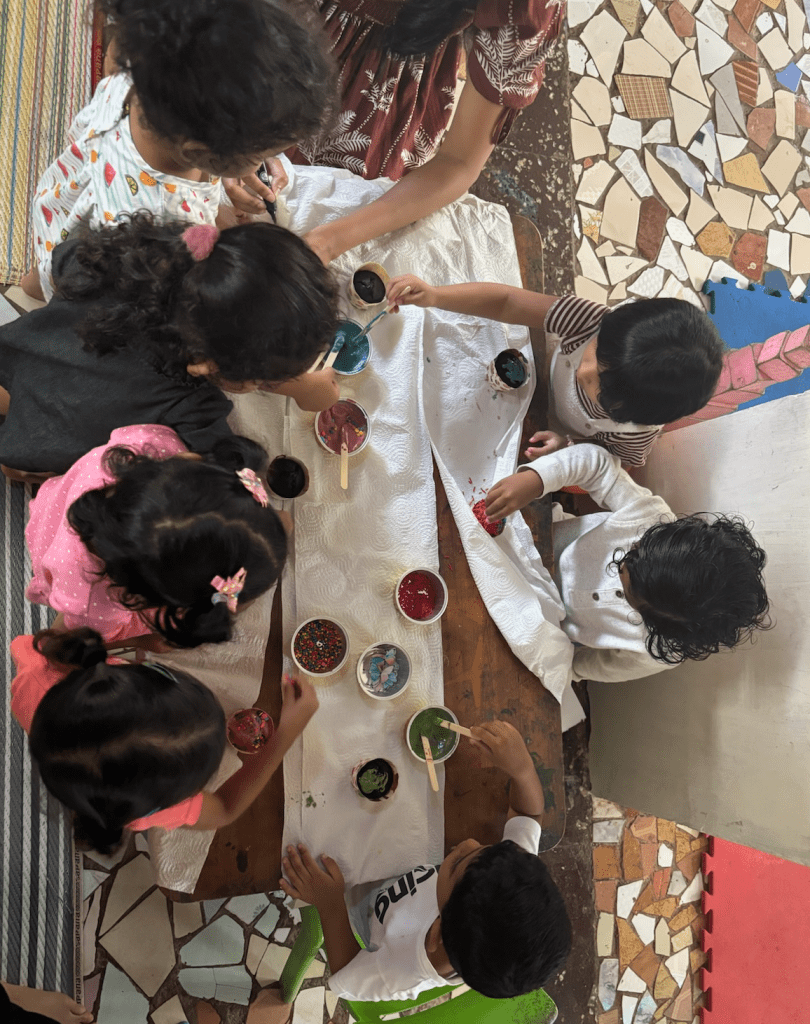
The teachers, once again in their infinite wisdom, send kids out in small batches of five or so to decorate cupcakes. The three of us split up and pick our groups. I sit beside the kids that look the least intimidating. Each child gets a cupcake and a wooden ice cream stick to spread the icing with.
My daughter and I had done a practice run at home the day before, a sort of feasibility assessment. Because of that, she hovers around and gives her friends instructions. “You have to do the icing first.” None of her classmates seem to mind, or listen. One girl dumps sprinkles straight onto the plain cupcake and I let it happen. There’s no moral authority here.
A boy methodically covers his cupcake in so much icing that it becomes structurally unsound. Another girl asks for purple icing. We don’t have purple. But I, being a woman of science and hubris, decide that we will handle this using the laws of color theory. I mix red and blue icing and instead of purple, there’s a gloomy shade of grey. There’s your purple!!! I say, trying to drum up some excitement.
She stares at it, weighing whether she can live with this compromise. She decides she can, but I see her clock the gap between what she wanted and what she got. Welcome to being alive, sweetie.

Meanwhile, the little guy is STILL packing on an ungodly amount of icing onto his cupcake. He has created exactly what he set out to create, which is chaos. I respect it. Within half an hour, all the kids have had their turns icing cupcakes, and their creations are neatly laid out on a tray. The kids move onto activity tables while my ragtag F1 pit crew and I pack up the frosting leftovers. Somehow we’ve survived.
It’s snack time now. The three of us have to choose between fleeing the scene or sticking around. We decide to stay, but we split up again and gravitate toward the kids we already know, because making new friends at any age is terrifying. Also, some of these toddlers have strong leadership energy that I’m not equipped to handle.
Our job here is to be professional naggers.
Next bite, come on!!! Chew your food. No dreaming. Finish what’s in your mouth. Next bite. Come on, hurry up, eat fast so you can play outside. Okay not too fast, chew your food properly.
One by one, kids finish their food, and present their full tummy and empty(ish) tiffin to their teachers, who shower them with validation for doing such a good job eating, and put their tiffin in each kid’s bag. Some tiffins have names, others don’t. Some bags do, others don’t. None of it matters. The teachers move through the chaos, slotting the right tiffin into the right bag every single time.
Now, it’s playtime. Outside on the playground, the dynamics shift. Some kids cluster together right away like they’ve already got their people figured out. Others kind of hover around the edges, waiting to be invited in. Everyone’s in the same space, finding things to explore and examine. There are caterpillars to inspect, rocks to collect, leaves to look at, and a mini trampoline that everyone wants a turn on. Some kids form a small cluster near the big tree. There’s an imaginary ice cream shop there.
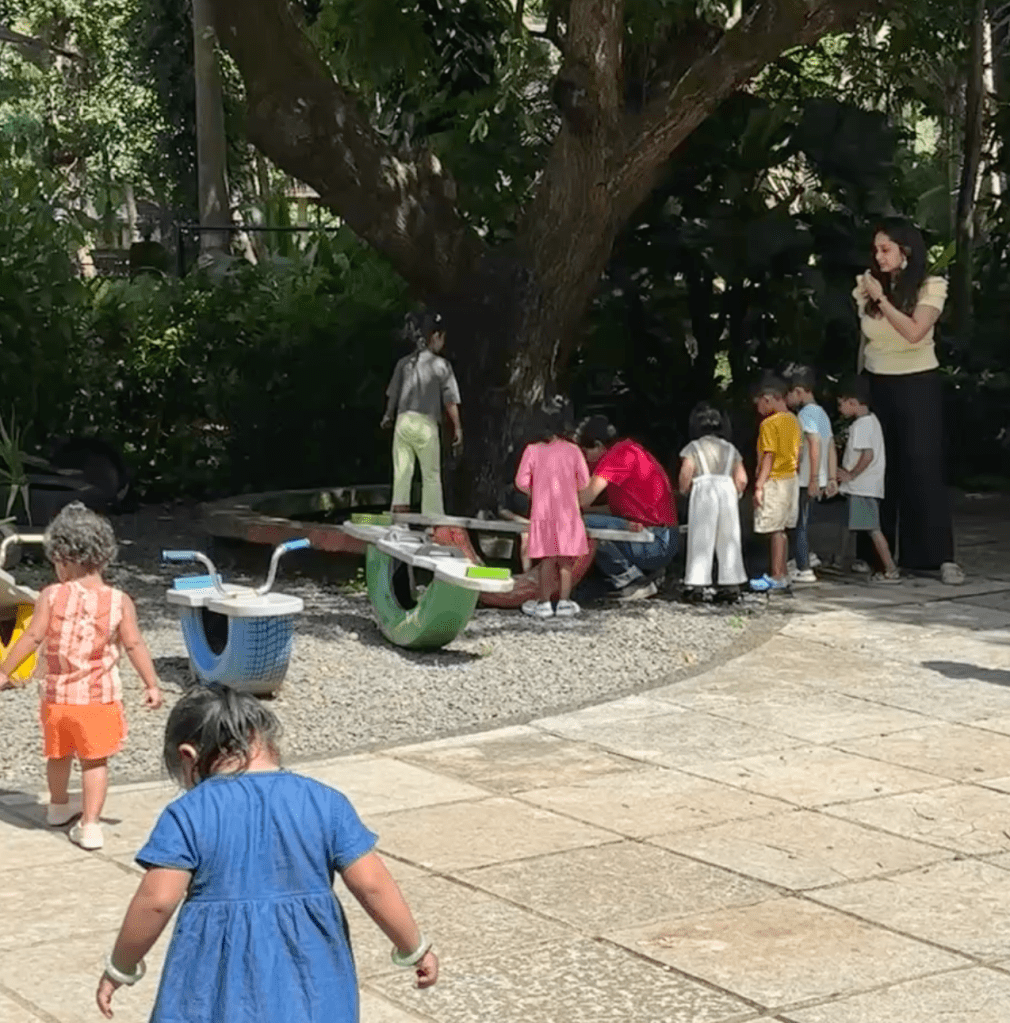
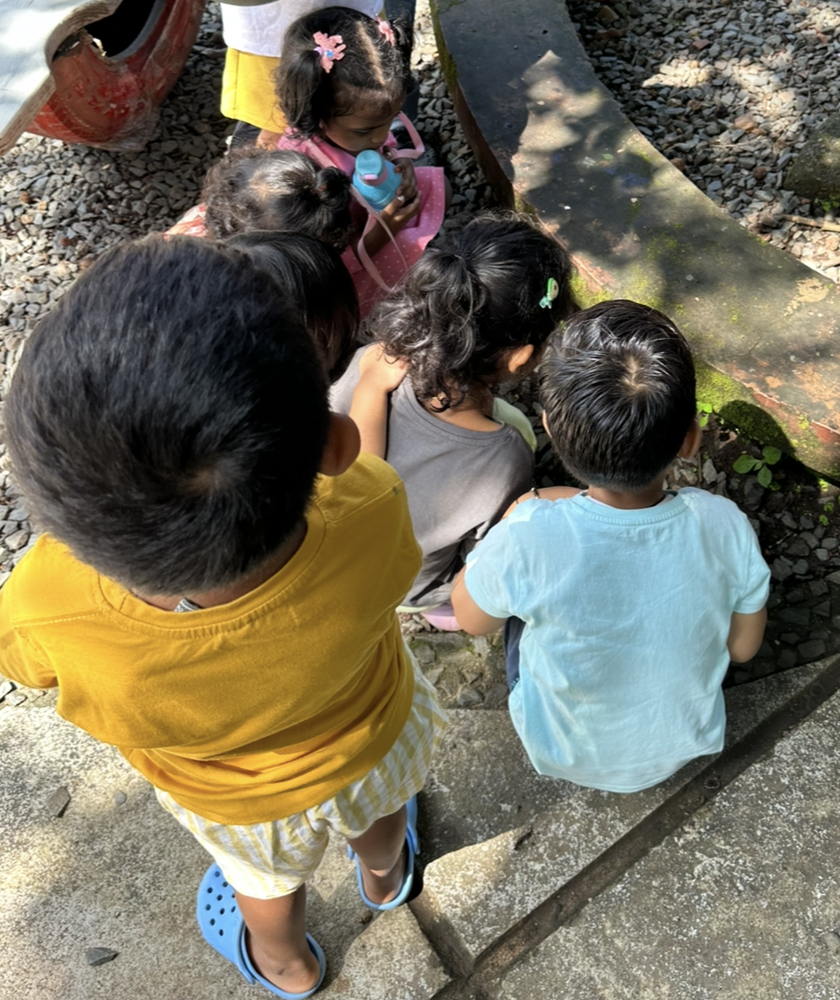
My daughter and two other girls are playing some game I can’t quite track. There are rules I don’t understand, and negotiations happening in half-sentences. There’s a lot of pointing. At one point one of the girls runs off upset, then comes back two minutes later and everything is fine again. The emotional weather of toddlers moves fast.
One of the teachers steps out into the playground and announces that it’s time for water. Like a bunch of parched gazelles, the kids all come running over and grab their water bottles to quench their thirst. It’s nearly time to come back inside, so they line up at the sink. Each child washes their hands and then holds their dripping hands up to a teacher’s face for inspection. Smell my hands! Smell them!!!!!!
The teacher dutifully smells countless pairs of small hands and confirms that yes, they smell lovely, very clean, wonderful job. It amuses me that they need someone to witness even that.
We enter the playroom again, but silently this time. There’s soft instrumental music playing in the background. It’s quiet time. It’s like the room finally exhales, and everyone plops down on the mats. My daughter immediately drapes half her body over another kid because the concept of personal space has not yet made its way into her operating system. A teacher walks over and gently relocates her.
The three of us adults look around, unsure of the etiquette. Ahh what the heck, might as well find our own corners and lay down on the mat along with them.
The kids are supposed to rest, not sleep exactly, just be still for five minutes. You can tell that some kids are exhausted. Others stare at the ceiling, fidgeting, their little bodies are incapable of stillness. My daughter gets up and comes to lay next to me on the floor.
She doesn’t say anything, just curls against my side, and I feel the weight of her settling in that particular way children settle when they’re exactly where they want to be.

The instrumental music fades out, and the spell breaks. Everyone sits up. It’s singing time now!!! Each child takes a turn standing in front of the class to sing a nursery rhyme, earning a sticker of their choosing as payment for their courage. Some go up solo, some in pairs.
Some kids ham it up, throwing their arms wide, singing louder than everyone else. Some kids just freeze and stand there while the class sings around them. My daughter goes up and sings the alphabet song with these little hand motions that I’ve seen her practice at home. I watch her watching everyone watch her. I can see her trying to hold on to her confidence, balancing the thrill of being seen with the discomfort of it.
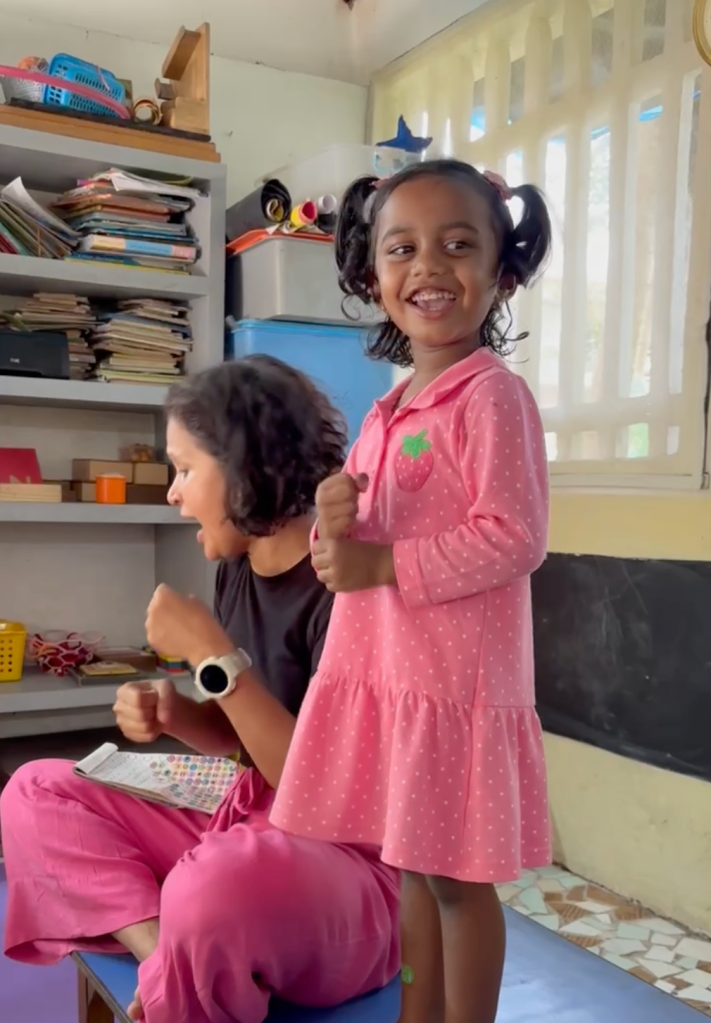
Since it’s her birthday, she gets to hand out chocolates to everyone. I’ve never seen her more sure of herself in my life, marching over to each eager child and handing them a chocolate. I’ve never seen so many kids fight to make eye contact with her. It’s a power trip and she knows it.
Everyone gathers around a table for the mini-celebration. We stick a candle into one of the undecorated cupcakes, which is an unassuming stand-in for the real cake, and the teachers do a quick safety briefing. No hands on the table. No blowing out someone else’s candle. Everyone nods, and then we sing.
She looks around absolutely beaming as everyone does their best rendition of happy birthday. There’s so much joy on her face. The teachers quietly hand her friend something. Give this to Sierra, they say. It’s a beautiful handmade birthday card for her. She accepts it like it’s a piece of treasure, and it kind of is. It’s up on my fridge as I write this.
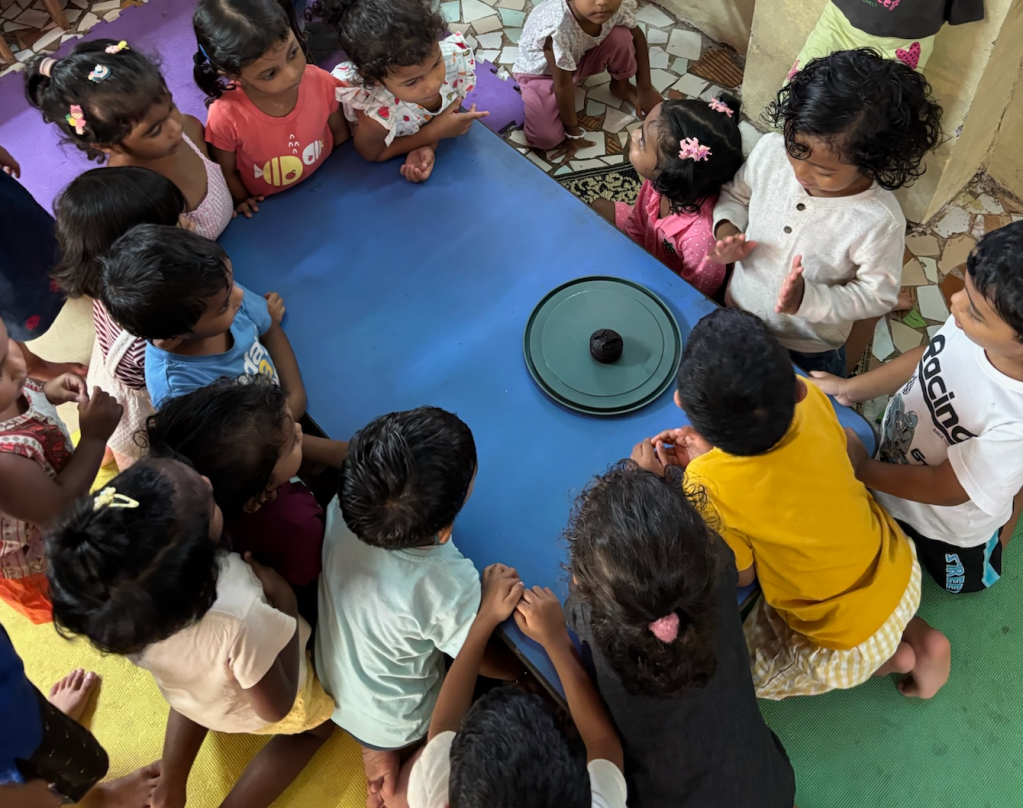
After the singing and chocolate distribution, the day begins to wind down. Cupcake icing feels like it happened two lifetimes ago. Time does this weird thing when you’re with toddlers where every minute stretches out forever but also, the whole day disappears in a flash.
One by one, parents appear at the door. Kids start collecting their things. Shoes are reunited with the wrong feet. It’s all done.
I say hi to some of the parents as we head out, and I recount some parts of the day. “Must be nice. Not a care in the world.” one of them says, and I agree. That’s what we all say when we watch small children exist in their small universes. The shorthand for what we think childhood should be.
But in the car later, I keep thinking about it.
Not a care in the world.
I just spent the entire morning watching these kids care about everything. Kids have cares, urgent, all-consuming cares. They just don’t overlap with our Venn diagram of RealProblems. I think about their teachers, who are truly doing God’s work, managing the ONE segment of the human population with no tools to handle any of their cares alone.
Kids don’t know they’re supposed to be carefree. Kids don’t know they’re supposed to represent innocence.
Kids care whether their cupcakes had the sprinkles they wanted. They care about what their drawing looks like. They care about being picked, being noticed, being told they did well. They care about their hands smelling soapy enough after washing. They care if anyone will play with them outside, if their turn will come during song time, if they’ll be brave enough to stand up in front of everyone and remember the words. They care if the teacher notices their effort. They care if they get the right sticker, and they care if that sticker accidentally falls off on the drive home.
These concerns aren’t small to them. They’re everything. Their world is exactly this size right now, and these are the worries that fill it. They’re not performing some perfect childhood for us to gaze at longingly. They’re just living at the scale they’re capable of living at. And to them, whether they get to play ice cream shop and be the shopkeeper is a real problem that occasionally requires intervention from real adults.
That day, I thought about what my daughter’s birthday represented to me, and how I felt about the milestone. All through her day at school, my mind kept coming back to a particular verse in the Bible. Jesus is talking to his closest friends, and they’re clearly stressed and afraid. He’s trying to calm them down, trying to give them something to hold onto. He says: are not two sparrows sold for a penny? Yet not one of them will fall to the ground outside your Father’s care. Even the very hairs of your head are numbered. So don’t be afraid, you are worth more than many sparrows.
I’ve read that verse a hundred times. It’s meant to recalibrate our fears. To tell us: the cares you’re carrying, you’re holding them in hands that aren’t big enough. These sparrows are barely worth a thing, and yet there’s someone watching over them. So relax. You matter more than sparrows, and I’m watching over you.
But sitting here with these three-year-olds, seeing them care so deeply about so many things, I wonder if I’ve been understanding this message incorrectly. Or incompletely.
Because the sparrow doesn’t know it’s worth almost nothing. The sparrow has no idea it’s small. The sparrow is just falling, and in that moment, falling is the entire universe. That’s all there is.
The sparrow’s not sitting there thinking: well, at least my problems aren’t that big in the grand scheme of things. The sparrow has its cares, sparrow-sized but absolute. The dumb lil guy is trying to find food, avoid predators, and survive the day.
And it’s the same with us. We’re always at capacity. Always carrying what we’re capable of carrying. We take our many cares and fill whatever container we’re given. Give a 3-year-old a 3-year-old’s life and they’ll fill it completely with 3-year-old problems. Someone took their toy. They didn’t get TV time. Their sibling pushed them.
Give a 30-year-old a 30-year-old’s life and they’ll fill it completely with 30-year-old problems. Career’s stalling. Your friends seem to have a better life than you. Timelines that you set for yourself feel unattainable. Money’s tight. The world is in disarray.
Give a 70-year-old a 70-year-old’s life and they’ll fill it completely. Mortality. Sickness. Did any of my striving matter? What happens now?
We’re all just convinced we’ve finally arrived at the level where our problems are legitimate.
I’m amused at the idea of someone looking at our lives the way we look at these kids. Wow, so carefree. I’m thinking about God watching us lose our minds over our problems, seeing us spiral and thinking: they’re so worried. They have no idea how small this truly is. They don’t know what I know. And that could sound patronizing, right? Like our problems don’t matter. Or like we’re being dramatic. But I don’t think that’s it at all.
Because the verse isn’t saying that our worries are stupid or invalid. Or that we’re wrong to care. It’s saying that we aren’t carrying any of this alone. That someone’s paying attention. Someone sees our cares. If God’s paying attention to sparrows with their sparrow-sized concerns, then he’s paying attention to us with ours.
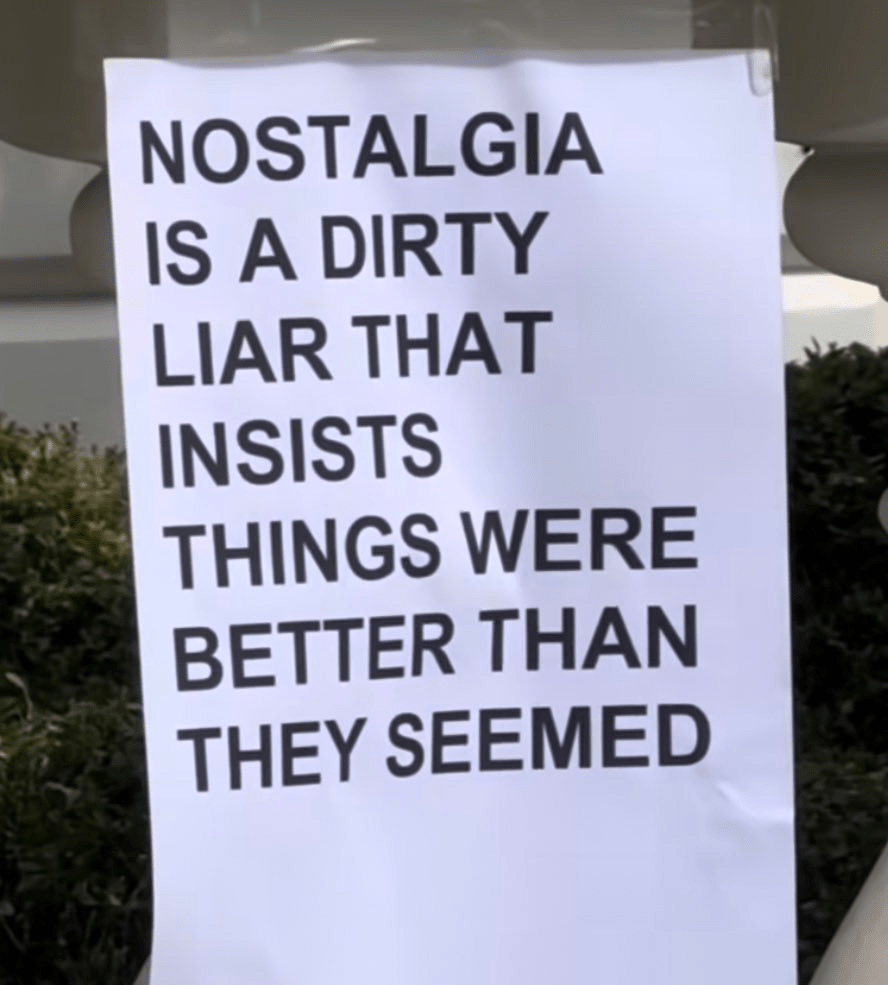
This part of the essay is about nostalgia
I think we’re only capable of being carefree in hindsight because nostalgia is a ~~~liar~~~ and somehow we still fall for it.
Nostalgia will literally take the raw footage of your life and run it through a filter that warms everything up, edits out all the parts where you were just as lost and scared as you are now. And then it plays it back and tells you: see? You were so happy then. Those were the good days. Why can’t you be that happy now?
But that’s a lie. Even with an amazing childhood and a wonderful family and all my needs met, I wasn’t carefree at seven. I was just worried about different things. About whether the other kids liked me. Whether I was smart enough. Whether I was the right amount of everything. I spent so many of those “golden” days longing for whatever came next—the cooler school uniform that came with being in a higher grade, for permission to go out alone, for the moment when life would finally start for real. I was living the same way I’m living now: trying to get through today while worrying about tomorrow.
Nostalgia forgets this. It tells me those were the best days, as if the younger version of me had some kind of peace that I’ve somehow lost. But I didn’t. I was just as uncertain then as I am now.
But I’d be remiss not to mention this—it’s a privilege to get to misremember your childhood as simpler than it was, instead of remembering it exactly as hard as it actually was.
Every time someone says “kids are so carefree” part of me is just grateful they get to believe that. That whatever they went through as a kid was unimportant enough to fade into something soft and manageable in retrospect. Not everyone gets that. There are many people in my life who love my daughter fiercely, and I know part of why they show up for her the way they do is because they’re determined to give her what they didn’t get.
They’re contributing to the kind of childhood everyone should have—the safe one, the easy one, the “carefree” one. And I love them even more for choosing to build something they never had instead of resenting those of us fumbling through relatively easy problems. It’s lucky, getting to lie to yourself about the past. I don’t take that for granted.
The word “remember” literally means to put back together. Re-member. To take all these scattered pieces of who you were and integrate them into who you are now. Make yourself whole. That’s what memory is supposed to do—connect all your past selves into one continuous person.
But nostalgia doesn’t re-member you. It does the opposite. It takes the real, complicated person you actually were and replaces it with someone simpler. Someone who didn’t actually exist. So instead of putting yourself back together, you just end up more fractured because now you’re carrying around this completely fictional version of your past self.
In ten years, nostalgia will work its magic and feed me back a heavily edited version of this day. It’ll tell me these were the ***best years***, that everything was love and laughter and magic, and that I should have appreciated it more. It’ll forget that right now I’m worried about whether I’m a good parent, whether I’ll have another baby, whether my career is going anywhere, whether there’s still time to become whoever I thought I’d be.
Instead of remembering all that, I’ll look back at 32-year-old me with the same tender, condescending misunderstanding I have for every younger version of myself. Poor thing. She had no idea how good she had it. She was so worried for no reason.
I can literally see this scam coming my way and I still can’t stop it from happening. It’s a great system that we’ve got going.
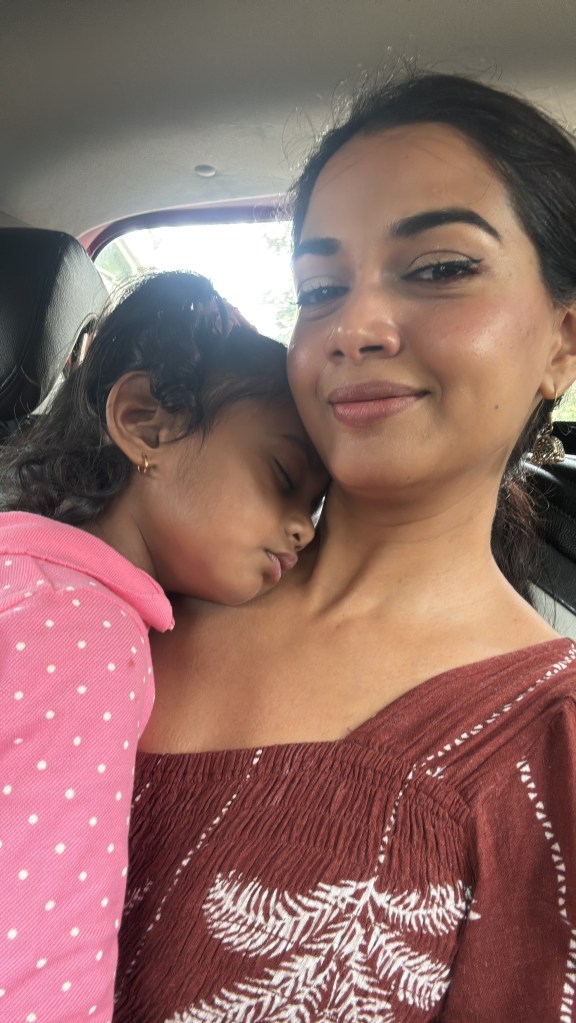
My daughter is on my lap. She’s sticky, sweaty, and fast asleep. In a few years she won’t remember today. She won’t remember her third birthday, the sprinkles, the singing, the way she marched around handing out chocolates like she owned the place. It’ll be gone. Another piece that doesn’t make it into the puzzle of who she becomes.
I think that’s why we call children carefree. Not because they actually are, but because we need to believe WE once were. We need to believe there was a time when we weren’t like this. When we weren’t constantly second-guessing ourselves.
My daughter will grow up and do the exact same thing. She’ll look at photos from today and construct a story about how easy she had it. She’ll have forgotten how much she cared about all the things that growing people care about. She might replace it all with some warm version where she was always happy and unburdened, and I was endlessly patient, and we were all just floating through golden years.
I think that’s exactly what I’m trying to accomplish. If she gets to lie to herself about how easy this was, that means I gave her something worth mis-remembering. Let her forget the hard parts. Let nostalgia do what it does. If she only remembers the warmth, maybe I did my job well.
Our car pulls into the building compound. I carry her up two floors. Three is heavier than two. Four will be heavier than three.
The sparrows are still out there, falling and flying ,and falling and flying. So are we. The caring doesn’t stop, and I’m not sure it ever does.


 Unfinished Conversations
Leave a comment