This essay is about a brief stint I had in the slam poetry circles of Mumbai, exactly a decade ago.
I was 21 and this guy that I was casually seeing told me that he wrote poetry. Oh wow, I said. Show me! That’s the only correct response when someone tells you they do anything creative. Whether it’s poetry or singing or writing stories or burping the alphabet. Wow, show me.
And he did. I wasn’t sure what to expect, but it was actually really good. I hadn’t done much writing back then, but I’d always loved words. Since poetry felt completely out of reach to me, I stuck to safer things like pointlessly long Instagram captions.
When he invited me to a slam poetry event hosted by a Mumbai-based collective of artists and poets, I said yes. I walked into this room that had wooden flooring and no chairs. It was dimly lit with fairy lights that cast a warm glow on the people that were scattered in little cozy groups.
Everyone looked effortlessly artistic in a way that I’d always envied. Interesting haircuts, cool clothes, some outside smoking cigarettes. I felt both intimidated and fascinated. I sat in the back, trying to be invisible, and within minutes I was completely drawn in.
If you’ve never been to a slam poetry event, it’s nothing like the quiet, polite poetry readings you might imagine. There’s a raw theatricality to it––part confession, part performance art. Every person who went up had their own style, their own way of delivering words.
Some almost sang, others practically whispered. But the real magic was how the audience responded––instead of clapping, which would break the spell between pieces, people would snap their fingers.
Snap snap snap snap snap.
The first time everyone snapped after a particularly good line, I got chills.
The whole thing had its own unwritten rules, its own culture. People would share the most intense parts of themselves––heartbreak, depression, family trauma, sexuality, politics. But especially heartbreak. So much heartbreak. And every brave baddie who got up there was met with those gentle snaps of appreciation, like rain on a tin roof.
I left that first night feeling like I’d discovered a hidden world right in my own city. I followed their Facebook page immediately, started showing up to every event I could find. I’d rush there straight from work in my office clothes, feeling like I was living a double life.

We’d gather in these small venues in little gullies around the city, fairy lights mandatory, often with someone strumming a ukulele between performances. People would usually be sitting on the floor, leaning on each other both literally and metaphorically.
Making friends there was surprisingly easy. The vulnerability of performance created instant connections. After someone finished, I’d tell them how brave they were, how well they wrote––and I meant it. Despite looking like extras from an indie art film, these people were genuinely kind and openly supportive in a way that felt rare and precious.
After a few weeks of being a devoted audience member, this girl with perfect winged eyeliner suggested I try performing. “Just talk about your life,” she said, making it sound so easy. And because I was young and easily swayed by people with good makeup skills, I agreed.
Finding material to write about wasn’t hard. I spent my days at a cancer hospital working on clinical trials with stage 4 breast cancer patients. Death and mortality were my constant companions hovering over my excel sheets and consent forms. I had plenty to say about all of it.
So I found a concept I could work with, and wrote my first spoken word poetry piece.
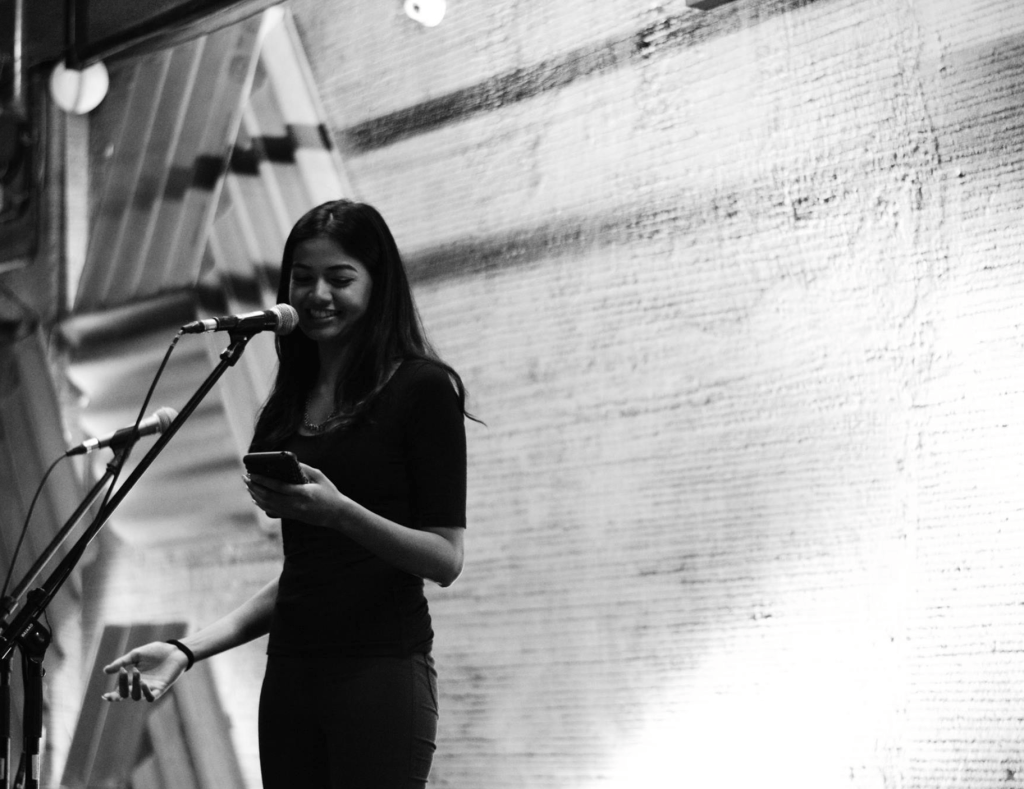
As fate would have it, my first performance wasn’t at one of our cozy little gatherings. No fairy lights or sitting on the floor. Instead, it was at Khar Social, a proper bar with a stage, stage lights, and a sound system. And a photographer.
I got up there with my phone, Google Keep open, hands shaking so badly I could barely read my own words. My face was doing this weird twitchy thing it does when I’m terrified.
Deep breaths between sentences. Trying not to get teary or choked up. At first, I could barely hear the snaps over my pounding heart. But then they got louder.
Holy crap, they actually liked it. I walked off stage to genuine applause and collapsed next to Eyeliner Girl, who was all like YOU WERE AMAZING, and I believed her. I was hooked.
After that, I wrote constantly. I tried turning every thought into potentially profound material. I was desperate to recreate that feeling. But there was a problem: I’d set myself up as this deep, profound voice talking about deep and profound things. How do you follow that up? Enough sad things hadn’t happened to me yet.
My life was pretty good. Loving parents. Financial stability. Great friends. Generally well-liked. The biggest challenge I had growing up was my moustache and even that was no longer an issue thanks to Dulhan Beauty Parlor. So what now?
You must know that 2014 was a strange time. This was peak Sad Girl™ era. I wasn’t on Tumblr, but life was fairly Tumblr-fied. I knew the language of performed melancholy. So I tried to dig deeper, be sadder, find the darkness. I wrote new pieces dripping with manufactured angst.
They were so, so bad.
And naturally, every time I thought about performing them, something felt off. The words sat heavy in my mouth like lies waiting to be exposed. There’s something particularly cringe about pretending to be sad when your biggest problem is having too few problems.
Around my sixth or seventh slam poetry event, I knew my time there was up. The fairy lights still twinkled, the snaps were still snappy, and everyone was just as kind and supportive. But I’d leave each event feeling strangely drained, and I couldn’t figure out why.
At first, I blamed it on my work. Maybe spending my days dealing with cancer patients meant I needed less heaviness in my free time, not more. But that wasn’t quite it. The real problem began to surface when I finally admitted something to myself: I didn’t have a lot of sad or serious stuff to write about, and I felt like a fraud if I pretended that I did.
So rather than forcing it, I decided to try something different. I wrote a light-hearted piece called “I Wish I Could Speak Hindi,” about being the only monolingual person at work. It poked fun at how my colleagues would call me smart just because I spoke English really well, while they casually switched between three languages.
The poem had lots of silly jokes and puns, and I made fun of myself a lot. I was less nervous performing this one, but the timing couldn’t have been worse.
The performer before me shared a gut-wrenching poem about growing up in an abusive home. Before him, someone talked about losing their grandparent. And then there I was, up next, making jokes about my bad Hindi.


The room felt like a vacuum.
A few polite snaps echoed in the silence. That’s when it hit me––what had been bothering me all along wasn’t the poetry itself, or even the constant exposure to heavy emotions. It was the unspoken expectation that vulnerability could only look one way: serious, profound, and usually sad.
A decade later, slam poetry has become something of a punchline. There are Instagram comedians who make hilarious reels mocking spoken word poets and their quirks. And I get it. The scene prided itself on authenticity and finding your voice, but somehow we all ended up sounding the same––like we were doing impressions of what we thought poets should sound like.

After about ten failed attempts at writing new poems, I quit. Both the scene and the writing. I lasted about two months or so. It took me nearly a decade to start creative writing again (hello, unfinished conversations).
I realized I needed something messier and more true to my lived experience. I needed a format that matched how my mind works and how I like to communicate. I needed to jump between serious thoughts and stupid jokes.
I think in the last few years, I’ve developed my own voice and writing style, and more significantly perhaps, my own preferences. I’ve realized, I really don’t like being told what or how to feel.
It’s one thing when art makes you feel something. It’s another when it stands behind you and tickles your back and tells you to get goosebumps. I hate when something tries too hard to be profound or moving, I feel like it ends up achieving the opposite.
Like those stupid Instagram quotes that end with “Read that again.” or “Let that sink in.”

I don’t need to read it again. I read it once and understood it. It wasn’t that deep. And why should I need a moment of self reflection every time I read something? Do I really need this direction? Are you calling me stupid?
The whole thing annoys me. Not the feelings themselves, but this weird process where the performance of feelings becomes more important than the actual feelings.
I think that’s where I started to feel less enthusiastic about the poetry scene. The moment we gathered, I felt like I was handed a script. Here’s your cue to feel deeply. Here’s where you bare your soul. Here’s where you snap in solidarity.
It’s not that the poetry wasn’t good, or that the poets weren’t genuine. Many of them were brilliant, and their experiences were real. But the form itself started feeling like a cage. This was especially true when I was writing poetry.
I’m not great at it, and when you’re trying to fit your feelings into perfect syllables and rhyme schemes, you stop looking for true words and start looking for convenient ones.
It wasn’t until years later that I found a name for this whole thing. A French philosopher named Jean Baudrillard (JB for ease) had this idea about how we sometimes create versions of reality that become more “real” than reality itself. Side note: his ideas inspired The Matrix.
He called it hyperreality.

You know when you eat strawberry-flavored candy and realize it doesn’t taste anything like actual strawberries but somehow we’ve all agreed that this artificial flavor is what strawberry should taste like? JB was fascinated by how we create these perfect simulations of real things, mainly because of what happens next: the simulations start calling the shots.
The artificial begins to define what real ought to be.
Simulations aren’t necessarily fake. They’re just polished versions of reality that become more compelling than reality itself. Like an Instagram filter called ‘natural’. And I think the most unsettling thing about this guy’s theory isn’t just that we can’t tell the difference between what’s real and what’s simulated anymore. It’s that we’ve stopped caring about it.
Like the other day, I mentioned to someone that I was at a bachelorette party, and the first question they asked was “Were there strippers?”
It hit me––I’ve never actually been to a bachelorette with strippers. Neither has anyone I know. In fact, most bachelorette parties I’ve been to involve dancing, brunches, and someone inevitably crying/puking. Followed by more dancing. It’s perfect.
But because movies and TV shows have hammered this stripper thing into our collective imagination, it’s become the “real” version of what a bachelorette party should be.
When I came across JB’s ideas, I immediately thought of my slam poetry phase. The perfectly curated atmosphere of vulnerability, the prescribed emotional peaks and valleys.
There we all were, taking turns to crack open our hearts on command, searching for the most vulnerable parts of ourselves to share. We were creating a hyperreal version of emotional authenticity.
I used to think my problem with slam poetry was that I hadn’t been through enough. My life was too ordinary, too lacking in anything profound to make “real” art. But the real issue was that I was trying to reshape my actual experiences––which were mostly just ordinary––to fit a hyperreal version of what meaningful expression should look like.
The weird thing is how natural it felt at the time. Of course poetry meant mining your deepest traumas. Of course authenticity meant serious faces and metaphors about fixing broken things with gold or whatever.
I’m not saying that serious or vulnerable poetry isn’t valid––it absolutely was, and still is. And I’m really not trying to slam slam poetry and the community that exists around it. Some people’s life experiences come out better in rhymes and heavy words, and that’s beautiful.
I had to accept that it was pointless for me to try and fit that same mold of expression just because I wanted to belong. Even now, I have to catch myself being performative ALL the time when I’m writing. I sometimes re-read older essays and spot so many places where it’s like I’m expecting to hear snap snap snap snap snap snap for sounding clever or profound.
The silly thing is when I wrote that poem about my Hindi, I was probably being more authentic than my attempts at serious poetry. But it didn’t fit into the simulation we’d created. It was like bringing a real strawberry to a Skittles factory. Technically authentic, but just not what anyone was looking for.
I’ve been thinking of that whole phase a lot these days. I have so much more to write about, so many more seriously-snap-snap-snap-worthy experiences. And while I never went back, I think a part of it never really left me.
What I remember most vividly from that time isn’t the poems or the performances but the way those rooms felt alive. The flicker of the lights that sometimes hung a little too low, the way the air felt. Heavy but in a good way.
The way people looked when they walked up to the mic—nervous, hopeful, defiant—and the subtle transformation in their faces as they walked back, lighter somehow.
The way people leaned on each other as if they couldn’t hold the weight of their stories alone. The cushions we’d sit on until our legs went to sleep. The way we filled those rooms with an unspoken agreement that said “let’s try something.” I loved being part of it. Not just the poetry, but the permission.
I loved the way those spaces made me feel brave, even if the bravery didn’t stick. I loved watching people pull fragments of themselves into the light, even though I never quite found the right pieces to offer up.
These days, when I write, I think about creating my own kind of room. It’s not as warm or communal obviously. It’s just me. No stage, no script, no snaps. But it feels freer.
I thought I’d share some additional stuff
I’d have this song playing when I wrote most of my poetry: Saturn by Sleeping at Last
Here’s the only spoken word poem I’ve ever recorded, it’s about Christmas so I thought that was kinda timely. I haven’t watched it since I recorded it because I cringe too hard, it’s physically painful. I was not a great poetry performer at alllll thank God I put a stop to it.
I tried to find the poem about my Hindi but it’s lost somewhere in the digital ether. Probably for the best lol.
And lastly, here’s the first poem I wrote. I was 21, and the poem is about the idea that when you die you lose 21 grams (not real science, but based on vibes, which are infinitely more accurate duh)
21 grams
21 years, clouded with delusion but pretending you know it all.
21 years, taking leaps of faith with nobody to catch your fall
Did you know that when you die, you lose 21 grams?
We mourn the loss of 21, and bury it in the sand.
We bury with it our memories,
As blurry as our reflection in the water.
A father, mother, son or daughter.
Brother, sister, stranger or friend.
Every single person that meets their end.
21 grams is all that leaves us when we die, 21 grams escapes in that last sigh.
Does our soul count for just that much?
When it leaves behind this empty, worthless vessel that we can see and touch
Do you think I’m beautiful? But what do you see?
Is it this fragile exterior that decays when I’m gone
Or the 21 grams that I take with me beyond?
Do you think I’m beautiful? But what do you see?
What have I done for you that makes you want to love me?
I’m every poet’s existential crisis,
Contemplating the abstract when what you finally realize is,
Maybe life is more than what it seems,
Maybe we ought to be more than just hopes and dreams.
I am a puddle that remembers the ocean and cries,
I am the horizon that stretches out before your eyes.
I am stupid to think the rat race has a finish line,
I am noble when I put your needs before mine.
I am my bank balance and savings,
I am my longings and cravings.
I am my favorite song, and when it plays
I am the music in it that never ceases to amaze.
I am not beautiful for what you see.
What you see is a person wrestling with time, holding onto the past
Like sand slipping through your fingers, as you try pulling it up out of the hour glass.
We take our beatings, and hide our battle scars,
But those 21 grams is all that remains ours.
You carry nothing with you when you go.
Not the money you’ve earned or the stuff you’ve bought,
How hard will you work, and yet you miss the plot
As much as you may try, there is so little in your control.
So think long and hard before you tell me,
What is the weight of your soul?
I know this poem was meant to be serious, but I actually had to laugh out loud after reading it. 21 year old me had SO much going on.
She ran so that I could walk. And eventually sit down and relax.
Bless her little heart ❤️


Leave a comment