
I wrote this little opinion piece a couple of weeks ago and then sat on it for a while because I’m afraid of offending my dear community of writers. I’m still scared so I’m secretly hoping they’re all too busy to read it. Caution is always wise, like most of the time.
Okay shall we begin?
For the longest time, I wanted to call myself a writer. The allure for me wasn’t the prestige of publishing a book, but the sheer vanity of the title. I don’t see myself becoming an author, I just like posting little brain dumps on random corners of the internet. The only reason I identify as ‘writer’ is because I do it for a living.
And here’s what I’ve learnt from my two-ish years of experience.
People like to think that writing is cool and special. Writers like to be envied. Maybe everyone likes to be envied, but I think writers seem to relish the envy directed at their career choice. There’s no other reason they’d so often use their writing-powers for the purpose of self-mythologizing.
When people say they want to be writers, they’re generally thinking of writing as an art, or a craft. And writing can be an art and a craft, just as there’s art and craft in most human endeavors. But writing is also just a job, and not necessarily a glamorous one when you’re writing SEO-optimized tech blogs for the next cool SaaS tool to build a mobile app – like I spent much of my time doing.
What irks me about writers as a community is the collective performance of struggle. Like our work is soOOooOo hard. We’re locked in hand-to-hand combat against writer’s block and existential angst. Any writer that talks about the writing experience complains a lot. I do too. We’re a bunch of whiners when it comes to our work.
I think this is because we sometimes treat writing like a calling and not a job. “I simply can’t not write.” The words! They bubble up inside me. We’re artists. Tortured, passionate creatures, toiling at a mighty task.

I’m not delusional enough to compare myself to authors of merit or repute. And I’m definitely not driven by a demon to write. I’m usually driven by a deadline and a paycheck. And to some degree, by my own inclinations and routine. The same things that, in various proportions, drive people to do anything and be anything. Project managers, poultry farmers, accountants, or dog trainers.
And sure, people in all of those professions have annoying traits when it comes to their work. I’m married to a former project manager, so I know.

Writers have their own brand of annoying too: The smug use of unnecessarily complex words, the regular dropping of literary references. But the most exasperating trait of all: Our constant glorification of how challenging writing is supposed to be.
When I was younger, I lapped this stuff up.
How noble and quirky it must be to stare at a blank page and turn my thoughts into something tangible – and how difficult it is!!!!! After two years (a duration I emphasize to clarify that it’s relatively brief) I can now call BS on the whole thing.
Pretty much every writer I know, amateur or professional, finds writing to be easier for them than the average person, because obviously, that’s what having an aptitude for something means.
Sure, writing something really, really good is hard. Very hard. In the same way producing great work of any kind is hard, but writing specifically? It isn’t THAT hard, at least not for the subset of people who’ve chosen to do it. Everyday. For a living.
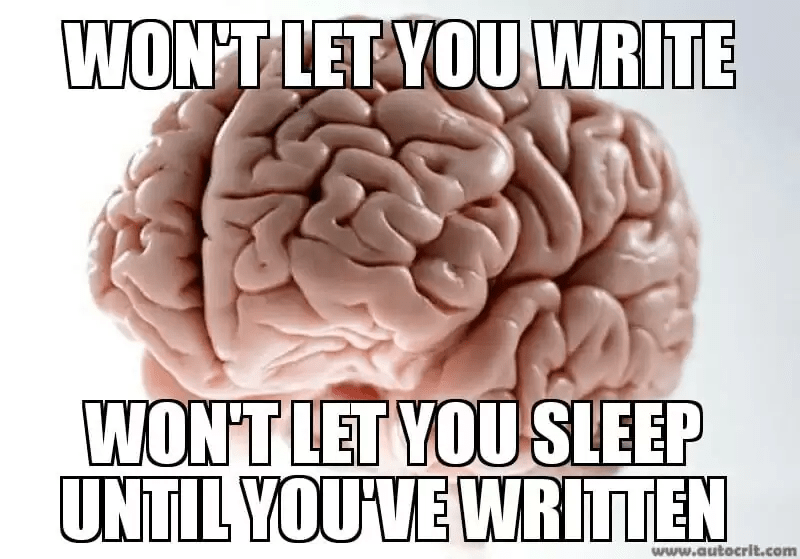
Sometimes when I wrap up my writing for the day, I feel somewhat embarrassed. I can’t be alone in thinking there’s something just a little bit silly about devoting so much of time and energy to something like writing. It feels almost too easy, too indulgent to actually do this for work.
Maybe that’s why I used to counter those feelings of guilt by flooding the interwebs with endless nonsense about how difficult my chosen path is.
In fact, there’s usually an inverse relationship between how hard a job is and how much those that do it complain about its difficulty. You don’t see ER doctors or coal miners tweeting about how hard their jobs are. Who would they even need to convince?
I thought writing was a calling for me for two easy reasons: I was better than the average person at it, and I had more fun than the average person doing it. It wasn’t the career I wanted for prestige. My prestigious career was the one I left behind. To be a scientist of some sort. I was NOT smart enough for that. I found p-values and statistics too difficult.
And too much difficulty is sometimes a signal – one you might miss if you’ve internalized the idea that this is the way things are supposed to be. The way writers often do.
Difficulty doesn’t automatically equate to significance.
If what you’re doing is soooo incredibly hard, it must also be important, right? Otherwise what’s all that hard work even for? We falsely equate difficulty with meaning. I do this all the time, convincing myself that the struggle is necessary rather than pausing to question what it’s actually telling me.
This dynamic can emerge in any scenario: During my early years of dating, I believed that effort and work were indicators of a relationship’s value. I then found myself in a string of relationships that were literally all work and no joy.
You could also work incredibly hard, and suffer greatly, in the pursuit of an unimportant goal, and there’s nothing wrong with that as long as you’re doing it with your eyes wide open. I strive for lots of unimportant things – going to the market to buy a particular type of seafood, writing this blog, washing my hair every 4-5 business days.
99% of all human activity is, in the grand scheme of things, unimportant. Doesn’t mean it isn’t worthwhile. I feel the same way about writing. I’m desperately trying to take myself less seriously as a professional, and especially as a professional writer.
I want to make it clear that I’m not suggesting that writing well is easy, it can be difficult. However, there’s a possibility that the difficulty I experience is either because I’m engaging in the wrong task, or I’m not approaching the right task effectively. Dwelling too much on the difficulty can prevent you from spotting these misalignments.
Having said that, if you want to be a writer, more power to you. It’ll help all of us if we become super sharp at differentiating between ‘productive struggles’ (those that lead to growth and improvement) and ‘fruitless struggles’ that lead nowhere.
Yesterday, I spotted a familiar book on my friend’s dining table: A Gentleman in Moscow. I read it just before the pandemic hit, and its theme (a man confined to house arrest in a Moscow hotel) was one that felt quite personal during the long-ish period of quarantine.
This quote has become increasingly meaningful to me. Although it doesn’t specifically talk about writing, it applies to any major effort we make, whether in our careers or personal lives, especially when viewed through the perspective of convenience or ease.
“I’ll tell you what is convenient,” he said after a moment. “To sleep until noon and have someone bring you your breakfast on a tray. To cancel an appointment at the very last minute. To keep a carriage waiting at the door of one party, so that on a moment’s notice it can whisk you away to another.
To sidestep marriage in your youth and put off having children altogether. These are the greatest of conveniences, Anushka—and at one time, I had them all. But in the end, it has been the inconveniences that have mattered to me most.”


 Unfinished Conversations
Leave a comment