
The theme of change shows up quite often in this blog – it’s not intentional but clearly the subject takes up a good amount of my headspace. Perhaps it’s a function of being in your 20s and 30s, a time notorious for its relentless churn. Or maybe it’s just me, stuck in a rut and mistaking personal upheaval for profound insight.
There’s this essay on why our music preferences don’t change that much after highschool, this one on dealing with the in-between parts of change, this essay on moving to a new place and why that doesn’t always lead to change, and this essay on how the world has changed and how we can make some sense of it.
So in keeping with what seems to be my favorite topic, I’m back!!! To talk about change.
When I got engaged and started a new job at 26, I thought my life was changing a LOT. Then I got married at 27 and a global pandemic hit 3 months later. More change.
Then we moved cities, bought a house, my husband started a business while I switched careers and started writing, AND I had a baby all within about a year and a half. Change.
The following year, I got laid off, lost a long-time friend, hit a rough patch in our business, and my mental health plummeted to an all-time low – at which point I decided I was going to spend a lot more time thinking and writing about change so I could make sense of the potty-stain that was my life at the time. That was a year ago.
This weekend, I’ve been thinking about change again, so here’s a new addition to my library of change-resources. It’s mainly written to help me navigate my current season, but if it applies to you, then 🙏🙏🙏.
And if while reading you find that it doesn’t apply to you at all, please scroll all the way till the end. I left you a present as a thank you for being here. It’s my Sunday playlist, it’s got just the right tempo, just the right mix of cool and interesting songs, and it’s guaranteed to wow everyone during your next car ride.
Okay, back to it. Here are some general, unorganized notes about change, decisions, and whatever.
The rest is still unwritten
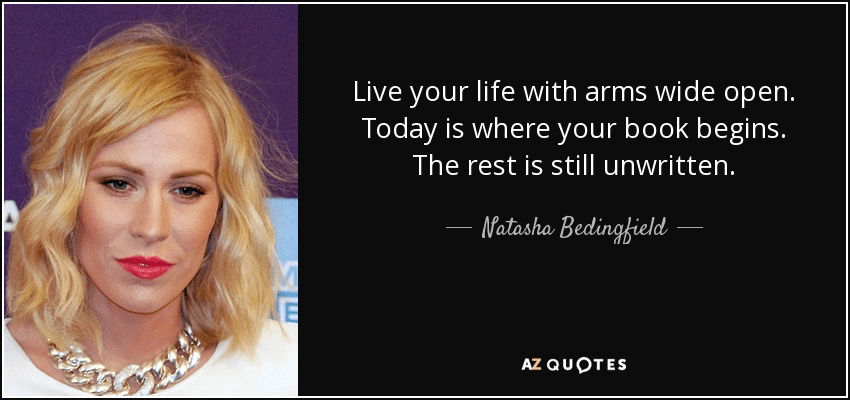
One of the great thinkers and philosophers of our time said, ‘Today is where your book begins, the rest is still unwritten’ and honestly she was right.
There’s a weird thing that happens after you turn 30. You’re no longer a ‘young’ adult, you’re a slightly deflated ‘regular’ adult, and this does something to your self-perception. In some ways, you feel like a finished product. Like you’ve hit the apex of your evolution, and this present version of you will take you through the rest of your life.
This is a cognitive bias called the End-of-History Illusion. It’s our tendency to assume that although we’ve changed a lot in the past, in the future, we’ll remain pretty much the same.
It’s not that we don’t believe that we’ll change, or that we don’t want to. There’s some change that we aspire towards, like fitness or success or some life milestones, and some change that we anticipate, like getting older.
But I think it’s hard to wrap our minds around just how much change is still going to happen. At all times, we’re the most mature, the most changed, the most world-weary, that we’ve ever been. History feels over, we feel settled in how we see the world.
Surely, the future you is just an extension of this present version?
No, it isn’t. Time has no mercy when it comes to such hubris.
The fundamental disconnect lies in how we imagine future growth taking place. We picture ourselves, with our current desires, limitations, and perspectives, somehow absorbing all this change. We think we ought to make decisions when the present version of ourselves is ‘ready’ for it.
Ask anyone who’s embarked on a life-altering decision – starting a business, getting married, quitting a job, or having a child – were they truly ready? “Ready” is a comforting fantasy born from the harsh reality of limited information. We make calculated leaps fueled by hope and call it ready.
And once you’re living out your decision, you are read-ied. You adapt, screw up, fix it, and keep going until one day, someone comes along and asks you, “How did you know you were ready?” and you either fabricate a narrative of meticulous planning or sheepishly admit, “I just took a chance.”
So what then? Even if you acknowledge that the future-you might be super different, it doesn’t really help you make better decisions. Sure, you’ll be different. But different how?
If the rest is still unwritten (and also really unhelpful, Natasha) – we really have no way of anticipating what the rest’s effects might be. The “how” of future transformation is maddeningly opaque.
The takeaway I guess, is to continue to take thoughtful and calculated risks and hope for the best, and trust that if there’s some precedent, it may just work again. You may grow, evolve, expand, and become the person that can turn those risks into something worthwhile. On the flip side, you also have permission to be a little gracious to yourself if things go wrong.
You were just doing the best with whatever information you had at the time.
The inevitability of change
“For he that gets hurt will be he who has stalled”
Natasha Bedingfield didn’t write that. Nobel Laureate, poet extraordinaire, and average-vocalist Bob Dylan wrote that. It’s a song I listen to at least once a week, like a balm for my overstimulated brain.
The earlier section was on how we change, this section is on how we cope with the world changing. I’ll keep it brief because the more I think about it, the more my head hurts 😦
Most of my thoughts about our changing world occurred to me when I had the privilege of bringing new life into it. What kind of world will my child grow up in?
This particular brand of fear is a human birthright. Our only frame of reference for ‘simpler times’ is our own childhood, and our default notion is to assume that we had it better. Even the obvious downsides we experienced somehow get reinterpreted as valuable character-building experiences in hindsight.
My grandfather who grew up in a village in Mangalore had to walk to school and says he was definitely followed home by a panther on a couple of occasions. He is also convinced that his childhood was more wholesome than mine.
My friend who just turned forty told me that her childhood was the last ‘real childhood’ because she grew up without cell phones.
My peers say the exact same thing about our childhood because we grew up without smartphones.
We are all right, and we’re all wrong. There have always been things that are wrong with the world. Many things. And we’ve always been attempting – somewhat haphazardly – to fix them.
Sometimes, our fixing works well but then we discover that our solution caused more problems than it solved. And so we try to fix it again. Progress almost always comes with unintended consequences just like adolescence comes with pimples. That’s the inevitability of change.
To those who wring their hands about the future of children exposed to social media and claim it’ll ruin them, I think you’re probably right BUT I also know this: You don’t know how or where you’re wrong.
And that’s an important thing to keep in mind.
Explain the future to me like I’m an earthworm
In college, I had a class called Comparative Physiology for two whole semesters. I basically spent a year studying how living things get more and more complex in their little bodies as they ascended the evolutionary ladder from single cell organisms to earthworms, then animals, and finally, the pinnacle of achievement: us.
It was super interesting to see what the bare minimum for survival was and how creatures got more complex as we added features like lungs, or a nervous system, or an unhealthy attachment to Instagram reels.
I’ve forgotten almost everything I studied, except for stuff about earthworms.
Earthworms have no eyes, but they have salivary glands for some reason. They’ve got something like a heart that actually pumps blood. I think their brain is a ring of nerves but that’s it.
I remember looking at a badly dissected (by me) worm in the lab, and wondering how we could possibly share the same world. How did our paths cross?
Here I was, in a class full of students, spending HOURS studying the insides of this worm. We had to study every segment (not making this up). An earthworm literally starts with a mouth and ends with a butt. That’s about it. And this earthworm did not give a crap about me or my comparative physiology class or my species in general. So who was the smart one here?
I didn’t love comparative physiology much, but what I did take away from the class was the fact some creatures share our world, yet experience it in a way that’s fundamentally different, on a cellular level.
They don’t know what they don’t know, and they never will.
You’d never in a million years, even with the best slide deck, be able to explain what chicken triple schezwan fried rice is to an earthworm. You will never be able to tell an earthworm that Facebook is a thing that exists and that sometime in the early 2010s, this thing called ‘Confession Pages’ sprung up all over where people would leave random, anonymous confessions about each other and this terrorized the not-popular kids in college for a while except for the rare occasion where someone would confess that they find you pretty and your whole day would be made.




The earthworm careth not.
When I think of future versions of myself, I imagine the present version of me as an earthworm. Unable to know what I don’t know. Remarkably clueless about the world I will inhabit.
If someone were to try and explain the future to me, I wouldn’t be able to understand it. And if I did, I probably wouldn’t believe them. And even if I believe them, I won’t know how to prepare myself adequately because I won’t know how to cope until I have to. Just like you can’t explain the concept of flight to a caterpillar.
Side note –– I also like to think of people I don’t agree with as earthworms, but that’s just for calming-down purposes. No scientific rationale there. They’re like earthworms of the ideological persuasion, burrowing through life with a completely different sensory experience.
This is honestly a very dumb section overall, I only put it in here because I do it a lot.
And every time I feel very strongly about the future, or feel like I won’t be able to bet on myself and take a risk, I remember that the future-me who will live those decisions out is a different animal. One that I have no capacity to fully understand today.
Me today: Earthworm.
Future me: Fully evolved person eating chicken fried rice crying about why nobody likes her on Facebook.
Disclaimer: This section mainly applies to people who are super risk averse and tend to think and double-think through everything and sometimes paralyze themselves in the process. There are easily 100 loopholes in this heuristic technique, so my professional advice is: You do you boo.
I don’t know how to play chess
Which is why I hate all chess-related metaphors for life.
I’ve played chess before, but I need someone coaching me through it. Continuously. I’ve never been much of a strategic thinker. I’m really not great at this five-steps-ahead stuff.
This is why I tend to avoid a chess-like approach to thinking through decisions. In my opinion, it’s a bad model. When I lose at chess because of a bad move, my opponent can literally trace where it all went wrong, point out the error I made, and how it led to my defeat.
But decisions don’t work that way. When something goes horribly wrong, we can’t work backwards and pick out the one singular bad decision where it all started. We just can’t learn from mistakes that way. In reality, there are a bunch of tinier, undetectable mistakes that might result in a one small misstep, that suddenly turns huge.
If you look back and try and pinpoint what what wrong to learn from that mistake, you might land on the wrong one and also miss the fact that most of our decisions involve A LOT more complex information. And most of life involves a lot of stuff that’s really, unfortunately, beyond our scope of control.
A good decision is the result of a good process, and that process must include an attempt to assess what you already know, which, if you’re honest with yourself will lead to a simple confession: I’m not so sure. Which is absolutely fine!!! Because improving decision quality is about increasing your chances of good outcomes, not guaranteeing them.
Try and develop a good process for decision-making: Factor in what you know, consider what you don’t, acknowledge that like the earthworm there will also be things you don’t know that you don’t know, examine the evidence, think about what has happened in the past, know it can happen again or be entirely different (unhelpful), talk to a few wise and trusted people, and then trust your gut.
That’s my process. I’ve refined it after making so.many.bad.decisions I can’t even tell you and don’t know where to begin, so I simply won’t.
There’s no going back
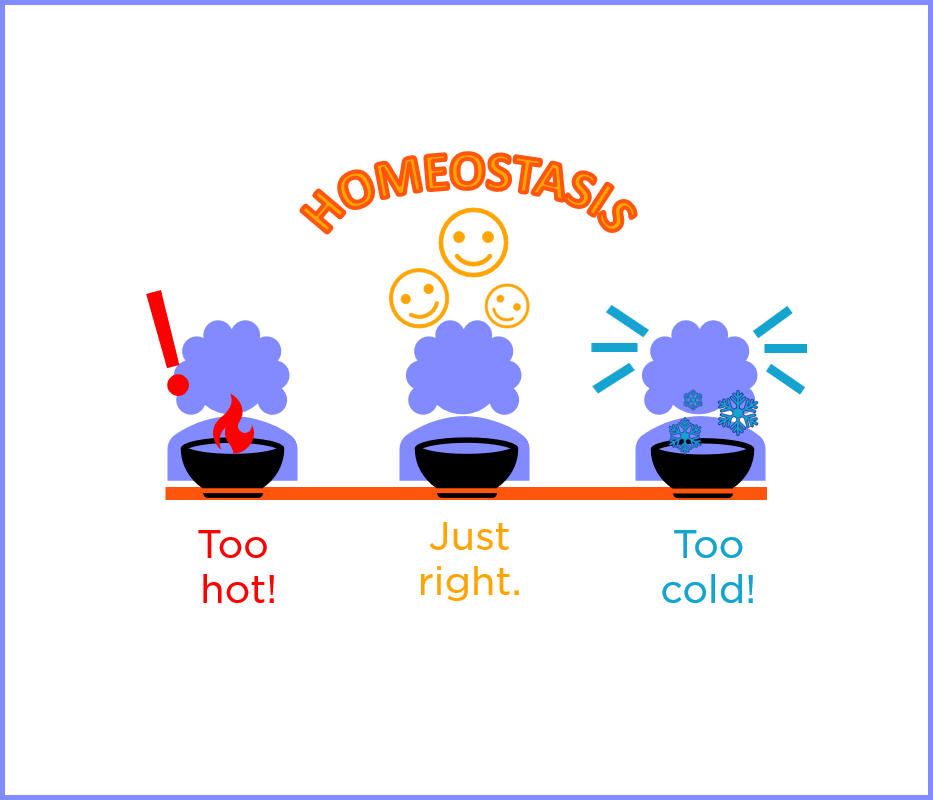
I think the concept of homeostasis is pretty mainstream. We know what this is right? Homeostasis basically means a steady state. A place for everything and everything in its place type of situation.
It means the default state is one that is perfectly balanced, in equilibrium.
And speaking of steady state, balanced, and equilibrium, I’m currently parenting a toddler so those words mean nothing to me. As someone who craves just some form of balance and predictability, this phase of life has been quite challenging for me.
I’m learning to thrive in unpredictability but it’s so so hard 😭
I have to cope with an entirely unpredictable schedule and lots of chaos, while trying to keep some crucial important things predictable and steady: Making sure my child is fed, bathed, and happy, and making sure my fridge has groceries, and making sure my work gets done mostly on time, and making sure I drink water.
It’s a balancing act. Like chess, I’m really not naturally good at it. Unlike chess, I’m not sure if anyone is.
I find any and all routine disruption a little bit stressful, even the good kind, like mid-day beers. I’ll be buzzed but also kinda anxious.
Which is why when I found out about the concept of allostasis, I felt a little better. Allostasis is your body’s response to stressors, where it constantly adapts and rearranges to maintain a new kind of equilibrium. Unlike homeostasis, this steady state is DYNAMIC. It’s a constant push and pull between what is and what needs to be.
To me, this feels more truthful to the experience of being alive.
When adapting to change, our measure of success is when we feel like nothing changed. When we return to the familiar. This works sometimes but not all the time and can lead us to believing we haven’t succeeded, when in fact we have.
When I move to a new city, I want it to feel like home, which means I might want it to bear characteristics of the place I left to begin with.
When I make new friends, there’s this weird pressure to make the equation fit some pre-existing mold of what friendship should be, and I subconsciously nudge the relationship towards that familiar dynamic.
And obviously I’m here with the baby example because it’s the most frustrating of the lot. I’ve pegged my success as a mother and general human being in my ability to go ‘back to normal’. My old wardrobe, my old schedule, workload, social life, and fitness levels. I was so grateful that another Mom took the time out of her day to shake my up and tell me that this is a fools errand!!!!! I was the fool!!
There is no going back. You aren’t the same, so expect nothing else to be the same. Ever. I was delivered this hard nugg of truth along with a side of ‘that’s okay, that’s the whole point.’ We sometimes forget that the goal really shouldn’t be to go back but to move forward and work with that new version of ourselves.
It gave me so much joy to have the opportunity to tell another new mom that when she asked me the question. No, things will never go back to normal, please don’t fall for the trap of wanting to feel like your old self. You can pursue the things you liked and enjoyed about life before a baby, but it will be different and that doesn’t mean it’ll be worse unless YOU make it worse by comparing it to the past.
And I get it. There’s a comfort in clinging to the past, a safety in the familiar. We want to believe that if things just go back to “normal,” all our worries and problems will disappear.
But normal isn’t a fixed point in time, it isn’t a place we can return to because it didn’t exist. Normal is always just another stop on our journey as we hurtle-turtle towards change. We are all constantly in a state of allostasis, rearranging ourselves to fit the new situations we encounter.
You were doing it back then, and you’re doing it now. All the new things in your life become a part of the new equilibrium you establish through adaptation, rearranging, and lots of courage.
Okay, those are all my notes. It was a very helpful exercise for me to write it all down as I navigate my daily changes – diapers and others.
For those who scrolled till the bottom for the playlist (PS, I didn’t make it, someone else did, I just found it on Spotify but trust me it’s such a good find), 🎁here you go🎁

I just saw that only 37 people have liked it which means it’s still super underrated and a bit of a hidden gem so you’re welcome!!!!
 Unfinished Conversations
Leave a comment