I’ve spent the last two weeks in Bombay.
Some people return to the places they used to live and marvel at how much they’ve changed. On the other hand, I’ve been surprised by how very much the same I am. I felt a strange sense of continuity, a realization that some core parts of me haven’t budged an inch.
Speaking of change, I’m finally back to working full-time again! While I typically avoid discussing work here, fairness dictates I close the loop, considering my previous essays on the dissatisfaction of unemployment (I Get To Be Happy?)
Let me tell you something that no other parent will tell you ever because this is happening to me and only me as a mom and a working professional because I’m so unique in my experiences – Managing a job and a toddler is HARD.
I now have a decade of work experience and enough stress stored in my body to power a small city, I can do twice as much work at any given time compared to my pre-baby days. I’d be lying if I said I didn’t enjoy the thrill of getting it all done. I love the feeling of tired accomplishment that comes from completion.
The only thing that sucks is that I haven’t been able to find a routine around my precious passion project: this blog.
I don’t plan on abandoning it any time soon, but the inconsistency has been making it harder and harder to pick things back up. Like a neglected text message, every time you think of tending to it, you must jump over your own self-loathing to get there.
I’ve had multiple essays sitting in drafts, about 60 percent complete, with nobody to dress them up, put their shoes on, smack their bums and pack them off for publishing.
At first, when I was about a week behind my writing schedule, I told myself that I deserved time. I had to first stop drowning in my regular work-day before I could tackle extra projects.
Then, at about two weeks late, came a wave of self-compassion. I told myself to be kinder. This wasn’t supposed to feel like a chore. If it wasn’t fun anymore, maybe forcing it wasn’t the answer. Maybe it needed to wait until the joy returned.
Now, three weeks behind schedule, the voice has faded. There’s a strange quiet acceptance.
I have enough excuses to keep me going for at least another couple of weeks – I’ve been traveling, some work things came up, my birthday is coming soon, I was getting my daughter into a new routine – you see? I can do this for days.
But the truth is actually a lot more simple: I’ve just been busy. Life has been happening to me. And this project isn’t actually me living life, it’s me documenting it. It runs parallel to my daily routine.
I’ve been busy, so what?
We’ve all been busy. What does that mean for creative work? What does it mean for me, in particular?
Honestly, the only reason I’ve been busy is because all things that I’d hoped would happen to me, have happened.
I love spending time with my daughter in this new phase of her life as she finds words to describe the world around her. I love hearing her little voice call to me. I love having work that fits into my routine. I have a social life that makes my days brighter. I’ve been visiting family. I’ve been coloring so much, literally for an hour a day.
And as I do these seemingly meaningless, repetitive things, I think back to this blog. My unfinished conversations. I feel an undeniable pang of guilt at my neglect – the last few months have been so full of things worth writing about, and I haven’t done it.
Those moments are gone now, almost forgotten.
This guilt followed me to Bombay, fueled by the knowledge that a packed itinerary meant even less writing time. As I stood in my old home, a memory surfaced: The root of this lingering guilt.
I kept a diary from the age of 9 to about 19. I wrote nearly every day about the things that happened in my life and how I felt about them.
I remember so clearly why I wrote a diary at the time – to keep myself from forgetting. I wrote to be a witness to my own life. My diary was my defense against waking up at the end of my life and realizing I’d missed it.
I had so many well-meaning older adults tell me how wonderful childhood and youth were, and I figured if I was truly having The Time of My Life, I might as well document it.
If this was as good as it gets, I’d obviously want to come back and revisit it. I was, and still am, a sucker for nostalgia.
By keeping a diary, I could create my own lore. I could remember what it was like to be a teenager, I could access it any time I wanted. What a gift to my future self! – I’d think, as I sat down to write.
Last week, the very future self I envisioned, opened a heavy, heavy box full of diaries.
She was 30. She wore makeup. Her mum had finally allowed her to wax her legs. Not only did she have a boyfriend, she was now married. And she had a precious little daughter.
Perfect! This is exactly the woman I was waiting for, and writing for.
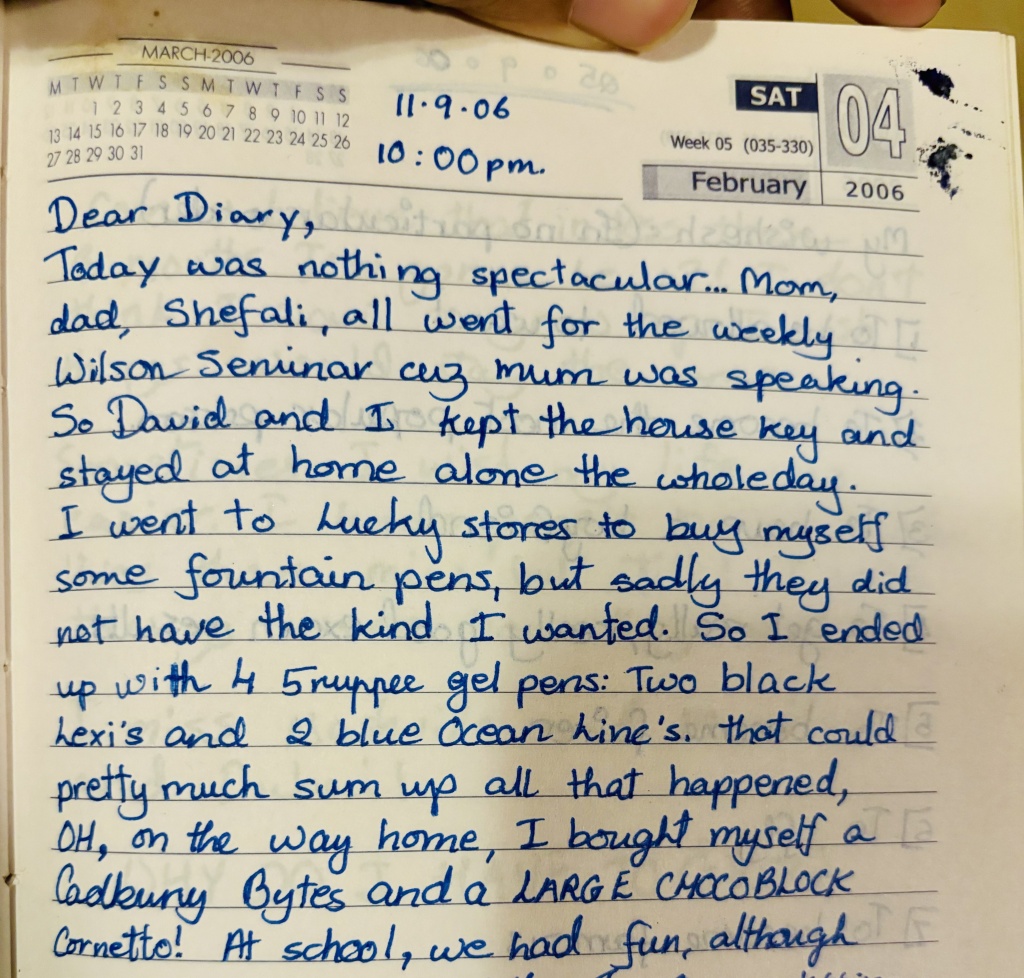
As I turned the pages, I couldn’t bring myself to read much of what I’d written. It was one of the most moving experiences I’ve had, but not in the ways I expected. For one, I realized that my memory of those years was so vastly different from how I’d recorded it.
My diaries were painfully cringe – which means they were more accurate in their depiction of life as an angsty teenager than I’d have wanted.

Dear Sonia, if you want people to take you seriously, please learn to spell it first.
I didn’t open my diaries to discover unusual insight. Instead I discovered honesty – and honestly, I was just a regular 13 year old. Insecure, confused, and foolish. The only gift I was giving my future self was gratitude that puberty ends. And adulthood begins.
Childhood wasn’t carefree. I had pages and pages and pages of genuine cares – academics, boys, parents, God, self-image, acceptance, friendships, fears. All the things most people forget about those years, I had documented as they were happening to me.
Not as I’d like to remember fifteen years later.
There is never going to be a place where your memories are stored accurately – not your photo gallery, not your memory, not your Facebook memories.
We have no direct access to our past. The moment you’re in right now cannot be preserved. How we remember our life depends almost entirely on our imagination and not our memory.
Years later, your imagination will embellish your memories and paint a picture of what life was like. This is so much better than having a diary.
So many – and I mean SO MANY – of the things I wrote about in my diary were honestly things I’d rather forget.
I liked my cloudy memory of those moments more than the real versions. The messy, painful, confusing real versions that I read about – page after page. It’s no wonder every adult told me that being a teenager was incredible, they’d forgotten everything about it.
Narrative memory is a weird thing. We tell ourselves stories about what happens to us, we pick and choose what to focus on, and we forget things that don’t fit the narrative.
A lady named Sarah Manguso had a similar experience as mine. She kept diaries for decades and documented every moment and milestone in her life. She later wrote a book about what this record-keeping taught her, and as I read her words, I felt them in my bones.
“I came to understand that the forgotten moments are the price of continued participation in life, a force indifferent to time.”
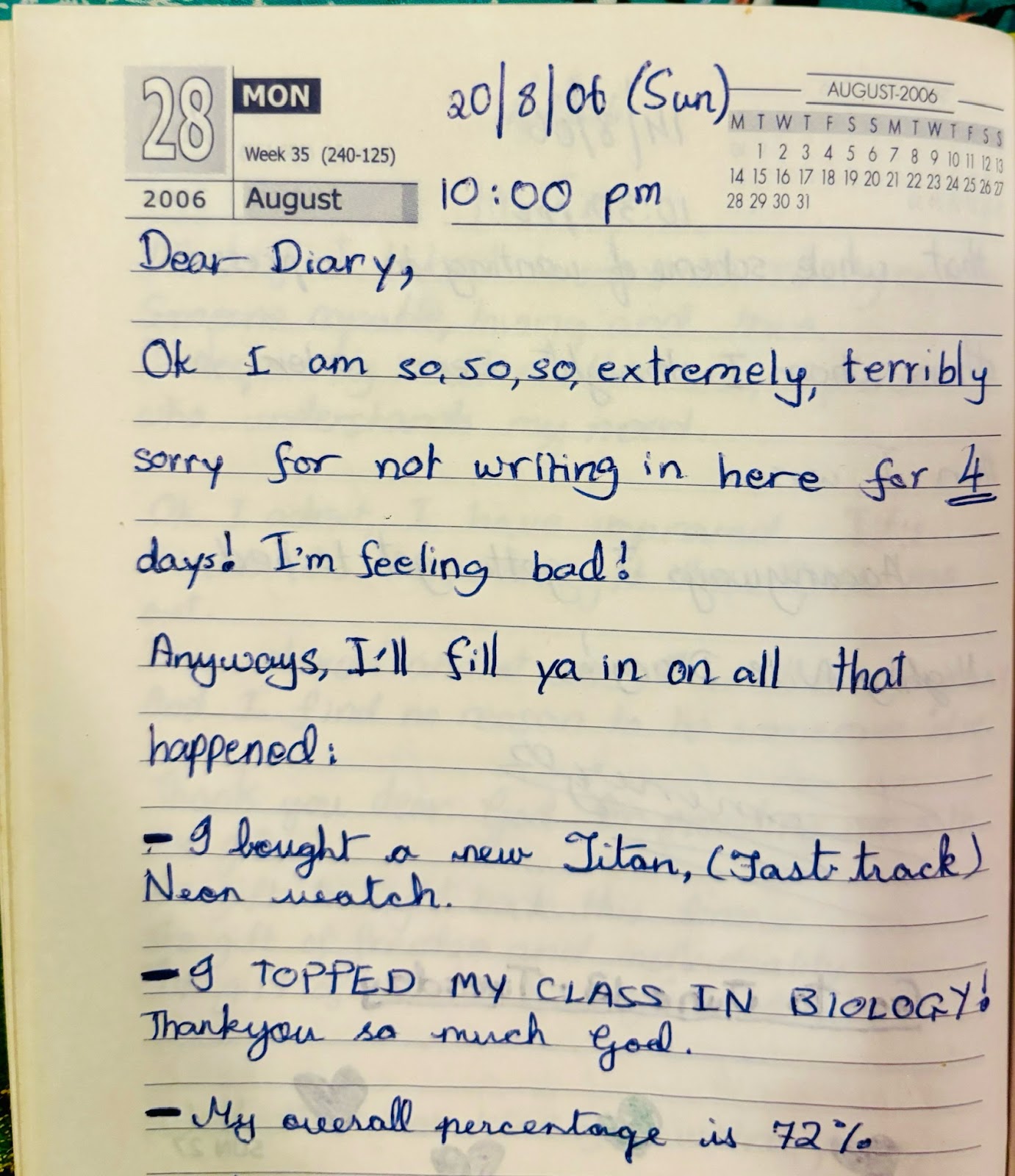
As I skimmed through diary after diary, I found it amusing how eventually, as life began happening to me, as I began growing up, every entry would begin with a sincere apology.
“I’m so sorry for not writing.”
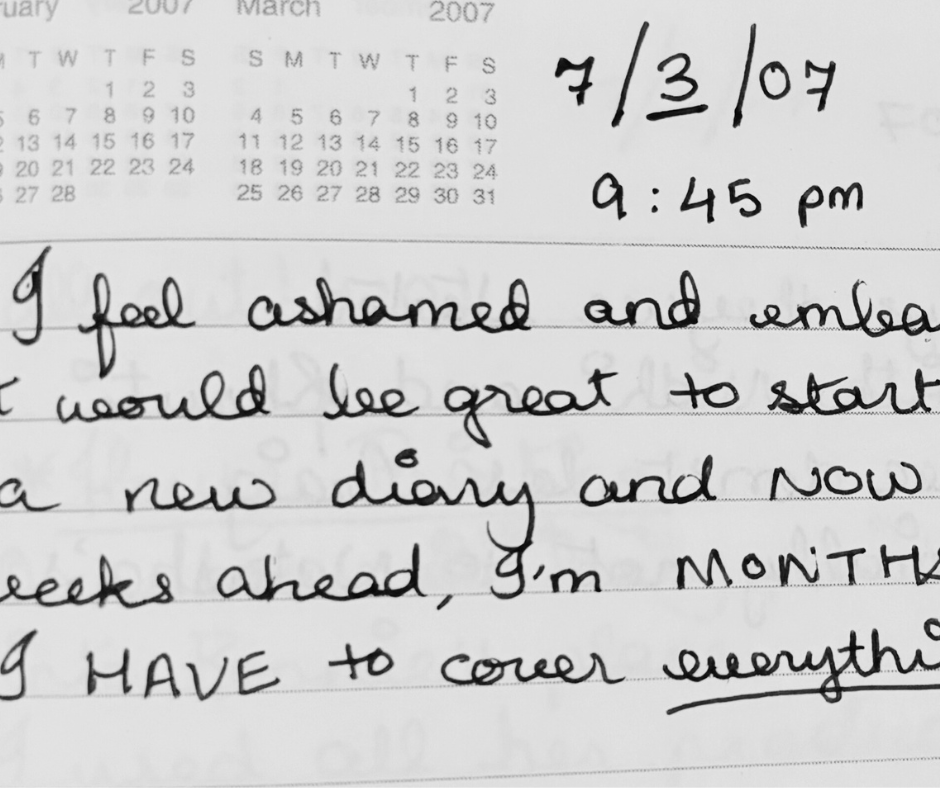
“There’s so much I have to cover, I’ll just summarize it in points.”
“I’m so sorry I haven’t written for so long, I’ll do better.”

With every passing day I neglected to record, I got more stressed about the memories I was potentially losing. I still couldn’t bring myself to start again. I’d try, but the burden of covering all that lost time was almost too much.
And here I was, 30 years old, feeling the same feelings.
I wanted to start this essay in exactly the same way:
“Hi everyone, I’m so sorry for not writing. Life has been happening to me, and I’ve been enjoying it so much but I’m so so sorry I haven’t forgotten to keep a record of it to come back to because somehow the sweetness in this moment cannot be savored fully because I must, for some godforsaken reason, store some of it for later when it’s old and moldy.”
I hadn’t changed one bit.
I know that there aren’t many people that keep (or have kept) a diary. Most people (I think?) don’t worry about hoarding memories in this particular way. They do it in different ways – through music, through photos, through people.
That’s why every drunken party will have nostalgia jams playing after 2 am. When we’re happy, we’re like – yeah play anything, I don’t care. The moment we reach a certain state of euphoria, we’re like – play this one super specific song that I can never get over. We want to connect our happy present to the only other time that truly mattered: Our past.
That’s why we take pictures of everything we want to remember, even though it doesn’t help and eventually serves no purpose. If you only live once, you absolutely cannot afford to forget.
Life MUST NOT pass you by. Others, maybe. But not you.
The padding
“The best thing about time passing is the privilege of running out of it, of watching the wave of mortality break over me and everyone I know. No more time, no more potential. The privilege of ruling things out. Finishing. Knowing I’m finished. And knowing time will go on without me. “
During my two weeks in Bombay, I visited my grandfather. We call him Aba. He’s in his early 90s, and he’s a legend of a man. Maybe everyone feels that way about their grandfather, but I know I’m right.
I think one of my very first memories ever is with him – he was making my brother and I jump from a high stool that he was standing right in front of. We were supposed to leap into his arms.
As a little girl, I remember this being a particularly scary thing to do. My grandfather wasn’t the one we took naps with or got hugs from. He was a mountain of a man. What if this was him teaching me a lesson, like some tough-love moment? I wasn’t sure, and therefore, I absolutely did not jump.
Until he said: “Arre, I’m your Aba, I won’t let anything happen to you.”
I was surprised at his words even then, which in hindsight, might be the only reason I still remember this story. I think it was the first time I understood that he loved me. And so I jumped.
A story like this wouldn’t ever show up in my diary. This was a moment that I’d consider padding. This was filler content. What would show up in my diary would be something like:
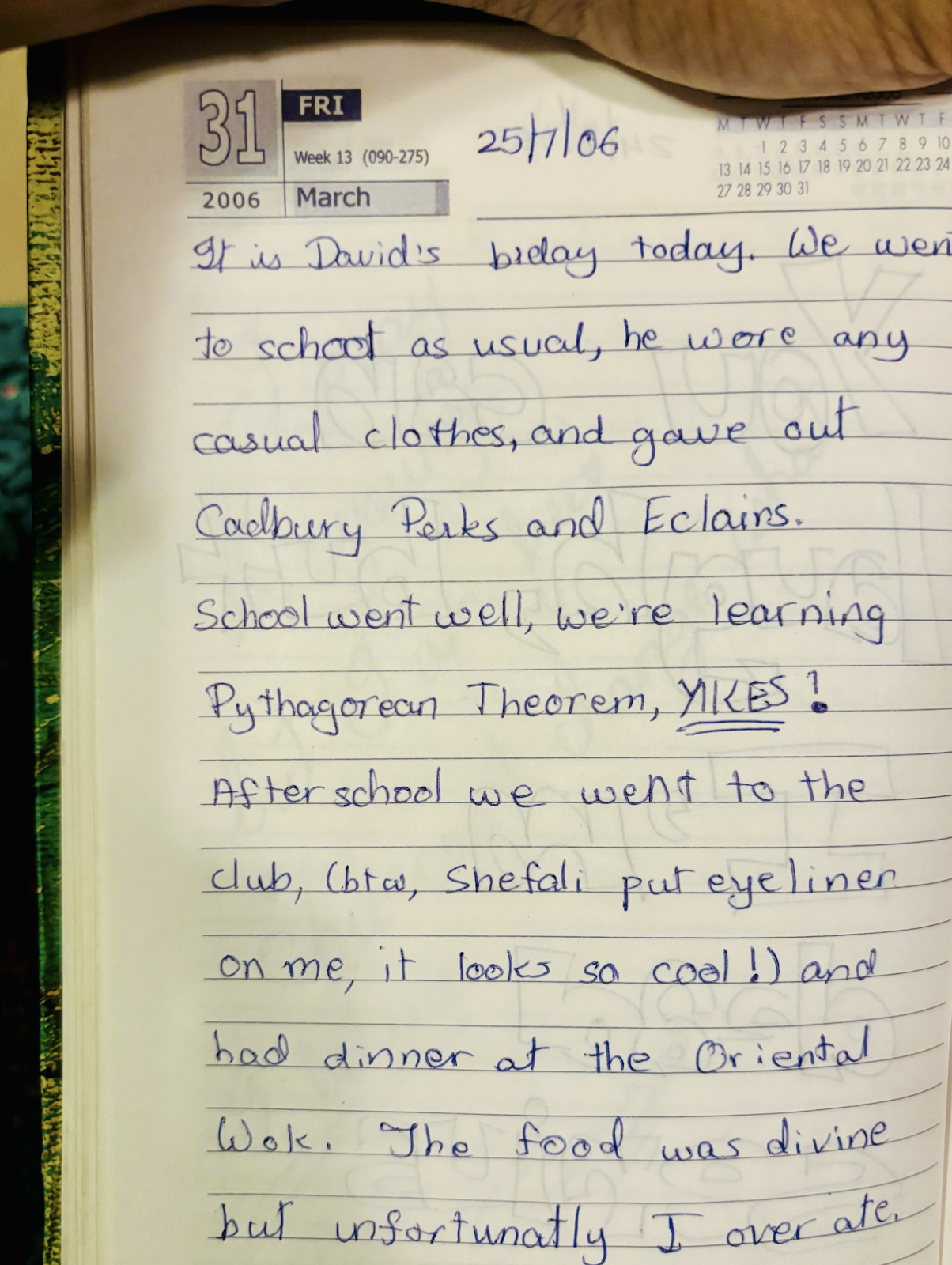
Most of life is padding. Most of it is filler content. And we don’t get to decide what we’ll remember later. I know this because last week I sat beside Aba’s bed for some time and heard him talk. His voice was now a little raspy.
And he didn’t talk about anything we’d consider important. Everything he said was padding. The moments that we don’t think are worth recollecting. But it was wonderful to hear it all.
We really don’t know what’s important or worth remembering when it’s happening to us. We don’t get to decide what we’ll remember. I don’t often think of Aba’s landmark 90th birthday party, but I think of him promising he’d catch me when I jumped. In fact, I don’t even remember jumping.
Any version of our life that we try to hold on to will eventually resemble a work of fiction. The very act of choosing which moments to record and which to omit already compromise the integrity of the process. It turns us into storytellers.
Diary writing is an editorial task in every way imaginable. And how insanely arrogant it is to assume we’ll get the selection process right.
There’s no time in your life when this hits you harder than motherhood. Being a mother is a lot like being a teenager. You have no idea what’s happening to you or your body, nobody tells you anything. Most of your routine is dictated to you by someone else.
And everyone around you keeps expecting you to enjoy it – you’ll never get this time back, they say.
“Time punishes us by taking everything, but it also saves us — by taking everything.”
I recognized the desire to obsessively document things once again when my daughter was born. I felt it right away, that parental desire to freeze time. It began when I was pregnant. I had sweet but anxious thoughts swimming around my head: I’ll never be pregnant for the first time again. I’ll never have this moment again. HOARD IT.
But in the last few weeks and months, as I’ve found myself with not enough time to archive and store my memories through words, I’ve come to realize that our brains are designed to forget. The ability to forget is a gift.
Forgetting is the price we pay for living. It’s the acceptance of impermanence that allows for true presence.
You cannot hold on for dear life, and live. We can’t be historians of our own lives, that’s just impossible and also very stupid.
As I read through my diaries, I realized that they were just compilations of moments I had forgotten. My own record keeping had been inadequate. It was a curated museum exhibit, sterile and airless, missing the chaos of lived experience.
Now that I’m a mother, I’ve begun to inhabit time differently. I used to constantly be fighting time, and it was exhausting. But having a child does a wonderful thing for you – the pressure to be the main character, the one driving the narrative, has miraculously dissolved.
I’ve now become a crucial character in someone else’s story. I’m the constant and steady earth under which my daughter’s life unfolds. I’m the warmth that lulls her to sleep, and the first face she sees when she wakes up. I am no longer merely a thing living in the world, I am a world.
But it’s only for a short, short season. I know this because countless parents have told me so. It goes by so fast, enjoy it. ENJOY IT!!!!!!
So how do I enjoy it? What should I do? Should I capture it in photos? Live in the moment? What are my options? What exactly does ‘enjoying it’ entail? Is it a matter of perspective? What should I do during the inevitable hard parts? Do I enjoy those too?
I hear the weight of nostalgia in their voices when they say this. It feels like it comes from a place of loss ––as if by telling me to savor every second, they can prevent me from feeling the same regret they carry. There’s this collective myth we’ve created that if we’re not consciously cherishing each moment, somehow we’re failing at life itself.
It simply isn’t true.
I won’t know which moments of today will make it to my memory archive as an older woman. Also, there’s simply no way of engineering that. But my memories aren’t all that important. The point of life is not to recollect it later, but to experience it as it happens.
There’s a certain peace in accepting that some memories will fade, and some will stick. And I can’t engineer that process. This is the price we pay for a life fully lived, and in accepting it, I’ve found an unexpected freedom.

Look at me, having my cute little fun times for a few moments against the backdrop of eternity.
 Unfinished Conversations
Leave a comment