
It’s been a long, dreary, exhausting day. I still have a bunch of tasks to finish. I’m complaining to a friend named Goldie about work.*
*Name changed because I’m not allowed to write about my friends
“Why do you need to have this job? Why is it so important?” Goldie asks.
I was ready to get back to work since having a baby, but as it turns out, getting hired wasn’t as easy as I remembered it to be. I spent six long months looking and applying, and amid a sea of rejections, interviews, and confidence rollercoasters, I finally got an offer letter.
A month into the new job and I already can’t keep up with it.
I regularly have 3-am nights trying to catch up on deadlines. I’m anxious all the time. I’m on multiple hour-long calls while my daughter screams her guts out in another room. I’m perpetually playing catch up at work and at home – and I’m never caught up enough.
I had hoped I’d grow into the role, but the truth was becoming plain to see: This wasn’t the right job for me. Or I wasn’t the right person for it.
Whatever. Right or wrong, who cares. I’ll MAKE it the right job for me by working hard and giving it my best. Why? Because being a writer makes me happy. Because before having a baby, I was thriving at work. Every little thing I did was magic. And opportunities landed on my lap like magic.
So I wasn’t gonna let one set-back set me back. I would power through and do the hard things. There are tons of working moms that do much more than this. Get it together!!!
“Having a great job doesn’t change how people see you, not the people that care about you at least,” says Goldie.
Yeah okay that’s a nice bubble to live in, but here on Sonia’s Earth, it feels like a load of bull.
I need this job. Being a writer finally feels like an “I am” statement for me. Something I can whip out whenever I’m asked about myself. It’s an identity pillar that I have grown to love, mainly because it’s something I’ve built with my bare hands.
Sure, I have other “I am” statements I could use. I could say, “I’m a mom.” That’s my favorite “I am” statement. But does it get you the admiration of your peers, along with mad respect yo? No, not really.
Writing makes me happy. Would I be able to be happy if I didn’t have the legitimacy of a real career?
I’m embarrassed that a job matters this much to me.
The games people play
“A finite game is played for the purpose of winning, an infinite game for the purpose of continuing the play.”
– James Carse, “Finite and Infinite Games,”
According to this book, you can categorize stuff under two ‘games’: those you play to win and get over with, and those you play for the sake of playing. To get better, or because you enjoy it, or simply because you have to.
Once you get the idea, it becomes fun to categorize different things as finite or infinite games in your life (assuming you don’t have actual real fun things to do obvs)
Getting a degree in English literature: Finite game
Reading English literature books: Infinite game
Being pregnant: Finite game
Parenting: Infinite game
Gardening: Infinite game
Learning a new skill (cooking, sports, a language, dance): Infinite game
Working out: Infinite game
Finding someone to marry: Finite game
Figuring life out with the person you marry: Infinite game
I like this section of the book that says:
“The more we are recognized as winners, the more we know ourselves to be losers. That is why it is rare for the winners of highly coveted and publicized prizes to settle for their titles and retire. Winners, especially celebrated winners, must prove repeatedly they are winners. The script must be played over and over again. Titles must be defended by new contests. No one is ever wealthy enough, honored enough, applauded enough.”
In my three decades of life experience, I’ve had countless moments where I genuinely felt like I won. Like I was at the top of my game. Life was incredible, I accomplished something huge. And then just like that the landscape shifts, the rules change, or you change, and the journey begins all over again.
Landing a dream job is great, but then you might outgrow it. Relocating to a new city brings an initial rush of excitement, only to be followed by the daunting task of building a life from scratch. Nurturing a circle of close friends is life-giving, but then distance pulls you apart and makes it harder to support one another. A bold career change is celebrated, but then the economy gets all shaky.
All the things you love will need constant adjusting. Every time you accomplish something worth being proud of, a new set of challenges are presented to you.
When I play finite games, I’m gonna have to keep winning. It’s gratifying but it also gets tiring. When I play infinite games, I’m not so sure what I get. That part is unclear.
What does seem clear to me is that unless I fall in love with the daily processes of being alive, finding happiness becomes super hard.
The makings of a sad girl
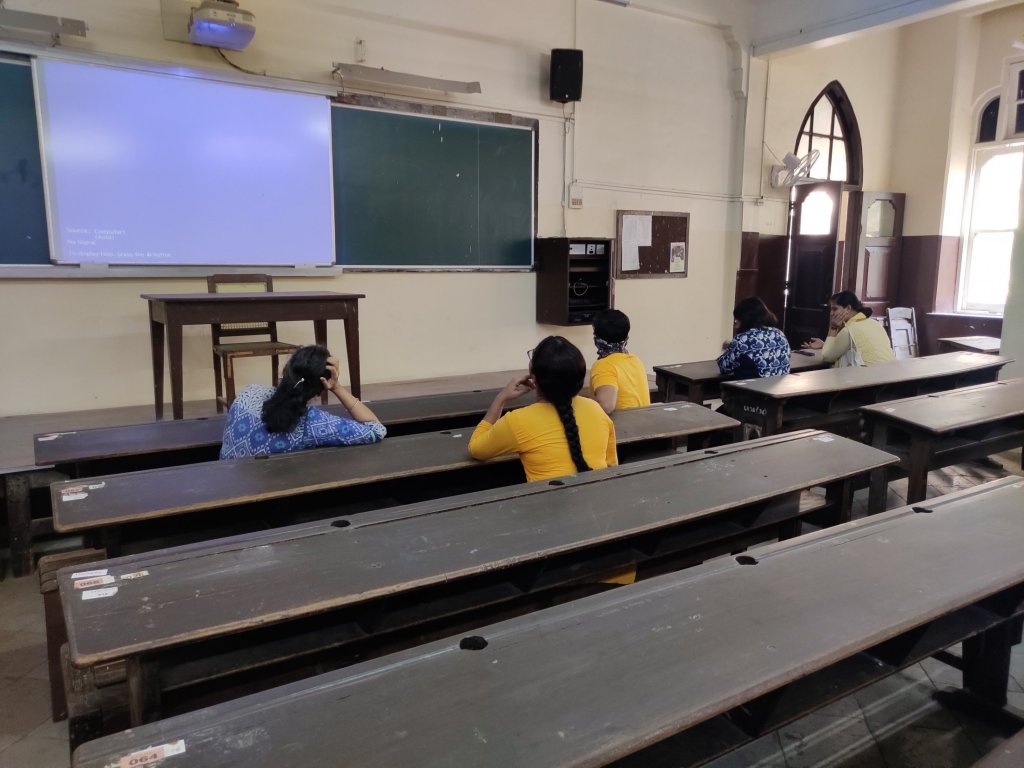
Fifteen years ago, I sat in a classroom called LR 23 with maybe a hundred other 16-year-olds. It was the first day of junior college, or 11th grade, at St. Xavier’s College. This was English class, and a professor with short hair walks in, introduces herself, and proceeded to write some stuff on the board in silence.
“Who you are ≠ What you get”
“If there’s one thing I want you to remember as you start college,” she said, “let it be this. Who you are does not equate to what marks you get. Your marks don’t define you.”
This message was aimed at decoupling our self-esteem from our academic achievements, but it felt kinda ironic. This was a reassuring head pat given to the wrong room. These were a hundred students who had most likely topped their class to claim a seat in this classroom. Many were head boys and head girls of their school, and had collections of awards and medals for extracurriculars.
Who we were (students at Xaviers) was literally an outcome of what we got (good grades).
I had joined junior college from a small private school and I’d just aced my GSCEs – my report card had a row of not just As, but A-stars (if you know you know). I was accustomed to the affirmation and identity that came with academic success. I was the student that teachers called ‘very bright’.
And I was about to become a very different person.
Three months later, I held the results of my first math test. My hands were doing that dumb shaky thing. I felt terrified. The grade I was looking at was barely enough to scrape by.
I wasn’t surprised. I was scared, but not surprised. From the first day of class, I knew things were different. Despite my efforts, despite the nights spent hunched over textbooks, I couldn’t bridge the gap between me and the understanding that seemed to come so effortlessly to my classmates.
But still, in the past, trying really hard had always paid off, and so I hoped against all hope that this test would confirm that. That my best efforts were enough. They weren’t. For so, so many reasons.
I had no idea how to use log tables, we were given calculators in high school. I wasn’t great at learning in a huge massive classroom with a hundred others. The worst part was that none of us in my class knew how to use log tables. Our professors just explained how they worked to us one day and everyone else miraculously seemed to get it. While I was still fumbling over decimal points.
Every morning, equations and formulae would cover the massive blackboard, and I felt more like an outsider, floundering about and making a fool of myself.
That moment, that test score – it wasn’t even an important test – but it unlocked a shiny new insecurity: That I was inadequate, and I didn’t have the brains to keep up. That I might not be that smart after all. It instantly seeped into every corner of my college life, casting long ugly shadows that I’ve struggled to run away from ever since.
I quickly decided to give up.
I would skip class as much as I possibly could because being in class made me feel stupid, and I would do literally anything to NOT feel that way. It was far too painful for me to grapple with losing one of my main “I am” statements. I was no longer very bright.
I also decided that trying itself was super lame. The only thing worse than failing, is trying not to fail and then failing anyway. That’s just gross no matter how you fold it.
And I didn’t think about the consequences. Doing things like thinking about consequences is also gross when you’re sixteen. I didn’t think about anything. I shut that part of my brain off, and every time it woke up, I clobbered it down with anything I could find / drink / eat / date.
––––––– ONE WHOLE YEAR LATER –––––––
We had another math test. I had my best stationery with me – Cello PinPoint, a bunch of really nice gel pens, a dope mechanical pencil. I sat in the hall, wrote my roll number on the answer supplement, read the questions, re-examined all the wonderful stationery I had, and then I looked at everyone’s shoes for a while.
Half an hour later, I walked over to the front of the class, with a familiar sense of detachment, and handed the paper in. I braced myself for the curious glances. I pretended not to care. I walked over to the huge pile of bags in front of the class (since you aren’t allowed to have your bag near you), found mine, put my amazing stationery in it, and left.
The following week, we got the results. I hadn’t attempted a single question, and I got a zero. I didn’t mind telling others, because I thought I could play it off as badass. She doesn’t care about stupid things like marks. I stared at the 0/40, and walked out into the hallway, found a quiet pillar, and cried my eyes out.
In the span of one year, I had plummeted from being a straight-A student to barely clearing the 11th grade, courtesy of six grace marks given to me by the college to help me make it.
The person who came to mind in that moment of reckoning was my English professor. I thought about her words from a year ago, and it felt like a cruel reminder of the gulf between the person I was and the person I had become.
I’m so glad Xaviers had so many pillars. I’d go there when my facade of indifference crumbled. When I couldn’t pretend that I didn’t care and had to confront all these harrowing realities.

There I’d be, lurking behind a pillar, full of fear that I wasn’t a smart girl. And lurking beneath that fear was an even more daunting thought– that if I wasn’t smart, I wouldn’t be successful. And without success, I wouldn’t be happy.
College is all about finite games. Each with its clear set of rules, winners, and losers. These academic challenges, tests, and grades are all designed with definitive endpoints. Success is quantified, measured in scores and GPAs.
That’s what makes it so unlike regular life, which is jam to the brim PACKED with infinite games. That’s also what made me really not like college that much. Maybe if I was great at finite games, I’d feel differently.
Okay so who am I?
“I am not who you think I am;
I am not who I think I am;
I am who I think you think I am.”
– Charles Horton Cooley
Confusing at first, but we’ll figure this out.
Charles introduces us to the concept of the “Looking Glass Self,” a theory suggesting that our self-image is shaped not just by our own beliefs but by our perception of how others view us. We like to see and understand ourselves through the eyes of others. He calls this the “Looking Glass Self.”
Here’s how the looking glass self works:
It’s a Saturday night and you want to stay in, but your friends have other plans for you. They manage to drag you to a party. You’re clueless about the vibe, so you choose an outfit that says “I’m here but let’s not make a whole thing of it please.” You slip on a pair of heels just so it looks like you care a little bit.
You’re at the party, drink in hand, trying to radiate some sort of coolness or intrigue or something. A girl looks your way, and your mind starts off: “Does she think I’m interesting? Boring? Trying too hard? God were these heels a bad idea?”
Suddenly, you’re not just you; you’re this weird mash-up of what you think they’re thinking about you. Like you’re playing a character in your own life, directed by what you guess is going on in someone else’s head.
This phenomenon leads to a very lame kind of performance where you find yourself adapting to what you assume others expect of you. E.g. when someone asks about your profession and you respond with “I’m a writer,” you immediately feel compelled to live up to this declaration, and fumble about to display the wit and intelligence you believe is expected from someone in your field.
Meanwhile, they’re probably wondering why nobody ordered any food at this party and you’re actually wondering the same thing.
Everyone sees themselves through the ‘looking glass self’ to varying degrees. We’re all walking around with these invisible mirrors, trying to reflect what we think others want to see from us. The thing is we’re notoriously bad at reading other people’s minds.
We can rarely see ourselves accurately through the eyes of someone else. Our assumptions for what someone thinks of us might be MILES off from the truth but we have no idea. Like, I always used to wonder if I had anything to offer as a friend, especially through my insecurity-riddled loser college days.
What did anyone get out of being my friend?
But if I presented this question to any of the college friends that love me, they’d smack my head. For e.g. Goldie says that I’m still an incredible person even if I don’t have some big writing job. I think she’s just trying to make me feel better about myself.
Super ordinary
The beach is my daughter’s absolute favorite place in the world, and luckily, it’s mine too. We pack a bag full of beach toys and get ready to go – a couple of spades, buckets of different sizes. She’s sitting on the floor, waiting for me to put her shoes on.
The beach is a little too sunny, so I find a spot that’s covered. There, she begins the solemn transfer of sand by the fistful into her bucket. This goes on for about an hour. The sea looks really inviting and calm that day. “Time for a walk! Give me your hand,” I say.
And so we walk hand-in-hand towards the water.
We cross the part where the sand is soft and fluffy, where you have to do extra leg work to make each step count, and we reach the hard sand that’s good for running. I let go of her hand, and she darts off. It’s this little duck-walk-run that’s my favorite thing to watch.
My parents have joined us for this beach day. Dad takes a couple of videos of my daughter running around. Further down the shore, there are about 15 fishermen hauling in a huge catch. The net is spread out along the sand, and we can see fish flapping about. I feel really bad for them but I try not to think about it.
They’ve got mackarels, squid, and a few that I can’t identify. A small crowd gathers to watch them sort out the fish, and a bunch of crows come swooping down for an evening snack.
Caught up in the net is one GIANT bigboy fish. Like larger than the size of my forearm (my forearms are huuuge) “I wonder if that would fit in my oven,” I tell mum. Should we ask them how much that fish costs? I don’t know. What do you think? Should we? Okay let’s ask. Actually no need, it’ll be too much fish. Okay no let’s just find out at least. Tell Dad to ask.
Excuse me, how much is that big fish? It’s 1500. Dad and I look at each other. We both chicken out. I don’t want to be eating fish for whole week, it’s just a few of us at home. Okay thank you, we say, and we leave. We continue walking along the beach, and find a spot to sit at to watch sunset. My husband joins us, and we talk about nothing much.
There it was. My little life. And I know it in my bones that this is happiness. It’s not the beach, it’s the people. And the nothing much of it all, the regular evening together where nothing happens. It’s bland in many ways, but it’s also perfect. And above everything else, it’s easy.
I didn’t like that. NO, I tell myself. This can’t be it. Not this. Because if THIS is happiness, then what have I been doing my whole life? What have I been chasing? Happiness must be earned. It’s a reward you get for achieving something great.
Otherwise, again, what the heck have I been doing?

I’ve spent my life trying to evade the ordinary. I wanted the things that made me happy to be special things that others don’t have. Big career wins. Mad skills. Outrageous life experiences that I could talk about for years. Things that were unique.
My entire definition of happiness was from the perspective of the looking glass self. What made me happy was the stuff that I thought others would think is worth celebrating. I wanted to see myself as a winner in the eyes of a watchful audience.
I’m learning how to spot the looking glass self every time it emerges, and shatter it. I don’t need those distortions. I need to remind myself that what actually makes me happy isn’t anything special. It’s the stuff that anyone can have, and stuff that everyone SHOULD have – the love and companionship of the people around them (cringe). The daily moments that I, in my infinite arrogance, consider too trivial to celebrate.
I think of my English professor, and her words make sense once again. Who I am does not equate to what I get.
I’m a deeply ordinary person, and yet, inexplicably, I get to be so, so happy. It defies logic. And most days, I can live with that absurdity.


Leave a comment