
Welcome to my 28th essay!
It always baffles me (and very quickly humbles me) to remember that real people take time out of their day to read the stuff I write. Thank you for being here.
Life on Planet Earth continues to be weird and wonderful and these days, I feel like it’s relentlessly striving to be both, which is great for me. I never run out of things to write about.
A big topic for me is internet culture and trends, tracing humanity’s footprints alongside the digital age. It’s been an unshakeable obsession to see how the digital age influences culture and, in turn, how culture impacts the internet. I’ve cared about this conversation for as long as I can remember.
Which is whyyyyyyyy it completely baffles me that there was an important, highly-discussed, over-analyzed, over-reported thing that happened in 2007 that I had NO idea about. What was I doing that was SO important in 2007? Attending school? Passing chemistry? Getting my period? How is any of that important!?!?! I feel like I missed the entire Renaissance.
So here I am, reporting on this sixteen-year-old trend that I think is still painfully relevant. If you’ve heard of it and are now over it, please accept my apologies. Also, how dare you NOT tell me about it.
Okay, the backstory:
In 2007, a simple question on an online forum set the stage for a distinction that has since been deemed super-friggin-important in understanding interpersonal communication dynamics. A woman logged onto a Reddit-type forum asking for help to say no to a friend who continuously invited themselves over to stay.
She had tried keeping this friend at bay with vague excuses in the past, but it wasn’t working and it looked like some concrete action was needed. So, someone named Andrea Donderi responded with this nugget of wisdom that then prompted countless blogs, articles, and features, and eventually ended up being reported by The Atlantic and The Guardian.
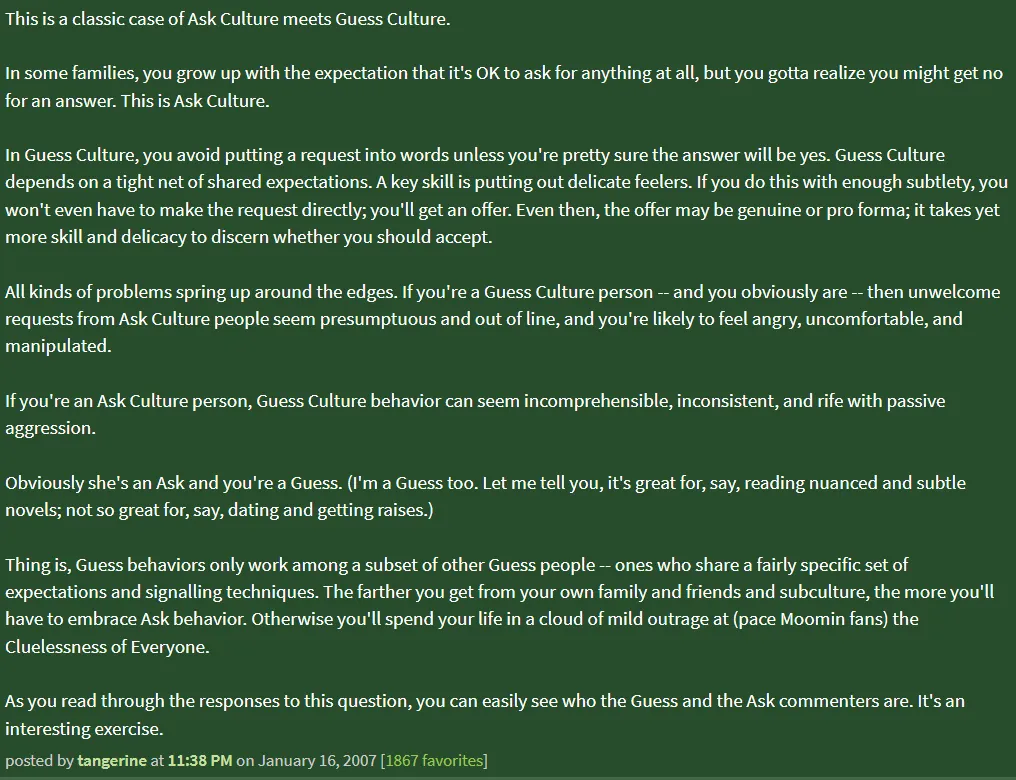
Ask Culture and Guess Culture
Firstly, I adore this concept. It’s chic, neat, and catchy. Big fan, Andrea!
People in Ask Culture value being candid and direct. When they ask a question, they believe in the agency of the responders to accept or deny the request, so they aren’t hesitant to ask directly. In ask culture, ‘no’ is an acceptable answer. It’s not offensive to either the asker or askee.
You’ll hear phrases like: “What’s the worst that can happen? They’ll say no, that’s it.” This directness can often be misconstrued as presumptuous or insensitive, especially to those who are part of Guess Culture.
Guess Culture looks a little different. Guessers avoid asking for things unless they are fairly certain that they will get what they want. To ask a question that’s met with a ‘no’ would mean that the asker made an error of judgement.
This approach aims to avoid potential confrontations or uncomfortable situations. To a Guesser, being put in a position where they have to say no is stressful, difficult, and possibly offensive (which is why they’d take to online forums to ask for help with it!).
So it kinda blows up the whole ‘what’s the worst that can happen’ thing. ‘NO’ is the worst that can happen!!!!! That’s terrible for a Guesser!!!
Guessers put in the work to understand if their request is legitimate, fair, and reasonable, and only then proceed to ask. Sometimes they don’t even ask, they merely suggest. Now Askers on the other hand are often seen as presumptuous and rude to Guessers because Askers go after what they want without taking into account possible objections.
To a Guesser, an Asker’s straightforwardness might make them feel like they’re backed into a corner. Conversely, an Asker might perceive a Guesser’s hints as evasive, non-confrontational, or even manipulative.
Here are some examples to illustrate the difference:
Borrowing an Item
Asker: “Hey, is it okay if I borrow your laptop for an hour?”
Guesser: “I’ve got this online class in a bit, and I left my laptop at home. Gaaaaahhhh.”
Asking for a Day Off
Asker: “I’d like to take next Friday off. Is that okay?”
Guesser: “Next Friday is my sister’s wedding, is there any important work due on that day?”
Discussing Rent with Roommates
Asker: “I think we should split the rent based on room size. What do you think?”
Guesser: “Do you ever feel that the way we divide rent might not reflect the space each of us uses?”
Which one are you? (The answer is less important than you think)
First of all – I’m not a big fan of labels that try to oversimplify what is obviously a nuanced, complex communication style shaped by context, culture, gender, upbringing, personality, and a bunch of other factors.
I don’t think anyone fits neatly under the label of an ‘Asker’ or ‘Guesser’ but for the purpose of this essay, let’s pretend that we do. Most people exhibit a blend of both traits, leaning one way or the other based on the context and the situation, but I do think we all sorta have a preference.

I’d like to reiterate that it’s NOT about politeness or rudeness, introversion or extroversion, shyness or boldness. With asking and guessing, it often comes down to etiquette. And the big, massive, glaring problem with etiquette is this:
Etiquette is really weird and ambiguous. It’s buried deep within our collective psyche like this unspoken code of conduct, but nobody really spells it out for anyone. They just get mad when you get it wrong. Etiquette is treated like logic, even when it often defies all reason.
Having said that, etiquette and social protocols are PAINFULLY important to me. I find them fascinating and irresistible. I love understanding the rules and why they exist, and from whatever I know so far, the confusion between asking and guessing solely arises when these two communication styles intersect.
Personally, I’m a Guesser that’s trying to be more of an Asker. I’ve found myself teetering on the fence for a long, long time.

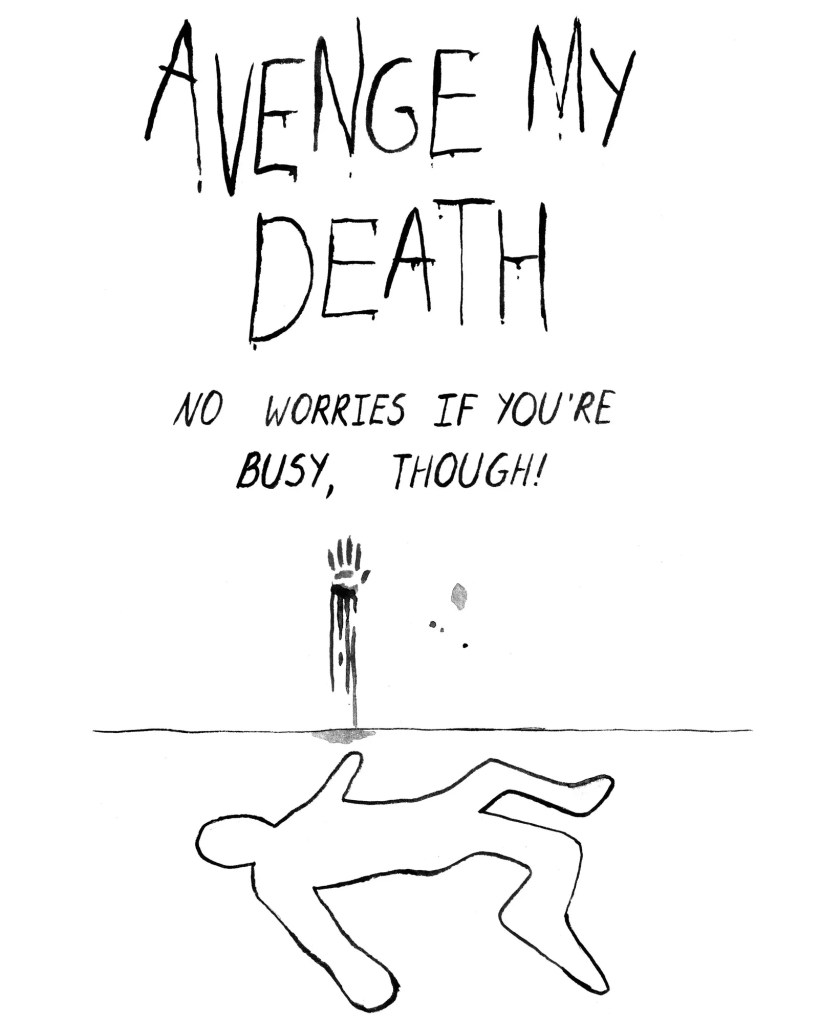
I was more of a “No Worries Either Way” girlie
This phrase has been my favorite escape hatch. It’s so beautifully neutral, so delightfully non-committal that it’s almost poetic in its ambiguity.
Do you need to ask someone something? If you sprinkle a little ‘Either one works for me’ or ‘But I’m cool with both’ or the all-encompassing ‘No worries either way,” it suggests that you’re both invested yet somehow also aloof.
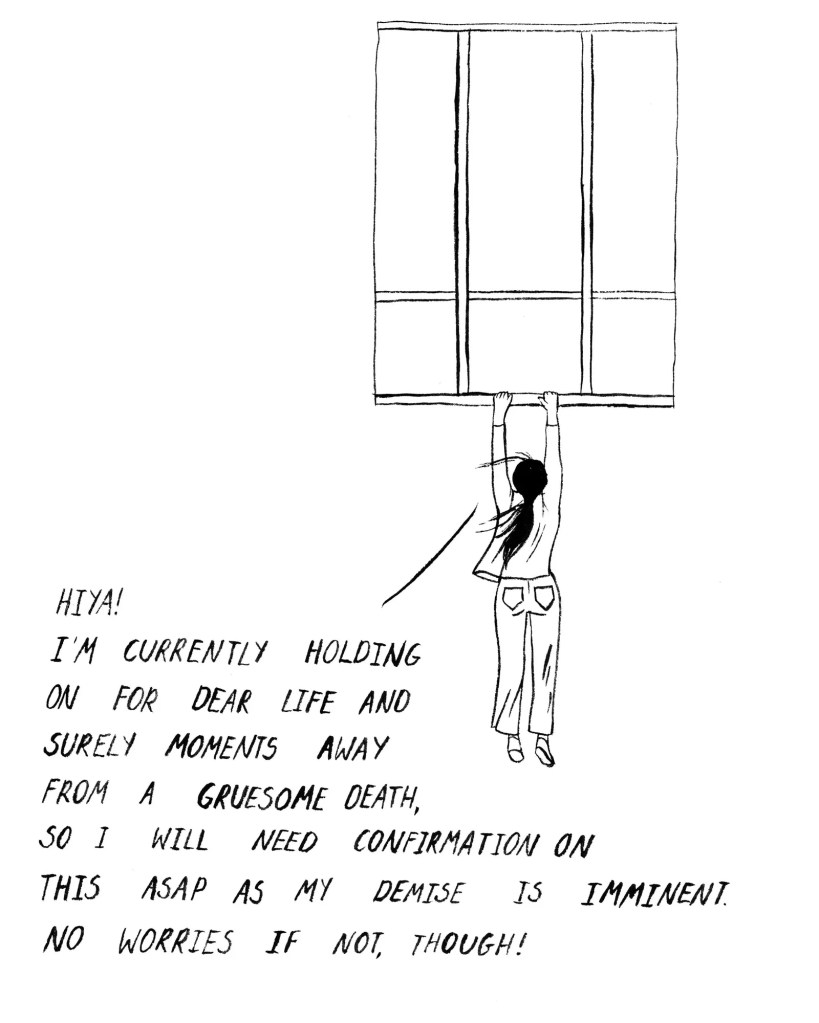
Natalya Lobanova did an incredible illustration series on it for The New Yorker.

This used to be my go-to phrase at work when I had to present a reasonable and important request. I’d ask the question and then quickly drop in a ‘no worries either way’ to let the other person know that actually nothing mattered and life was a big joke filled with no-worries and be-happies, so effectively, we could just hakuna matata the heck out.
But what I’ve now come to realize is that the need for guesswork often stems from the people-pleasing tendencies that I’ve navigated my entire life. People-pleasing occupies a significant and often misunderstood space and it is intricately tied to the spectrum of asking and guessing, which is why it feels important to unpack.
Unpack time 🧳
As far as communicating goes, people-pleasing revolves around our need to be accepted and understood, and obviously our fear of conflict. Communication strategies that are focused on conflict avoidance are designed to minimize friction in an environment that may not be forgiving of missteps and misunderstandings. This is not a bad thing. It’s sometimes a necessary thing.
In a shaky situation where a confrontation might mess things up irreparably, the effort to maintain a semblance of peace is actually super smart and important. The ability to read between the lines and discern subtle cues can be the difference between a successful interaction or a big awkward mess.
But as any people-pleaser knows, the emotional toll that these mechanisms take is like –– a lot of toll. Emotionally speaking.
Having to make continual adjustments to fit people’s expectations, especially in hostile or unfamiliar environments, makes you feel small and unsure of your own identity. It’s a seriously un-fun balancing act to navigate all this while holding some boundaries to protect your own well-being.
So like I was saying, people-pleasers often default to the guessing mode of interaction. There’s an underlying apprehension that asking a direct question may be perceived as intrusive, which then unsettles the delicate balance of interpersonal dynamics.
I jokingly call myself a people-pleaser in recovery because I’m working at being more upfront with what I want, need, and expect, while also navigating the possible stress that might arise from those wants, needs, or expectations not being met. I’m basically here doing the Lord’s work.
And I have a preference!!
When I began writing this essay, I included a section about how neither asking nor guessing was better. One wasn’t more effective than the other, they were just diFferENt. I wanted to remain beautifully neutral, which is quite typical of me.
But I was being dishonest. As someone who has grown into a space of valuing candid, open communication even at the risk of feeling uncomfortable or facing conflict, I have to say it:
Asking is a better way.
Being an Asker doesn’t mean you don’t give a damn about confrontation, etiquette, conflict, or people’s feelings. Instead, it symbolizes a mutual respect for clarity. An Asker should ideally be asking from a place of understanding that authentic relationships thrive on clarity. Asking minimizes the risk of miscommunication. It eases the pressure of guessing incorrectly.
Asking is clear. And clear is kind.
I didn’t come up with that last bit, Brene Brown –– the woman who put vulnerability on the map –– she came up with it.
The idea is that any communication that is deliberately unclear is also unkind. The cultural norm of “nice and polite” which is often used as an excuse to avoid tough conversations, is actually unkind. Leaving all the work of figuring things out to someone else while you drop vague clues that keep you safe and far away from discomfort is unkind. Being non-confrontational is sometimes unkind.
More often than not, asking and guessing isn’t about the question or solution at hand. It’s about us: how we’re perceived, and how we safeguard ourselves.
When things are left to guesswork, they aren’t clear. And instead of being nice and polite, it actually increases the likelihood of problematic and passive-aggressive behavior. It drives backchannel communication like the meeting after the meeting, the unofficial debrief, and the unpacking sessions.
In short, gossip.
If you have to grapple with guessing games, decipher subtle cues, and navigate a labyrinth of breadcrumbs (under the guise of politeness, of course), you end up needing backup. You’ll need to get help or perspective from others to validate your assumptions.
And this is why the guess-to-gossip pipeline is a swift and slippery one.
Now let it be known that I’m saying all this as a natural Guesser. I’ve spent most of my life being painfully non-communicative about important things. Left to my own preferences, I’m an avid conflict-avoider. I flee from tough conversations and feel physically sick at the thought of disagreement and disharmony, but I’m actively changing that about myself. It’s been the most glorious journey ever.

I didn’t get here entirely by choice. For one, in a marriage, you can’t carry on too long with guesswork. It’s unfair to expect anyone to be able to read your subtle hints and clues regardless of how well they know you. I used marriage as a safe space to practice asking, stating, expressing, and being completely unambiguous. It was scary but liberating. After seeing massive success there, I then attempted to carry those learnings into my other relationships.
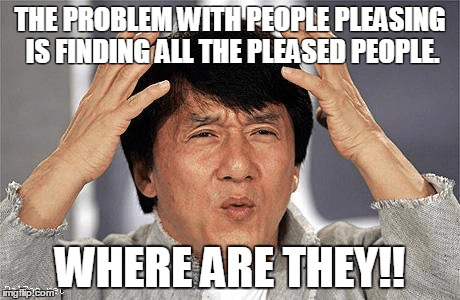
I feel like I might have come down a bit hard on Guessers
Like I said with people-pleasers too – there are many situations and contexts where it’s wise and prudent to use subtle cues to determine how you ought to respond. People-pleasing type of behavior isn’t always bad. Some sentiments do need gentle handling, and there’s an elegance in reading between the lines; in letting some battles remain unfought.
So here’s something I appreciate about Guessers – they often have an uncanny ability to preempt stuff. The actual effort that they put into empathizing, understanding, and anticipating needs is admirable, regardless of the motives.
Whether we lean towards asking directly or rely on the nuances of guessing, I’m reminding myself that I need to understand and respect the preferences of those I communicate with. While I might switch between the two on occasion, my goal is to be adaptable, and to recognize that not everyone shares my style of communicating. More importantly, not everyone is able to (or even wants to) bridge that gap.
Communication, at its heart, is about connection. It’s about understanding and being understood. I think what truly matters is the intention behind our asking or guessing, and creating a space where mutual understanding and respect are more important than yeses and nos.
WHY do ‘yeses and nos’ look so weird when you type them out!!!!!!! I read that out as ‘yee-seez and noss.’

 Unfinished Conversations
Leave a comment