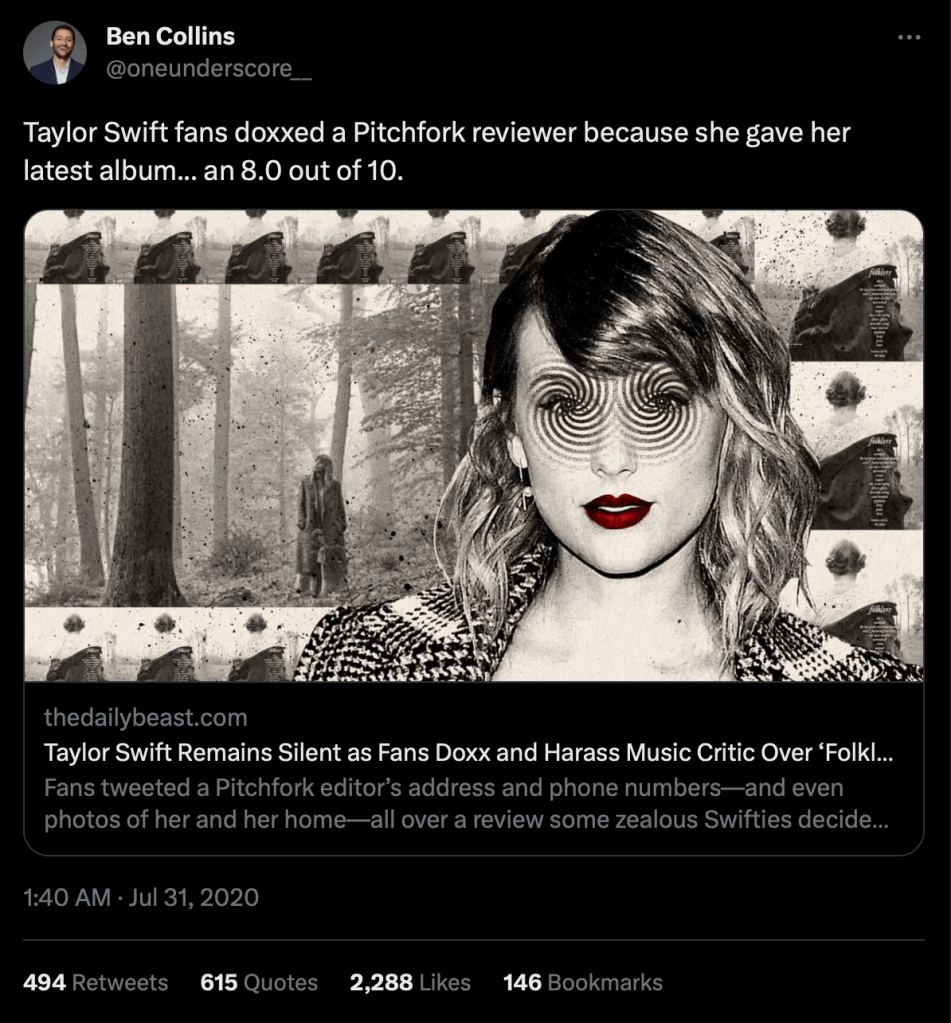
In 2020, Jillian Mapes, a senior editor at Pitchfork and avid Taylor Swift fan, published a review of Taylor Swift’s ‘Folklore’ album, rating it an eight out of ten. She described the album as a “sweater-weather record filled with cinematic love songs and rich fictional details.”
Her review led to an unexpected storm. A radical section of Taylor Swift fans began harassing Mapes online. She received death threats and phone calls to her home.
Her address and personal cellphone number was shared online – an act known as doxxing. They even threatened to burn down her home just hours after the 8/10 review was published. The reason: The review and rating didn’t seem good enough for them.
More recently, Chris Panella published an opinion piece, comparing Taylor Swift’s Eras Tour to Beyonce’s Renaissance World Tour. It was an interesting analysis of two large-scale tours with a similar kind of mass appeal, but the overall positive comparison led to an outburst of hate towards the journalist.
Hundreds of angry messages. Doxxing personal information. Tracking down family and friends. Mass emailing his boss to get him fired.
Now before you brand all Swifties as unhinged (though some most certainly might be), it’s worth noting that this backlash against critics isn’t exclusive to Taylor Swift’s fanbase. Similar incidents have occurred in other fandoms.
In 2019, Grande’s fans targeted culture writer Roslyn Talusan for defending critics when Grande tweeted a bunch of angry stuff about how bloggers should get a life. Another journalist at The Independent faced threats from Eminem’s fans over her critique of his use of a homophobic slur in his music well into 2018.
Frankly, expressing any public opinion online is met with some pushback, but the alarming rate at which it’s happening is what I want to talk about. So today, I’m making a brief case 💼 for the necessity of critique, especially in the context of popular culture and our ever-growing consumption of it.
Haters gonna hate
It’s the internet era. Our cultural exchanges and discourses have moved from living rooms and coffee houses to Twitter (X?) threads, Reddit forums, YouTube comment sections, and Instagram posts.
This transition has brought some distinct challenges when it comes to the realm of critique. We all have the ability and the means to be critics. In theory, it’s a critic’s utopia. We have access to a treasure trove of content and an abundance of platforms to voice our opinions.
This makes the internet a perfect battleground for polarized ideas. The speed, virality, and impulsive nature of these platforms tend to undermine thoughtful, balanced critique, which easily gets lost in the sea of memes, clapbacks, and clickbait headlines.
And the problem with thoughtful and balanced critique is that it’s so easily and hurriedly dismissed, with the person doing the critiquing branded as a hater or a troll. I think that’s lazy and incorrect. To critique something is to do a proper analysis and evaluation of it, with the goal of understanding its strengths and weaknesses; its purpose and impact.

This process involves more than just expressing an opinion or stating whether you like it or not. Critique is based on careful consideration and respect for the work or the idea. It’s generally rooted in some level of expertise or understanding. It’s meant to encourage improvement and open a dialogue.
“The true role of a critic is to pull apart the work, to delve into the marrow of it, to figure out what it is trying to say about our society and ourselves. You can love a work and think its politics are deeply problematic; you can believe something is terrible yet offers some accidentally acute insights about the way the world works,” shares Emily St. James in her think piece for Vox.
A good critique is informed. It draws on relevant knowledge and context. And it is constructive, aiming to offer insights that can help improve or deepen understanding of the subject. It’s a way of maintaining a dialogue about what we value and why, about what works and what doesn’t, and about how we can do better.
On the other hand, there’s being a hater. Haters or trolls on the internet aim to provoke and disrupt. The goal is to stir up anger, mostly for thrills. There’s no desire for discourse, respect, or understanding. Haters and trolls are usually in it for the ruckus.
“There’s only two types of people in the world: the ones that entertain, and the ones that observe.”
― Britney Spears
I promise you I didn’t make that up.
We need active observers, Britney
If you were to come across a debated piece of art – whether it’s music, writing, film, or any other kind of art – you’re likely to find some critical comments on it. But it doesn’t take long for this dialogue to either get defensive, and eventually, you’ll get dished out the internet’s favorite catchall phrase: Let people enjoy things.
Or the ever-polite, ‘If you don’t like it, just keep scrolling, buddy!’
Critique has long been undervalued, misunderstood, and sometimes even maligned. The mantra of ‘let people enjoy things’ undermines the potency of critique, and slowly corrodes our collective ability to really think about what we’re voraciously consuming.
Unsurprisingly, the world of cultural criticism and culture writing has been going through some pretty tough times over the past couple of years. Media companies are dialing back on culture writing, sparking a domino effect across the industry.
Buzzfeed parted with its culture writers and editors well before it began wrapping up its operations. The A.V. Club, a long-standing pillar of internet pop culture, found many of its staff opting for buyouts as part of a money-saving strategy.
We’ve forgotten that criticism isn’t about raining on parades. It isn’t about being a killjoy. Critique is about making sense of the culture we consume. To critically examine a piece of work is not to dismiss it––rather, it legitimizes it. Critique acknowledges its significance and its place within the cultural fabric.
Critique is not merely a laborious task, it’s a labor of love. It is a tiring process that requires time, dedication, and actual headache-inducing analytical skills. The beauty of critique lies in its ability to reveal the deeper subtextual messages embedded within art, uncovering the social commentaries that might otherwise go unnoticed.
I can be a Taylor Swift fan and still appreciate and actively seek out reliable critiques of her work and its impact. Critique and observation are not antithetical to fandom or enjoyment; they are complementary aspects that deepen our relationship with the thing we’re critiquing.
Critical analysis adds layers of understanding and insight, making the experience of consumption richer and more meaningful. It’s through this complex interplay of love, observation, and critique that we truly engage with the culture around us.
Can’t we just enjoy art without using our brains?
Of course we can.
Mindless media consumption and doom scrolling have their place – they make zoning out an absolute delight. I definitely recognize the role of entertainment and media as an effective tool for escapism. The desire to simply enjoy art for ‘art’s sake’ is wonderful.
BUT –
Art is, at its core, a form of communication. When we let media merely wash over us like a tepid bath, we risk missing out on what we’re really being sold. We miss so many subtle cues that shape our understanding of the world.
This is where critique plays a pivotal role. It’s the lens through which we can decipher the underlying cultural connotations, the societal commentary, and the philosophical undertones hidden beneath the veneer of entertainment.
We don’t just consume content, we consume culture along with it
Culture is the way we think, behave, and perceive the world. And our media consumption influences our culture, which, in turn, guides the media produced. It’s a cultural tango; a perpetually spinning cycle. And we get caught up in it more than we realize.
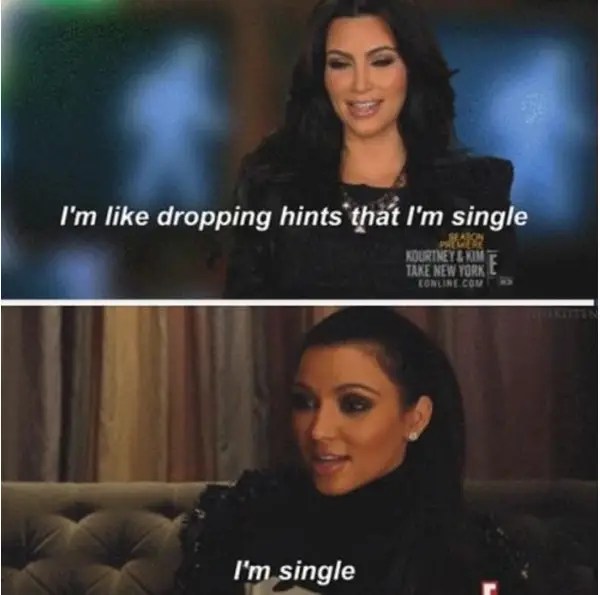
Who could have thought that watching people go about their daily lives would become a veritable cultural pastime? But it did. Take a show like Keeping Up with the Kardashians. On the surface, it’s an hour-long peek into the extravagant lives of a famous family.
But dig a little deeper (or maybe a lot deeper in this case), and you find a commentary on fame and a dissection of how private lives morph into public spectacles. The show has even birthed its own microculture, with distinct lingo, and fashion trends.
Superman was created by two Jewish immigrants, Jerry Siegel and Joe Shuster, during the Great Depression. Superman embodied the quintessential immigrant’s story of fitting into a new world. His character embodies hope, strength, and justice at a time when America desperately needed a symbol of optimism.
Wonder Woman was created in the 1940s by a psychologist named William Moulton Marston. He wanted to craft a feminist icon who exemplified strength and intelligence at a time when women were pushing for greater rights and independence.
Spiderman, created by Stan Lee and Steve Ditko in 1962, reflected a shift from flawless heroes to one with relatable problems, like teen angst and cute little crushes. He was created to resonate with younger readers, allowing them to see themselves in a superhero.
Barbie (I had to go there), introduced by Ruth Handler in 1959, quickly became more than just a doll. As a glamorous, independent woman who could be anything she wanted to be, Barbie reflected post-World War II optimism and the start of mainstream consumer culture. Although Barbie was often criticized for perpetuating unrealistic beauty standards, the evolution of the doll mirrors the changing roles and aspirations of women in society.
These characters were born out of the prevalent culture of their time and have now become a part of mainstream media. They reflect the changing times. They’re capsules of our cultural values, anxieties, and aspirations.
The dichotomy between fandom and critique is a false one.
Engaging in critique does not diminish our enjoyment, it actually really improves it. It gives depth to our understanding and enriches our engagement with art and culture. It takes us from passive consumers to active participants, engaged in the cultural discourses unfolding around us.
The stuff we love deserves more than blind adoration – it deserves thought, discussion, and yes, critique.

 Unfinished Conversations
Leave a comment