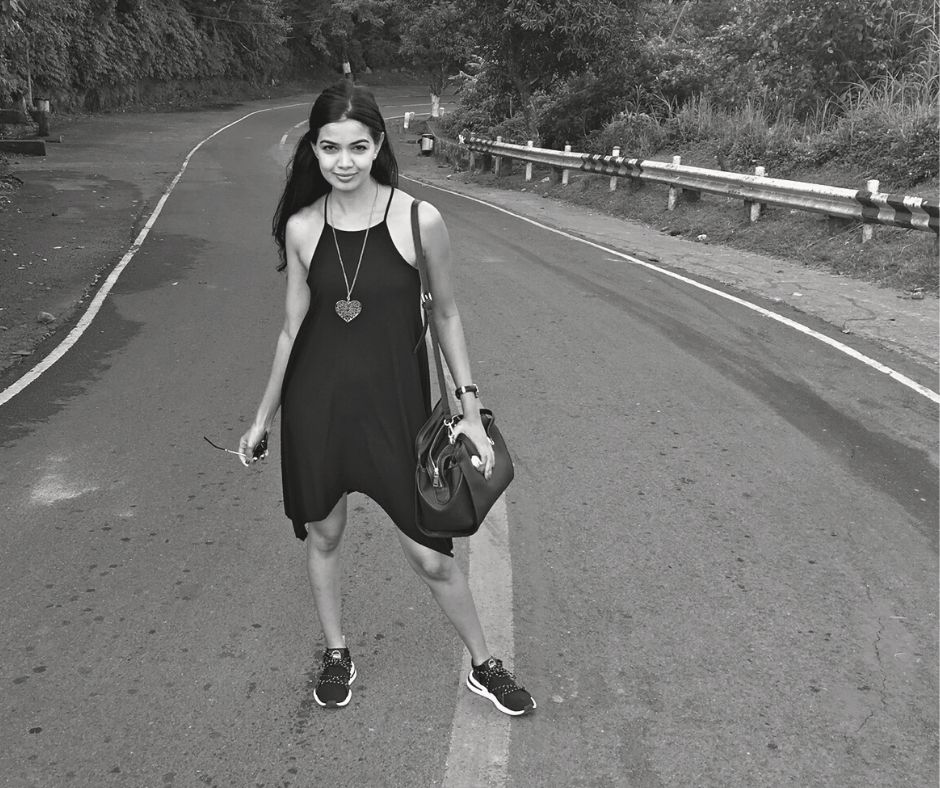
Buckle up, buttercups. Hold on to your party hats. It’s happening!!!!! I turn 30 this week.
As I grapple with existential questions like what cake I should get, and do I wear heels or not, I realize that these silly-goose birthday activities mainly exist to distract me from the fact that I’m now going to be iN My tHIrTieS.
In a desperate attempt to make this milestone birthday one for the gram, I thought I’d Google some ideas and maybe get inspired. The suggestions ranged from wine tastings and music festivals to bungee jumping and themed parties. Who knew turning 30 could be this much fun.
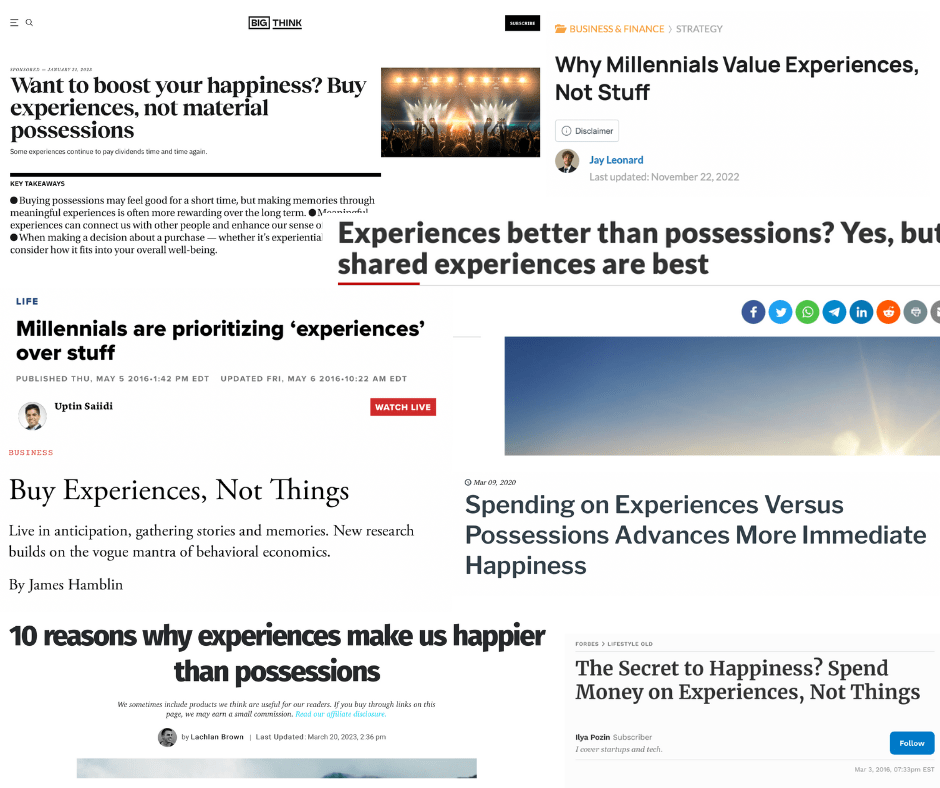
But most of these adrenaline-pumping, wallet-emptying adventures got me thinking about the modern trend of valuing experiences over material possessions. Like, I didn’t find a single article telling me to buy a bunch of things, which is odd given that most of the internet exists to sell you stuff.
I’m quite in favor of ditching the shopping in favor of making unforgettable memories, but I couldn’t resist diving headfirst into a rabbit hole to dissect this whole “experience vs. thing” conundrum. So let’s go.
Start by answering this quick Q
Say you have a good friend named Sonia.
Sonia, filled with generosity on her birthday, deposits INR 100,000 into your bank account (told you she’s a good friend.) You have the option to spend it on anything over the next two months. If you had to choose between spending on an experience or a thing, which would you choose?
Just so it’s clear what I mean by experience or thing in this context, here are some examples.
Experiences: Tickets to Madrid, Taylor Swift’s Eras tour, scuba certification, sky diving, a yoga retreat, pottery classes, a staycation.
Things: A MacBook, the latest phone, a guitar, a pair of Yeezys, an espresso machine, new furniture for your apartment, a cool dirt bike, an air fryer.
Which do you think would make you happier?
If you have your answer ready, let’s now assume you’re Team-Whatever-You-Chose for the purpose of this essay.
IMPORTANT SIDE NOTE: Instead of splitting this up into experiences vs. things, I’m gonna change the hypothesis to ‘Experiences are BETTER than things: True or False?’ This is because the popular notion is that spending on experiences makes you happier than spending on things.
The idea isn’t to land on one instead of the other. It’s to examine whether spending on experiences is genuinely more rewarding. It will help you answer the all-important question: Should you buy your good friend Sonia a spa voucher or a bottle of whiskey?
UNIMPORTANT SIDE NOTE: WHISKEY.
Sounds okay? Okay.
The research (I promise to make it quick)
Disclaimer: This is in no way a comprehensive analysis of the entire universe of research on this subject. Maybe one day I can do a meta-analysis but today isn’t that day because I STILL HAVEN’T CHOSEN AN OUTFIT. Priorities bro. I cherry-picked the studies that are most often cited when this subject is discussed. Feel free to check out the references at the end.
What does the science tell us about happiness derived from things vs. experiences? Most of this research was conducted by Dr. Thomas Gilovich and his colleagues from Cornell University. Their first paper on the subject was way, way back in 2003 and they’ve been at it since then.

In his study, people were asked to recall a recent purchase that they made for an experience and a material possession.
Then, they were asked about which purchase sparked more joy. There were follow up questions about whether there was more happiness associated with the memory of the experience or the material possession.
People reported that there was greater happiness found in experiential purchases, BUUUUTTT this was only by a small margin. If you’re more curious about their work, this article in The Atlantic summarizes their years of research pretty well.
Here’s an interesting quote from Dr. Thomas Gilovich: “You can really like your material stuff. You can even think that part of your identity is connected to those things, but nonetheless, they remain separate from you. In contrast, your experiences really are part of you.”
COOL SIDE NOTE: Gilovich’s most recent paper in 2020 opens with the epic line, “People are good at spending money.” I respect the hell out of that badassery!
But what happens when you have an experience and it turns out crappy? I feel like a few of the survey participants might have pointed that out to Gilovich because he later did another study that addressed the sucky experiences sitch.
Gilovich and co. said that when people remember a crappy experience after some time has passed, their opinion of that experience improves. He believes this happens because past events that were once stressful or frightening can turn into fun stories to share at parties or be seen as valuable experiences that contribute to personal growth.
Cool.
After some extensive digging, I did find a more reliable study that examined this ‘do vs. have’ paradigm.
One day, a couple of happiness scientists named Hajdu and Hajdu (maybe they were brothers?) took on the Herculean task of sifting through a whopping 10,000 responses from the ‘Hungarian Household Survey Project.’
This survey asked people to rate their satisfaction on a scale of 0 to 10 to gauge their contentment with life, and recorded their household spending habits over various time frames.
Armed with this data, Hajdu x 2 then categorized the respondents’ spending as either:
- Experiential (entertainment, sports, vacation)
- Material (clothing and electronics)
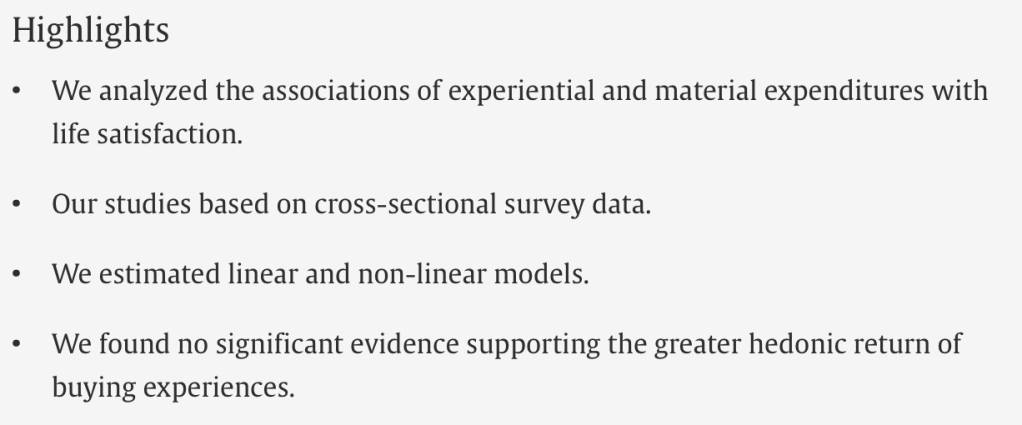
The Hajdus studied the correlations between experiential spending, material spending, and life satisfaction and they discovered that there was no difference in happiness when spending on experiences or spending on things. Spending money on BOTH experiences and things can lead to increased happiness, but it isn’t one or the other.
In their own words, “Although both experiential and material expenditures were positively associated with life satisfaction, we found no significant evidence supporting the greater return from experiential purchases.”
The problem with research like this is that it doesn’t grab headlines. Countless publications aren’t lining up to report it, even though it’s more robust in its design. A headline like ‘Happiness is an elusive son of a gun so spend money however you want’ doesn’t grab eyeballs or help you sell anything.
But I’d like to remind my readers at home that research isn’t meant to be exciting; it’s meant to be true.
Experiences are great
People that prefer experiences to things often do so for good reason. The thing with things, or material possessions, is that the happiness they provide can seem fleeting.
Our fickle brains are wired to grow accustomed to them, and like the law of diminishing returns, the joy derived from our shiny new toys soon fades.
It’s a phenomenon that social scientists and behavioural economists called boredom, or ‘hedonic habituation’ in case you want to impress your friends at a party. But apart from our tendency to get bored with things, material stuff tends push us towards the cycle of comparison. Your cool new phone isn’t as exciting if someone you know gets a better one, or when Apple drops a new model. This innate tendency to compare chips away at our sense of enjoyment.
But on the other hand, experiences are social currency. They are the stories we tell at dinner parties. Shared experiences forge solid relationships. If our social lives are the stage for happiness, experiences are the star performances. Everyone bonds over that one incredible party full of wild stories. They all laugh about that one trip they went on a few years ago.
Apart from the social aspect of it, experiences shape our personal identity. We’ve all been on an adventure that changed our lives. We’ve seen something truly magnificent and emerged a different person. Maybe it was the first time we went scuba diving and experienced the vast ocean. Or watched our absolute favorite artist perform live. These experiences are like journeys that bring us closer to self-actualization than any material item ever could.
But –
The experience economy thrived on young people that wanted to chase adventure. Being a victim of ‘Wanderlust’, was an interesting personality trait, and it was fueled by our need to document all of it on social media. I partly blame social media for being the enabler of our experience-addiction.
Here’s an all-too-common turn of events: You’ve hugged a dolphin, taken a cruise, climbed the mountain, zip-lined through Times Square and french-kissed the Mona Lisa. But instead of reveling in the “amazingness” of it all, you’re left feeling empty. Or empty-ish.
Turns out, we’re actively being pushed in the wrong direction as far as experiences go. As psychotherapist Nancy Colier wrote in Psychology Today, “We’ve turned experiences into a thing. A product. We’re so obsessed with chasing experiences that we’ve forgotten how to just live. And when the thrill evaporates, as it inevitably does, we’re left itching for the next fix.”
Our quest for amazing experiences has turned into a paradoxical black hole, sucking the life out of life itself. Instead of basking in the mundanity that makes up the bulk of our existence, we’re left chasing our tails in a FOMO-fueled race to tick off things on our bucket list.
One more thing about things – for many people, material stuff can actually provide long-lasting value and happiness. Things like a well-crafted piece of furniture, a cherished book collection, or a high-quality musical instrument. They actually enhance our daily lives. They’re things that make the ordinary everyday seem more beautiful.
Material things can also serve as outlets for creativity and self-expression. From clothing and accessories to home decor, the things we own can reflect our unique personalities, tastes, and values. While these items may not seem as thrilling as experiences, their practicality and utility can contribute to your overall satisfaction and happiness.
Of material things and memory lapses
Does Gilovich’s research conclusively prove that experiences hold the key to joy, leaving material possessions in the dust? Should we all just ‘do’ more and ‘have’ less?
Based on those initial surveys, I wouldn’t be so sure. (PS: Science is meant to be argued with. It’s only when we pick and prod away at it can we separate the fluff from the facts.)
To me, this research demonstrates that when prompted with a survey, people recall their experiences with a touch more fondness than their things. Like if you asked me which purchase made me happier: My comfy linen pants, or last night’s dinner at that nice restaurant, I’d probably say the dinner. We had a few cocktails, shared some laughs, and had an overall great time. It’s a happy memory.
But then, what if there were a few follow-up questions like:
“Sonia, you’ve worn your linen pants 27 times in the last couple of months, and every time you wear them, you feel like an aesthetic coastal grandmother and are compelled to upload an Instagram story and then you get a bunch of amazing uplifting compliments. How does that make you feel?”
While I might find this line of questioning a tad intrusive for a survey, the truth would be undeniable: Those comfy linen pants bring me a large measure of joy—perhaps even more than the fancy dinner.
The thing is, it’s hard to recall each of these linen-pant moments as clearly as I can recall an isolated happy experience like dinner with friends. Simple surveys don’t often push us to dig into the nitty-gritty of our memories, leaving us to rely on our flawed and fickle recollections.
My advice is simple: let’s not let such findings dictate our pursuit of happiness. Our memories are notoriously unreliable, and life is mostly made up of mundane, forgettable moments—the kind you might associate with a pair of linen pants, comfy shoes, or a trusty cellphone. They may be unremarkable, but they’re still worth cherishing.
This line of thought also neglects the extraordinary potential of things to pave the way for exciting new experiences. A really good camera lets you capture pictures of your scuba diving trip. A shiny bicycle not only keeps you fit, but also turns exercise into something exciting. Linen pants can ramp up your coastal grandmother aesthetic, turning you into the object of envy for your friends, countrymen, and of course, actual real-life grandmothers.
These are all top-notch experiences, brought to you by things.
Mad Men > Science
PLUS – is it even logical to distinguish between experiences and things when every ‘thing’ is sort of an experience in disguise? There really is no clear distinction between the two, in my opinion.
There are experience-like things, e.g. a cozy apartment, a nice coffee machine, or a swanky new bar. And there are also thing-like experiences, e.g. taking a quick holiday, only to forget all about the nice time you had because you’re slammed with work as soon as you return. Or a nice, fancy dinner.
In keeping with my Mad Men obsession, Don Draper sums it up perfectly. He’s a Madison Avenue ad man, hard-wired to sell people things to make them ‘happy’. And in a powerful scene, he explains that happiness is an endless pursuit – whether it’s a thing or an experience. Whether it’s something you DO to make you happy, or something you OWN that makes you happy.
“What is happiness? It’s a moment before you need more happiness.”
– Don Draper, Mad Men
In a world of never-ending desires, Don’s words strike a chord. He deftly exposes the human condition as insatiable happiness junkies perpetually chasing the next hit. There really isn’t any difference between the thrill of acquiring the latest gadget and the high of a booking another bunch of flight tickets. Both are temporary; both leave us craving more.
His words serve as a good reminder that our pursuit of contentment is as much a product of our own making as it is the influence of clever marketing campaigns.
I don’t want you to think I’m simply rubbishing away the decades of research conducted by Gilovich and his colleagues. I’m not. While it may seem like your identity as an experience-first person (like a surfer or a citizen of the world), always seems more profound than your identity as ‘the chick with the nice coffee machine.’ I like the point that Sasha Chapin raises in his Substack newsletter:
“Ah, yes—we who go on retreats in Bali are much happier than the unsophisticated materialistic people who spend money on handbags or whatever. It also supports the notion, which occasionally floats around, that wealthy people aren’t really made happy by their fancy possessions, which is comforting if you like to believe that wealthy people are idiots.”

Different strokes for different folks
I’m still no closer to figuring out how to celebrate my birthday, nor have I settled on a definitive answer to the conundrum of experiences vs. things. It seems we all lean towards one form of consumerism or the other, whether it’s collecting memories or accumulating stuff.
Experience enthusiasts might boast about their unforgettable trips and life-altering adventures, celebrating the thrill of stepping out of their comfort zones. On the other hand, thing enthusiasts can’t contain their joy over a new pair of shoes, or the satisfaction of purchasing a home after forgoing lots of experiences.
There’s no right or wrong side to this debate. We’re a diverse bunch, and I think we can give science a break. I don’t see the point in letting it decide what makes us happier, I’d rather we embrace the individuality of our choices.
So here’s where we’re at
Know thy season: The eternal debate of things vs. experiences or the art of having vs. doing, hinges upon the chapter of life you find yourself in, whether it’s with children or other dependents for example. Many experience-based pursuits don’t cater to this demographic, so when it comes to spending, things might be a more practical choice for this stage of life. As I gear up for my 30th with a 7-month-old baby, I’ve accepted that scaling mountains and jetskiing through the high seas may not be on the menu, but pancakes and sushi and some cocktails are. Huzzah!
Embrace self-discovery: By the time you’ve survived the trials of your twenties like me, you should have a decent grasp on whether you’re a thing person or an experience person. Embrace the possibility of being a hybrid, or even evolving from one to the other—it’s all part of the ride. The key is to identify what you fancy without succumbing to the pressure of following the herd. Remember, you know yourself better than any clickbait pop psychology article.
Beware the pitfalls of materialism and experience-seeking: Both paths can lead to ruin. Some may hoard fancy things believing that they will fill a void or make their lives drastically different. Others might become obsessed with gathering the perfect experiences, whether they’re meals, travels, or events. There is no universal fix for happiness but there are countless ways to spend your money, both wisely and foolishly. Choose wisely.
Acknowledge the duality of human experience: We’re complex creatures who crave both novelty and comfortable routine. It’s lovely to indulge in both the excitement of the moment and the anticipation of future delights. It’s exciting to get yourself a nice thing, and it can be thrilling to enjoy a new experience too.
Now take the Rs. 100,000 and run away please.
References
Buy Experiences, Not Things – The Atlantic
Why You Should Spend Your Money On Experiences, Not Things
To Do or to Have? That Is the Question.
Want to boost your happiness? Buy experiences, not material possessions – Big Think
Buying things vs. buying experiences (vs. buying nothing at all): Again, we see a stock-versus-flow confusion
Buy Things, Not Experiences — harold lee
Sorry, millennials: Not everyone is happier spending money on experiences over stuff – MarketWatch
Spend Your Money on Whatever You Want
Questioning the “I” in Experience: Experiential Purchases Foster Social Connection | ACR
Hedonic Adaptation to Positive and Negative Experiences
The relative relativity of material and experiential purchases.
Reports of subjective well-being: Judgmental processes and their methodological implications.
Happiness for Sale: Do Experiential Purchases Make Consumers Happier than Material Purchases? | Journal of Consumer Research | Oxford Academic
I am what I do, not what I have: the differential centrality of experiential and material purchases to the self


Leave a comment